
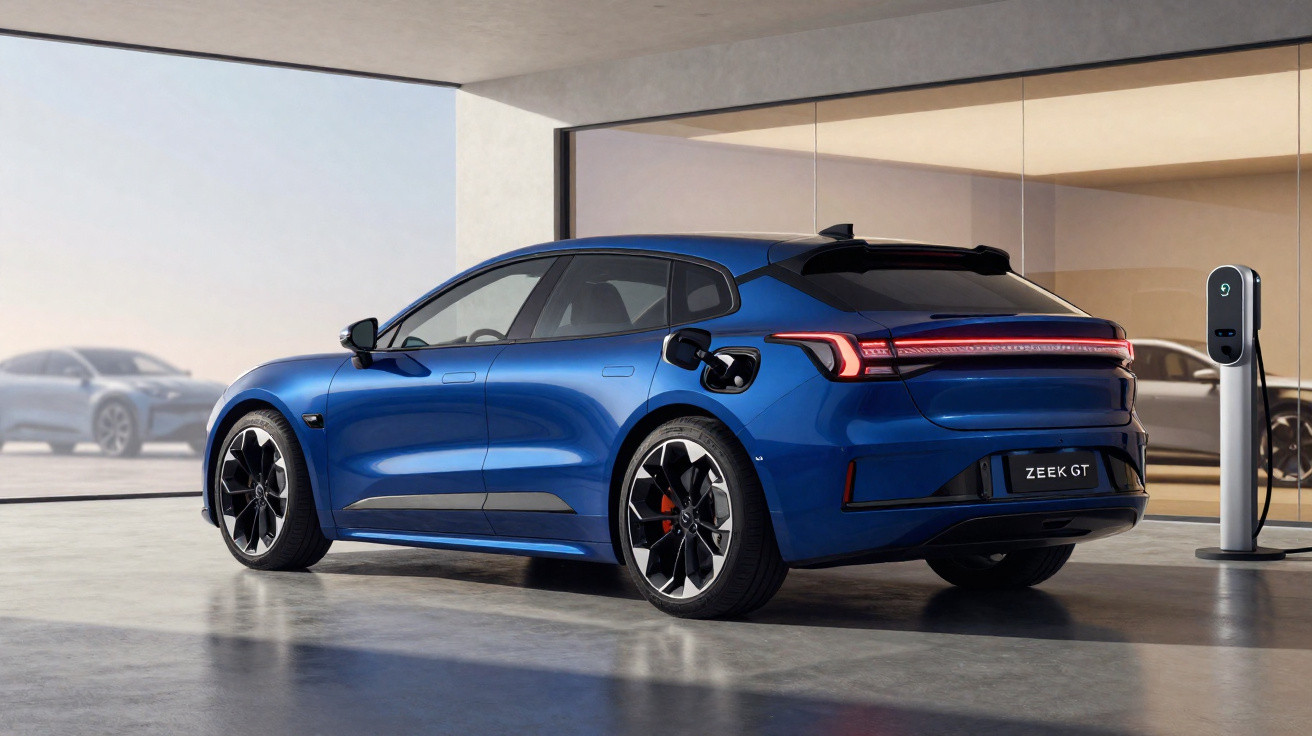
A brand-new electric estate car from China is aiming straight at the premium class - offering strong performance, luxury kit and a price that could make German manufacturers uneasy.
Zeekr, a young brand within the Geely Group, is preparing its major push into Western Europe. With the 7 GT, it is entering the market with a sporty electric estate positioned directly against BMW, Audi and Mercedes - promising more range, very rapid charging and a starting price that will turn heads in Munich.
Zeekr pushes into Western Europe - four EVs on the way
Zeekr only launched in 2021, yet in China it has already established itself as an ambitious premium name in the EV space. Until now, most sales have been in China, Scandinavia, the Netherlands, Switzerland and several Eastern European markets. Around 5,000 registrations in 2025 are now intended to signal the next step: expansion into Western Europe, with a focus on Germany, Belgium and France.
Four fully electric models are set for the market entry:
- Zeekr X: compact SUV (C-segment)
- Zeekr 7X: family-friendly SUV (D-segment)
- Zeekr 001: large coupé-SUV (E-segment)
- Zeekr 7 GT: sporty estate in the D-segment
Internally, the 7 GT is seen as the door-opener for Europe. It uses the brand’s latest technology and is meant to demonstrate that Zeekr wants to compete at the top not only on price, but also on design, range and performance.
A sporty estate rather than a sensible workhorse
Visually, the 7 GT clearly breaks away from the traditional image of a family estate. It has low, sleek proportions, an assertive front end and a rear that feels closer to a shooting brake than a purely practical load-lugger.
“The 7 GT looks like a blend of sports car and estate - and is therefore aimed squarely at customers considering a BMW i5 Touring or Audi A6 e-tron Avant.”
The surfacing is bold, the sides look muscular, and the roofline drops a long way towards the rear. Zeekr is trying to attract premium buyers who might otherwise look at Tesla or Mercedes-Benz, but want more space and less restraint in the styling.
Interior: huge boot and plenty of legroom
The cabin is where things get particularly interesting. The 7 GT uses a 2.92-metre wheelbase - a figure that stands out even among upper mid-size cars - and that translates into noticeably generous rear-seat space.
Adults with long legs can sit comfortably in the back, even on longer journeys. At the same time, it keeps the classic estate strengths: the boot holds 647 litres in standard form and up to 1,737 litres with the rear seats folded.
“With up to 1,737 litres of load space, the 7 GT beats many established estates - despite its sporty silhouette.”
On materials, Zeekr is keen to underline its premium ambitions. The company points to careful build quality, soft-touch surfaces and a look and feel that is closer to German executive cars than to a cut-price import.
Tech on board: generous standard equipment instead of long options lists
Even the entry version, known internally as “Core RWD”, comes with plenty of equipment. Among other items, the electric estate includes:
- 15-inch OLED central touchscreen
- Apple CarPlay and Android Auto
- adaptive cruise control
- panoramic glass roof
- dual-zone automatic climate control
- electric tailgate
- heated front and rear seats plus heated steering wheel
- ten-speaker sound system
- 22 kW onboard charger
- V2L function to supply power externally
The standard 22 kW onboard charger is particularly noteworthy versus rivals. Many premium EVs in Europe offer only 11 kW. With a suitable AC wallbox at home or work, charging stops can be noticeably shorter.
Up to 646 hp and up to 655 km of range
Zeekr offers the 7 GT with two power outputs. The lower-output version produces 422 hp, while the top model delivers an impressive 646 hp - firmly in the territory of high-powered BMW and Mercedes variants.
Depending on specification, it comes with a 75 kWh or 100 kWh battery. The version with the larger pack is especially eye-catching: Zeekr quotes up to 655 km of WLTP range. On paper, that puts it ahead of the BMW i5 Touring (up to 602 km) and also ahead of the Chinese rival Denza Z9 GT, which is expected to land at roughly 500 km.
“655 km of range - enough for the long-distance run from Hamburg to Munich with just one short charging stop.”
Charging at up to 480 kW: 10 to 80% in 13 minutes
On rapid charging, Zeekr also wants to set benchmarks. According to the spec sheet, the 7 GT can take up to 480 kW at a compatible high-power charger.
The manufacturer claims the battery can go from 10% to 80% in just 13 minutes. Real-world results will, of course, depend on temperature, the charging curve and the available infrastructure - but the figure makes the intent clear. For motorway driving, a short stop every two to three hours could, in theory, be little more than a coffee break to add sufficient energy.
There is also V2L (Vehicle-to-Load): the 7 GT can act as a mobile power socket, for example for e-bikes, camping equipment or tools. For tradespeople, outdoor enthusiasts or families on holiday, that can be a genuinely useful feature.
Price push: premium technology for just under €50,000
The price is where it becomes particularly compelling. In Belgium, the 7 GT currently starts at €49,990. For a premium car that is almost five metres long, with a large battery, strong performance and extensive standard kit, that looks clearly below what many buyers associate with the German premium segment.
| Model | Power | Battery | Range (km) | Boot (L) | Rapid charging 10–80% | Base price |
|---|---|---|---|---|---|---|
| Zeekr 7 GT | 422 / 646 hp | 75 / 100 kWh | up to 655 | 647 – 1,737 | 13 min (up to 480 kW) | €49,990 (Belgium) |
| BMW i5 Touring | n/a | n/a | 602 | n/a | n/a | n/a |
| Denza Z9 GT | n/a | n/a | approx. 500 | n/a | n/a | n/a |
Final pricing for Germany has not yet been confirmed. Typically, figures end up close to those in neighbouring countries. Even with a modest uplift, the 7 GT would still look strong on value for money within the premium mid-size class.
“If you want a fully electric premium estate with a large battery, you normally don’t get far at around €50,000 - that’s exactly where Zeekr is positioning itself.”
What the 7 GT could mean for German company-car drivers
The 7 GT could be especially interesting for fleets and company-car users. In Germany, the significantly reduced taxation of electric vehicles is a major factor. Drivers who previously defaulted to BMW, Audi or Mercedes might increasingly consider a Chinese option - provided the range, charging performance and space deliver.
With a large boot, plenty of power and extensive driver assistance, Zeekr’s estate appears tailored to sales reps, field staff and high-mileage drivers who cover long distances but still want a car that looks and feels sporty.
Risks, open questions and what buyers should consider
Despite the attractive headline figures, key questions remain unanswered. Zeekr is still virtually unknown in this market. Many potential buyers will be looking for clarity on:
- workshop network and service standards
- residual-value performance on the used market
- software updates and data security
- availability of spare parts
With new Chinese brands in particular, scepticism often lingers: how stable will the importer remain, and how smoothly will communication work if issues arise? Zeekr will need to build trust - for example through transparent warranties, reliable service partners and German-language customer support that is easy to reach.
There is also the day-to-day reality at public chargers. A maximum of 480 kW sounds impressive, but there are still very few charge points in Central Europe capable of delivering anything close to that. For many drivers, what will matter is the real charging curve at 150 kW or 300 kW units - the power levels that are far more commonly available today.
Context: where does Zeekr sit versus established brands?
Geely, the parent group, is far from an unknown quantity: it owns, among others, Volvo, Polestar and Lotus. That means Zeekr can draw on proven platforms, battery technology and software expertise. The 7 GT comes across less like a trial run and more like a calculated move into a clearly defined segment.
For German manufacturers, this means serious competition in the niche of the “sporty electric estate with long range”. Anyone who has been waiting for a BMW i5 Touring could suddenly see an alternative that offers more range, more standard equipment and a lower entry price. How much of a “China discount” remains on the brand image will ultimately be decided in everyday use - and by how patient customers are with the early teething issues that almost every new model brings.
Comments
No comments yet. Be the first to comment!
Leave a Comment