
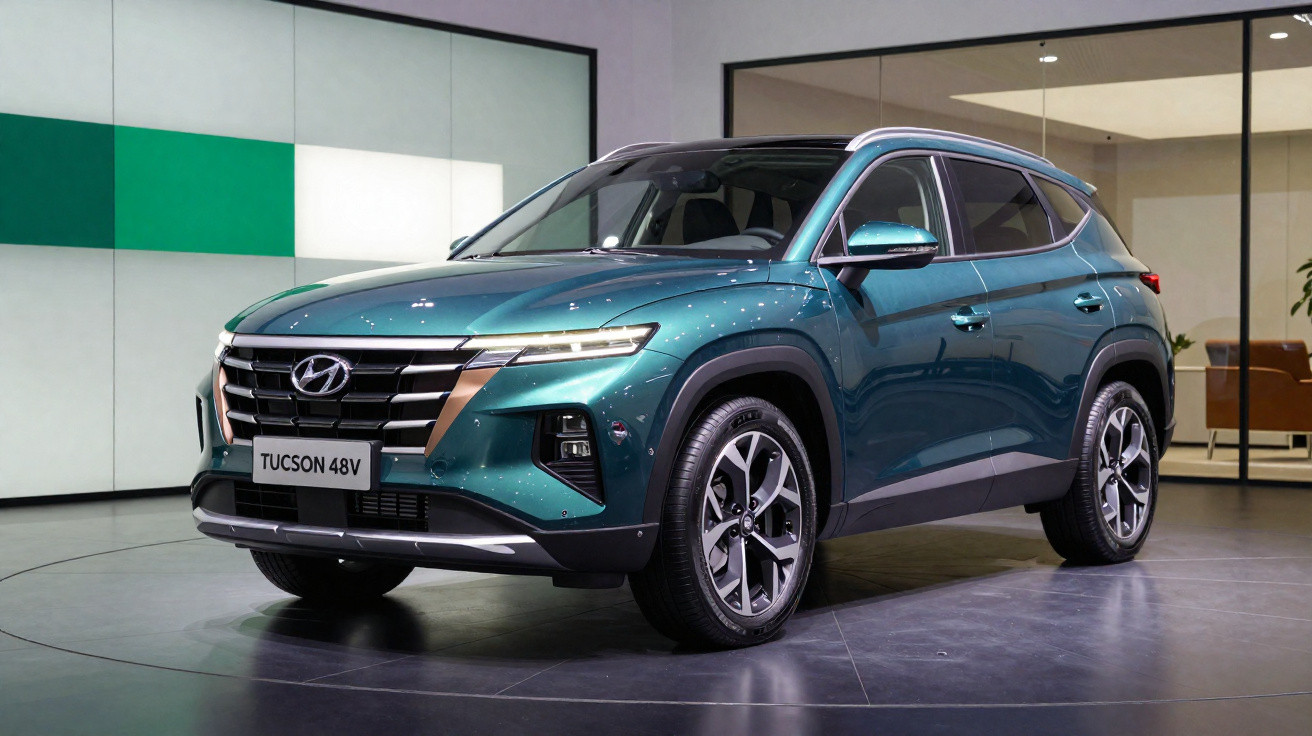
The presence of a mild-hybrid system is a smart way to make a Diesel engine even more efficient.
Tucson. Not the American city in the state of Arizona, but the compact SUV we first got to know in 2004-one of Hyundai’s biggest bets in a segment that, back then, wasn’t nearly as "red-hot" as it is today.
Over the past almost twenty years, though, the transformation has been huge: the Hyundai Tucson is now in its fourth generation.
More sophisticated styling
If there’s one reason the fourth-generation Hyundai Tucson stands out, it’s the design. It’s hard not to notice the shape of the front end, especially the way the daytime running lights are arranged.
Hyundai calls them parametric lights, even if the system isn’t as advanced as on the IONIQ 5. In all honesty, I’d rather describe it as a more original, less conventional styling touch.
Even after almost three years, it remains one of the most distinctive SUVs in its class. This particular example also draws attention because of the “48V” badge on the side, near the front wheels-but we’ll come back to that.
Interior evolution too
Beyond the bold exterior, the Hyundai Tucson’s cabin design has also moved on considerably. The dashboard lines, for instance, help create a more welcoming environment for the two people travelling up front.
Material quality is high across most surfaces. From the driver’s seat, the electric adjustments make it easy to find a comfortable driving position.
Right in front of the driver, the instrument display doesn’t feel like a digital afterthought replacing old analogue dials. Instead, it visually matches the rest of the layout.
In the middle of the dashboard, you can see the care taken to integrate the generously sized touchscreen into the overall design.
Less impressive is the decision to use touch-sensitive controls instead of traditional buttons-finished in glossy black.
It looks smarter, but it shows every speck of dust and quickly fills up with fingerprints-the kind that look like they’ll never disappear. And to operate the air conditioning, for example, you really do have to use these touch controls.
On the plus side, the screen offers plenty of features, sharp resolution, and multiple connectivity options. Apple CarPlay still requires a cable, although you can charge your phone wirelessly.
In this Diesel version with the mild-hybrid system, the automatic gearbox is operated by a conventional lever. It may well be the only element that feels slightly out of step inside this Hyundai Tucson; the hybrid version, for example, uses more discreet and more elegant buttons.
Space as a key strength
This is undoubtedly one of the SUV’s strongest arguments. Rear passengers get generous legroom, plus good space in width and headroom.
And even with three people in the back-doors shut and everyone belted up-if there are no complaints, it’s because there really is room. That’s not especially common, even in this segment.
Further back, the Hyundai Tucson with the Diesel engine offers a boot capacity of 560 l.
However, with this version’s 48 V mild-hybrid system, the associated battery is installed under the boot floor. The result is that capacity drops from 560 l to 521 l. Even so, it’s still more than enough for most journeys, including holiday trips.
Diesel and mild-hybrid. A good match?
Maybe it’s because I don’t drive Diesel cars as often these days, but the first impression is that the Diesel engine is noisier than ideal.
It’s paired with a mid-hybrid system and, for anyone who still isn’t familiar with it, it’s best to watch the video Guilherme made explaining it. As it happens, it was filmed behind the wheel of the Hyundai Tucson.
On the road, you barely notice the system at all-except for the moments when the combustion engine switches off simply because it isn’t needed. And that can happen quite often.
For example, it happened as I was approaching a red traffic light, well before the Tucson actually came to a stop. And when the 48 V battery is nearly full, there are times when the engine even shuts down on the motorway.
Don’t worry, though: the moment the system "thinks" it needs the combustion engine-or the battery needs topping up-the engine comes straight back on. Energy management is genuinely one of this system’s biggest strengths.
What’s it for?
This one is easy to answer: to burn less fuel. By taking some load off the combustion engine, fuel consumption should fall. And with a mild-hybrid system, several components can be powered purely by energy recovered during braking or deceleration.
According to the figures quoted by the brand, the difference can be around 0,3 l per 100 km. Even so, I wasn’t able to match the official 5,3 l/100 km. By the end of the test, the final figure was 6,4 l/100 km.
On the motorway, it’s easy to remember why Diesels were so sought-after until fairly recently, because this is where the averages become more restrained. And with a moderate pace, it can comfortably drop below the six-litre mark.
Still, with a slightly longer final drive ratio, I think it would be possible to persuade the Tucson to use even less fuel and to exploit the mild-hybrid system more effectively.
In town, you need to learn the system a bit better to start getting more out of it. Once you do, the averages begin to fall-but it’s worth remembering this Tucson still weighs 1660 kg, which doesn’t make the task any easier.
The dual-clutch gearbox isn’t "complicated", and the Hyundai Tucson has been very well developed in its ability to "flow" through most journeys.
The driving modes can also help depending on your mood, but 99% of the time they end up staying in the "normal" setting the car starts in.
The definition of a safe choice
The Hyundai Tucson is one of those models I could pick if I "only" had to drive. It may not be a dynamic benchmark, but the truth is the Hyundai Tucson "tolerates" everything you ask of it.
The suspension tuning delivers a high level of comfort in the cabin, even when the road surface isn’t on your side.
On top of that, the presence of 18″ wheels means the tyres have a more generous sidewall, helping to filter out many of the road’s worst imperfections.
Almost everything included as standard
With the Vanguard equipment level, it’s hard to find optional extras for the Hyundai Tucson, because almost everything is already included.
As options, you might choose one of the body colours that adds around €520 to the final price, or go for the configuration with a sunroof. In that case, the price increase is around €1200.
For the car I had the chance to test, with the Vanguard trim level, the price is €4500.
And at this point, that figure immediately raises the question of whether we really need a Diesel engine for our day-to-day routine. The reason is simple: today, for €750 more, you can opt for the HEV hybrid version that combines a petrol engine with an electric motor, while keeping the same equipment level.
Combined power rises to 230 cv, and the declared average consumption increases by only 0,5 litres per 100 kilometres. Yes, it runs on petrol rather than diesel. But in urban driving, the hybrid can spend a significant amount of time in 100% electric mode, using less fuel than the Diesel.
Above that sits the plug-in hybrid version, which is even more efficient and offers 265 cv of maximum combined power. In this case, though, we’re talking about a price close to €52 thousand.
Comments
No comments yet. Be the first to comment!
Leave a Comment