
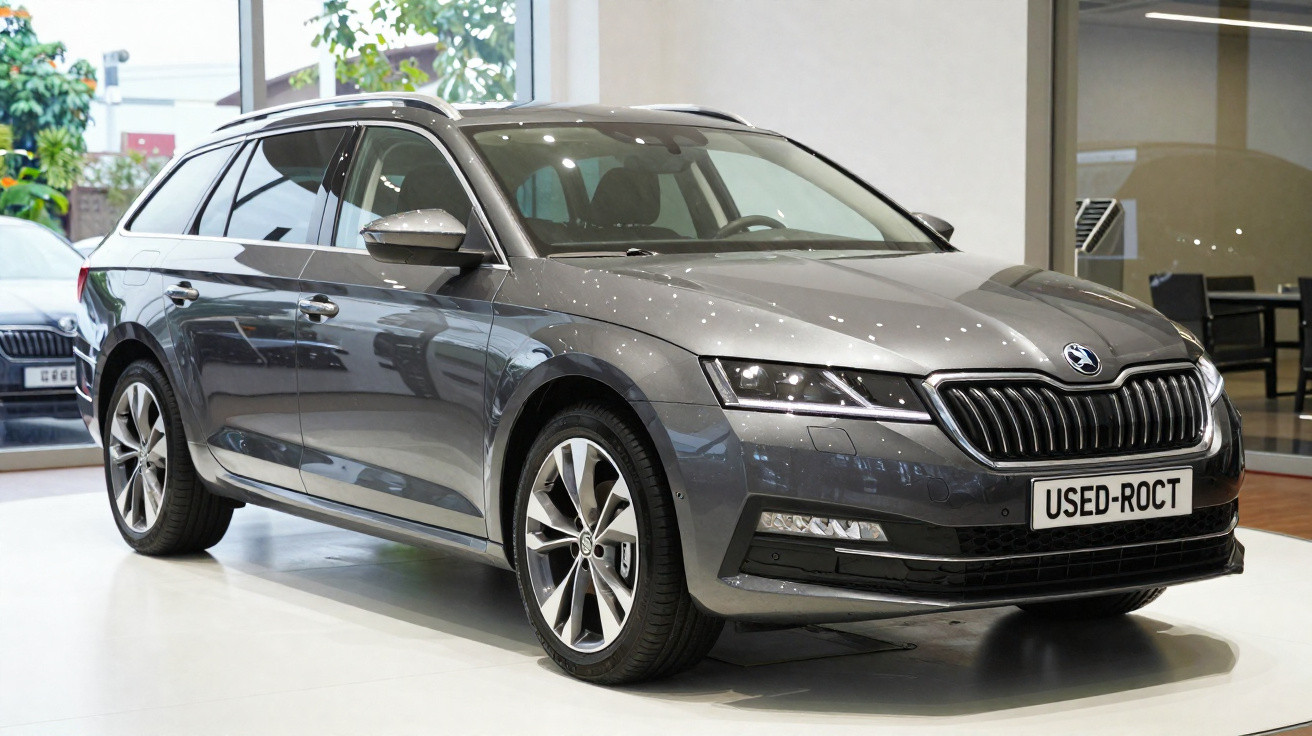
The Skoda Octavia Break is one of the best used estates you can buy on a modest budget. TDI or TSI? Either works.
Looking for a used family car for around €15,000, with plenty of room, strong reliability, decent comfort and a sensible equipment list? There’s good news - actually, there’s only good news - because when it comes to the Skoda Octavia Break, it’s hard to find a genuine downside.
That’s exactly why it’s our USED CAR OF THE WEEK. It may not be the most exciting choice, yet for more than 20 years it has built a reputation that’s difficult to argue with: space, toughness, efficient engines and tightly controlled running costs.
There are loads of examples for sale on Piscapisca.pt via Razão Automóvel (have a look - you won’t be short of options), but here we’re focusing on what is arguably the sweet spot: the third generation, launched in 2013 and known internally as the Octavia III (code 5E).
It was arguably the most significant Octavia of the lot. It was the first to use the Volkswagen Group’s MQB platform - the same technical base as the Volkswagen Golf Mk7 - and that delivered a clear step forward in build quality, on-road behaviour and technology.
The estate version - branded “Break” in the Portuguese market - is particularly appealing used. Built from 2013 to 2020 (with a facelift in 2017), it remains one of the most well-rounded family estates you can buy. That balance goes a long way towards explaining why it continues to be so sought-after.
Understated styling. So what?
The Octavia’s design has never been especially showy. But do you really want something loud and attention-seeking? The older I get, the more I find myself valuing other qualities. Yes, I’m still talking about cars…
At 4.66 metres long, the Octavia Break edges into the dimensions of estates from the class above - and that has always been one of its biggest competitive advantages. When it comes to interior packaging, Skoda is - by a wide margin - the brand that makes the most of Volkswagen Group platforms. There’s really no debate.
What people do debate is the 2017 facelift. It brought meaningful changes: a new lighting signature, a revised grille and, most notably, the controversial split front headlamps. Visually, it divided opinion. In the showroom, it barely mattered: the car kept selling strongly.
And back to space - remember these two figures: 610 litres with the rear seats up, and 1740 litres with them folded. That’s extremely hard to beat in this segment. Rumour has it the Volkswagen Golf Variant is quietly jealous…
If you’re still hung up on the “exuberance” question, there are the Scout versions (with a more adventurous look) whose bodywork sits somewhere between a family estate and an SUV. It’s not just styling either: these versions also come with four-wheel drive. The catch is that this extra versatility and presence costs more - and Scout models are both pricier and rarer on the used market.
Take a look on Piscapisca.pt and you’ll see there aren’t many. That’s another telling detail: Skoda owners tend to keep their cars for a long time - the same rational mindset we mentioned at the start of this USED CAR OF THE WEEK.
Skoda Octavia is XXL on the inside
It’s inside the Octavia that a big part of its reputation was forged. The old saying “beauty is on the inside” fits perfectly here.
Once again, the materials don’t impress through luxury, but through sturdiness and well-judged ergonomics. There are no flashy design statements or dramatic surfaces; instead, everything is where you expect it to be, and everything works the way you expect it to.
The controls are straightforward, it’s easy to get comfortable behind the wheel, and visibility remains among the best in the class. At a time when many newer cars are short on physical buttons, used cars like the Skoda Octavia Break feel like an ergonomic oasis from the touchscreen takeover.
On pre-facelift cars you’ll find simpler infotainment systems, while the 2017 facelift introduced larger displays, updated multimedia and Apple CarPlay/Android Auto compatibility - bringing the Octavia closer to more modern rivals.
The real headline, though, is space. In the rear seats, legroom is particularly generous, helped by the MQB platform’s long wheelbase.
The boot - already mentioned - remains one of this model’s standout strengths: 610 litres as standard, expanding to 1740 litres with the rear bench folded.
Another highlight is Skoda’s “Simply Clever” features. These are small, practical touches that make everyday life easier: an ice scraper hidden in the fuel flap, nets and dividers in the boot, bag hooks, bottle holders in the doors, and the well-known ticket holder on the A-pillar.
They’re not the sort of things shouted about in brochures, but these details help explain why the Octavia continues to be one of the most rational family choices out there. Find one on Piscapisca.pt, test-drive it, and then tell me I’m wrong.
Skoda Octavia Break: petrol or diesel?
From the driver’s seat it’s immediately clear why this Octavia generation was such a big step on from the previous model. As noted earlier, switching to MQB brought greater structural rigidity, lower weight and a far more modern technical foundation. The result is an estate that feels solid and grown-up from the first few metres.
It tracks straight and true at speed, wind noise is well suppressed, and the suspension tune leans towards comfort. It rounds off bumps effectively, deals with rougher surfaces without fuss, and always maintains a reassuring sense of control that encourages long-distance driving.
On B-roads it won’t feel as nimble as a compact hatchback, but it remains predictable and nicely balanced. The steering is accurate enough, and body movements stay well contained even when you pick up the pace. In short, it drives exactly like a well-sorted family estate should: safe, stable and easy to live with.
A lot of that experience depends on the engine you choose - and here it’s worth focusing on what’s actually common in the Portuguese market.
The 1.6 TDI is by far the most prevalent, making 115 hp after the facelift. It’s the classic choice for high-mileage drivers. Fuel use is low - a real-world average of 5.36 l/100 km on Spritmonitor - servicing is relatively affordable, and the engine’s character suits a family estate perfectly.
One step up sits the 2.0 TDI (150 hp), which many consider the range’s ideal balance. The extra torque is obvious: quicker overtakes, a more relaxed motorway feel, and better resilience on long trips or with a full load. It also pairs very well with the DSG automatic gearbox.
And, like the 1.6 TDI, the 2.0 TDI also has a strong reliability record. In this MotorCV report provided by Piscapisca.pt you can find the full history of factory campaigns (commonly known as recalls) for this Skoda Octavia generation.
On the petrol side, two options stand out. The 1.0 TSI (115 hp), introduced after the facelift, may look modest on paper, but in everyday driving it’s surprisingly capable. The turbocharger helps compensate for the small capacity, and in urban or mixed use it moves the Octavia Break along naturally while keeping consumption in check.
It’s one of the best engines in the segment. So don’t be put off by its size: it’s responsive, readily available in real driving, and has a strong reputation for reliability. Every car is different, but there are reports of multiple examples exceeding 400,000 km without any diagnosis of serious faults or major repairs.
Above that is the 1.5 TSI (150 hp), which brings more power and noticeably greater ease when the car is loaded or spends much of its time on the motorway. It’s also a compelling route for anyone wanting to avoid diesel without giving up useful performance headroom.
Overall, the Octavia Break isn’t trying to dazzle with headline numbers or big thrills. What it delivers is often more valuable: driving that is solid, comfortable and reassuringly predictable.
Price trends
On PiscaPisca.pt you’ll find multiple examples for sale, priced between €7390 and €26 990 - you can check all Skoda Octavia listings there.
Of course, asking prices vary with model year, mileage and trim level. Supply is strong, so finding an example that matches your expectations shouldn’t be difficult. The key point is this: with €15,000 it’s already possible to find a car in satisfactory condition.
To better understand how prices have moved in the Portuguese market, we’re sharing a chart with national price-trend data. All figures were provided by MotorCV.
Running costs and repairs
I know I’m starting to sound repetitive, but if there’s one trait that has always defined the Octavia, it’s rationality - not just at purchase time, but in everything that follows: servicing, parts and long-term costs.
Sharing its technical base with many Volkswagen Group models helps a lot. It means parts availability is excellent, independent garages know these engines well, and the aftermarket is huge.
Skoda has also created a useful option within its official network: Quality Parts. This is a parts range that doesn’t replace genuine Skoda original parts, but provides a more affordable alternative within the dealer network. Quality Parts can reduce maintenance costs while keeping compatibility with the car and access to the official brand network.
To illustrate the price differences, we’re sharing a few examples supplied directly by the brand for this model in the most popular version on our market: the Skoda Octavia Break 1.6 TDI.
Our pick
The reality with the Skoda Octavia Break is that there isn’t really a “wrong” choice. It mainly comes down to how you plan to use the car.
Versions with the 1.6 TDI are, by a long way, the most common on the Portuguese used market - and there’s a straightforward reason. Over the last decade, diesels clearly dominated sales, and this engine delivered exactly what many buyers wanted: low fuel consumption, dependable reliability and the ability to rack up miles without drama. If you do lots of road driving and want an economical family car for everyday use, it remains a very sensible option.
As mentioned, the facelift also introduced the 1.0 TSI, a small three-cylinder that deserves far more attention than its displacement suggests. It’s highly competent across the board: small, yet it punches above its weight. For mainly city use or short trips, it may even be the most appealing choice. It also manages motorway work well - you’ll only wish for more power if you regularly carry a full load of passengers.
If your budget stretches, it’s worth considering the 2.0 TDI. It offers more torque, more effortless motorway pace, and a strong, easy-going delivery that suits the Octavia Break’s family brief perfectly. It’s a genuine do-it-all engine.
Comments
No comments yet. Be the first to comment!
Leave a Comment