
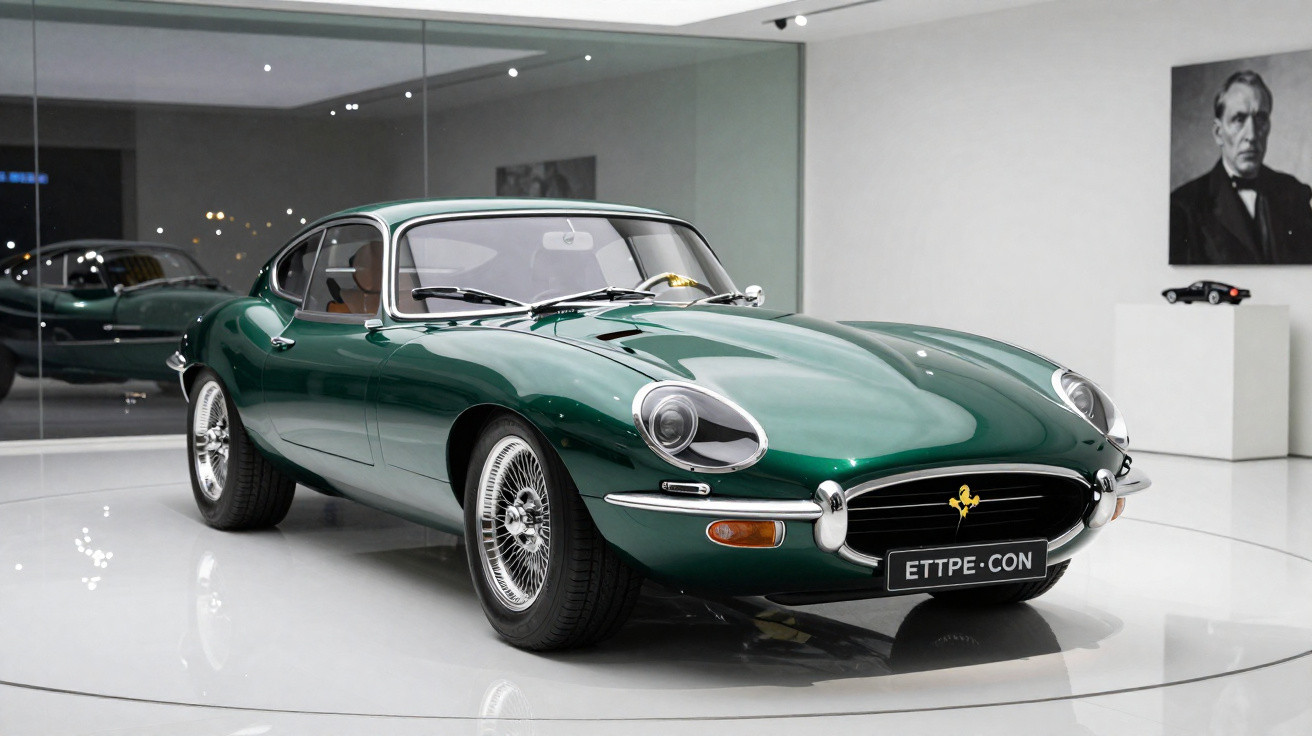
Jaguar E-Type: born on Her Majesty’s soil and hailed as the world’s most beautiful car
Born in Britain and repeatedly named the most beautiful car on the planet, the Jaguar E-Type stands as an engineering landmark and a genuine work of art on wheels.
This classic defined an era. Then and now, the Jaguar E-Type remains a striking British sports car built by Jaguar Cars Ltd between 1961 and 1974.
It offered the world what the motoring universe does best: exceptional styling, clever engineering and serious performance. It was so visually captivating that Mr Enzo Ferrari even pointed to it as the most beautiful of them all. And it delivered all of this at a price that was highly competitive for the 1960s, particularly when set against the cost of a Ferrari or Maserati.
At launch, the E-Type carried a modest price tag of around 4 thousand euros, while Ferraris cost double at 8 thousand euros. In today’s money, that works out at 150 thousand euros for the Jaguar and 300 thousand euros for the Ferrari. Yet despite being the cheaper option, the Jaguar could be significantly quicker. With a 3.8-litre inline six-cylinder engine, it reached a top speed of 240 km/h-giving rival marques a very real headache.
Engineering and development: building speed without a test track
Across its production run, 70 thousand units were sold. Development happened with instruments that were far from precise, and testing took place on motorways in the early hours, simply because there were no dedicated test circuits available. In practice, that meant the motorway was the only place where engineers could truly exploit the car and push it all the way to its maximum speed.
The rear suspension, for instance, came about through a wager. The Jaguar president made a bet with the Chief Engineer, giving him just one month to fully develop the rear suspension-convinced it couldn’t be done. In the end, it was completed within that month, and it proved so effective that it went on to be used for the following 25 years.
Public debut and cultural impact of the Jaguar E-Type
The public first saw the car at the Geneva Motor Show in March 1961. Even then, few people believed it would succeed-least of all the brand’s own president. But they underestimated the machine far too soon.
The Jaguar E-Type became an instant hit, and it was coveted by the jet set: Princess Grace of Monaco, Frank Sinatra, George Best and others all owned a magnificent E-Type. And exactly 51 years later, Jaguar drew on the E-Type when creating the brand’s new sports car, the Jaguar F-Type.
From Jaguar E-Type inspiration to the Eagle Speedster reimagining
The E-Type did more than inspire the F-Type. One company chose to redesign the E-Type entirely, bringing the Eagle Speedster to life. A car once sculpted by a visionary was made more robust, with softer, less sharply creased lines. Everything on it is new: wheels, tyres, brakes, the cabin, and even the engine.
The Eagle Speedster is powered by a 4.7-litre inline six-cylinder engine, paired with a 5-speed manual gearbox, enabling it to reach 260 km/h.
Its power-to-weight ratio is said to be better than that of a Porsche 911 Turbo, helped by a body made entirely from aluminium. Thanks to this, the Eagle Speedster launches from 0 to 100 km/h in under 5 seconds. And as if that were not enough, its soundtrack is described as superior to any other supercar-an exhaust note louder than thunder, strong enough to open springs, bring down trees and even burst eardrums.
This beauty costs 700 thousand euros. That is the price of driving the most beautiful car on earth-an undeniable privilege.


Comments
No comments yet. Be the first to comment!
Leave a Comment