
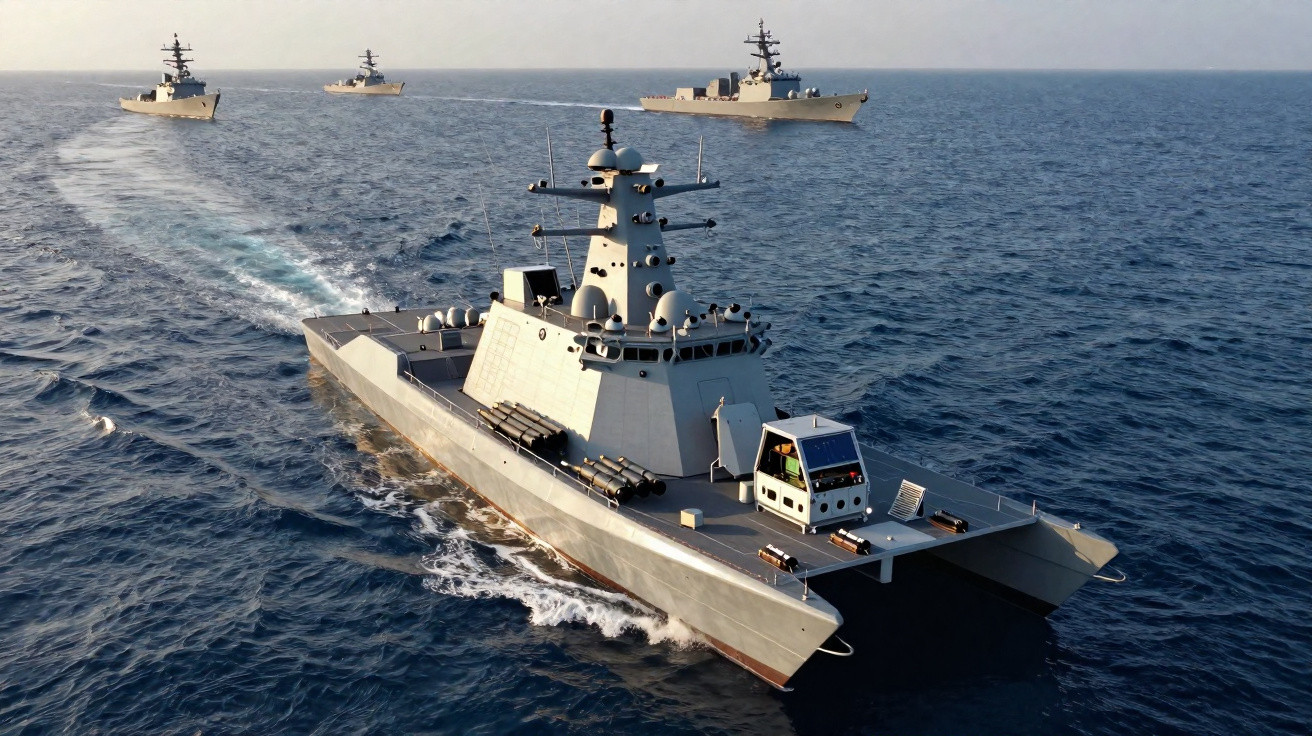
While arguments continue over vast surface fleets and billion‑dollar aircraft carriers, the US Navy is spending serious money and focus on smaller, cheaper, fully autonomous vessels. Its newest wager, the Modular Attack Surface Craft (MASC), pushes that thinking to the limit - blending the old logic of fast attack galleys with 21st‑century autonomy, software and long‑distance endurance.
A 20‑metre attack catamaran with no crew and serious bite
Developed by the US company BlackSea Technologies, MASC is a 20‑metre aluminium catamaran designed as a fighting ship from the outset rather than a commercial hull adapted for military use. That difference is central: the structure, propulsion and internal arrangement are purpose‑built around sensors, weapons and extended missions with nobody aboard.
Its twin‑hull configuration delivers strong stability alongside a shallow draught. In practice, this allows the craft to run close to shore, manoeuvre through restricted waters, or keep operating offshore without giving up seaworthiness. The design is aimed squarely at what naval planners describe as “littoral” operations - the cluttered, high‑risk coastal seas where many future confrontations are expected.
Power comes from Volvo Penta D8‑IPS600 integrated drives. Rather than long, conventional propeller shafts, the IPS approach packages the engine, transmission and steerable drive into compact pods. The result is a layout intended to ease maintenance, open up internal space for mission payloads and cut hydrodynamic drag.
The MASC can carry roughly 28,000 kg of payload - around twice that of typical autonomous surface vessels of similar size.
That spare payload capacity sits at the centre of the whole concept. MASC is built as a modular host platform, designed to accept mission containers: depending on the requirement, launchers, sonar arrays, electronic warfare suites or long‑range sensor packages can be installed and removed. In other words, it is less a single‑task “drone boat” and more a common chassis for multiple naval roles.
Seven missions, one hull: what makes the MASC genuinely “modular”
Where earlier unmanned surface vessels were often designed around one narrow job, MASC is intended to be multi‑role from day one. The US Navy is looking for an asset that can be reconfigured quickly for different contingencies without returning to a shipyard.
A plug‑and‑play warship
The craft is reported to support at least seven mission sets without putting a crew on board:
- Anti‑submarine warfare (ASW), towing or deploying sonar and cooperating with other platforms
- Anti‑surface warfare (ASuW) using missiles or loitering munitions against ships
- Electronic intelligence and electronic warfare, detecting and jamming hostile emissions
- Long‑range logistics, moving supplies through contested waters without endangering crews
- Precision naval strike against coastal or maritime targets
- Mine countermeasures, using towed or robotic systems to find and neutralise mines
- Infrastructure surveillance, from offshore platforms to undersea cables
That adaptability is underpinned by software known as UMAA - Unmanned Maritime Autonomy Architecture - the US Navy’s open‑architecture standard for autonomous vessels.
With UMAA, modules from different suppliers are meant to slot in like smartphone apps, avoiding lock‑in to a single defence contractor.
In practical terms, a MASC tasked with minehunting in the Gulf could, in theory, be turned into a missile‑carrying platform a few days later in the Pacific, assuming the required containers and software loads are available. The Navy’s aim is to shorten modernisation cycles and drive faster innovation than traditional warship programmes typically allow.
Planet‑spanning endurance from a compact hull
From Norfolk to Japan without a sailor on board
On paper, the performance figures are bold. At a steady cruising speed of 10 knots, MASC is listed as capable of travelling around 3,000 nautical miles, or roughly 5,500 km, in standard mode - a range in the territory of some crewed patrol vessels.
The more unusual claim is its long‑range deployment mode. With route optimisation, careful fuel management and limited use of high‑power systems, BlackSea states the craft can reach up to about 18,500 km without refuelling. Strategically, that implies a continuous unmanned transit from Norfolk, Virginia, to waters near Japan.
That kind of range supports a different model of forward presence: rather than sending a destroyer across the world, planners could dispatch a wave of MASC units days or even weeks earlier and pre‑position them near key straits and choke points.
Built like missiles: one a day on the production line
Industrial recycling from an earlier drone boat
BlackSea Technologies says that, at scale, it can reach a production tempo of one MASC hull per day by leveraging an existing line used for its Global Autonomous Reconnaissance Craft (GARC). A wide set of components - navigation equipment, computing units and perception sensors - are said to be shared across both families.
| Feature | GARC | MASC |
|---|---|---|
| Main role | Reconnaissance and surveillance | Attack and multi‑role combat missions |
| Hull type | Smaller USV | 20‑metre catamaran |
| Payload emphasis | Sensors | Sensors plus up to ~28 tonnes of weapons and equipment |
| Production line | Existing | Adapted from GARC line |
By reusing tooling and supply chains, development timelines can be compressed. BlackSea says it can assemble a working prototype in roughly six months - a rapid schedule in a naval context where new ships commonly take years to reach sea trials.
Exact cost data remains classified, but the underlying approach is straightforward: standardised, comparatively inexpensive, unmanned hulls produced in volume to flood contested waters.
A “distributed fleet” designed to fight more like a swarm
Quantity has a logic of its own
MASC fits into the US Navy’s idea of a “lethal distributed fleet”. Instead of concentrating combat power in a small number of very expensive ships, the concept spreads weapons across many smaller platforms. That complicates an adversary’s targeting and lowers the political impact of losing any single vessel.
In a crisis, dozens of small, armed USVs fanning out across a region can force an opponent to spread its defences thin, creating dilemmas at sea.
MASCs are not intended as direct replacements for destroyers or frigates. Instead, they are meant to multiply force: widening sensor coverage, carrying additional missiles and undertaking the highest‑risk tasks - minefields, narrow straits and suspected ambush areas - where the Navy would prefer not to send crewed ships.
The idea inevitably recalls Second World War Liberty Ships. Then, the United States produced simple cargo vessels in huge numbers to sustain Allied logistics. Today, planners are imagining a comparable principle applied to combat: many broadly standardised, “good enough” attack craft that can be lost and replaced without breaking the fleet.
From medieval attack galleys to AI‑driven catamarans
An old idea dressed in sensors and missiles
“Attack galley” may sound like a romantic label, yet the comparison carries weight. Medieval and early modern galleys were long, shallow‑draught vessels that darted along coasts, hitting flanks with speed and surprise. Their advantage was not heavy armour so much as manoeuvrability and concentrated striking power.
MASC follows a similar pattern. Instead of rowers below decks, software handles navigation, threat detection and route planning. Instead of archers, the payload could include anti‑ship missiles, lightweight torpedoes or loitering munitions exiting launch tubes at high speed.
As with galleys, MASCs are better understood as opportunistic hunters rather than brawlers. They are not designed to trade fire with a cruiser. They are built to show up where an opponent feels comparatively secure: near ports, along logistics routes, or around the margins of contested islands.
Risks, grey areas and real‑world scenarios
Greater autonomy brings legal and political uncertainty. How much judgement can a navy hand to software over a long mission? And after a strike, how does it demonstrate that a human being remained in the loop?
A plausible early role is high‑risk surveillance in flashpoints such as the Strait of Hormuz or the South China Sea. A MASC could patrol shipping lanes, search for mines or tail suspicious vessels. If it is attacked, the loss is equipment rather than lives - but the risk of escalation is clear.
Another possibility is saturation tactics. In a hypothetical clash near Taiwan, a US carrier strike group could send MASCs forward of crewed ships. Some might carry decoys and jammers, while others carry live missiles. Opposing radars and commanders would be forced to sort high‑value targets from cheaper drones under time pressure - potentially too late.
Key terms and concepts worth unpacking
What “autonomy” really means at sea
In naval usage, “autonomous” seldom implies independent, human‑like decision‑making. More often, it refers to systems that can follow planned routes, avoid collisions, manage fuel and handle basic changes - rough weather or nearby traffic - without constant human control.
Decisions at the higher end, particularly those involving lethal force, are generally retained by remote operators. Those operators may oversee several craft simultaneously, intervening only when rules of engagement demand human judgement.
Why mines and submarines fear small USVs
For submarines and minefields, small unmanned craft are becoming a growing problem. A quiet, relatively low‑cost platform such as MASC can tow sonar arrays or deploy small underwater drones to survey an area. Repeating that process day after day increases the odds of uncovering a lurking submarine or concealed mines.
At the same time, assigning mine clearance or close‑in ASW to unmanned vessels reduces exposure for sailors. That reduction in risk is among the strongest arguments navies use when defending such programmes to politicians and the public.
Paired with aerial drones and satellite inputs, MASCs become part of a layered surveillance‑and‑strike network. Each layer alone may seem manageable; together they stretch an adversary’s attention, air defences and electronic warfare resources - precisely the strategic pressure US planners are trying to generate.





Comments
No comments yet. Be the first to comment!
Leave a Comment