
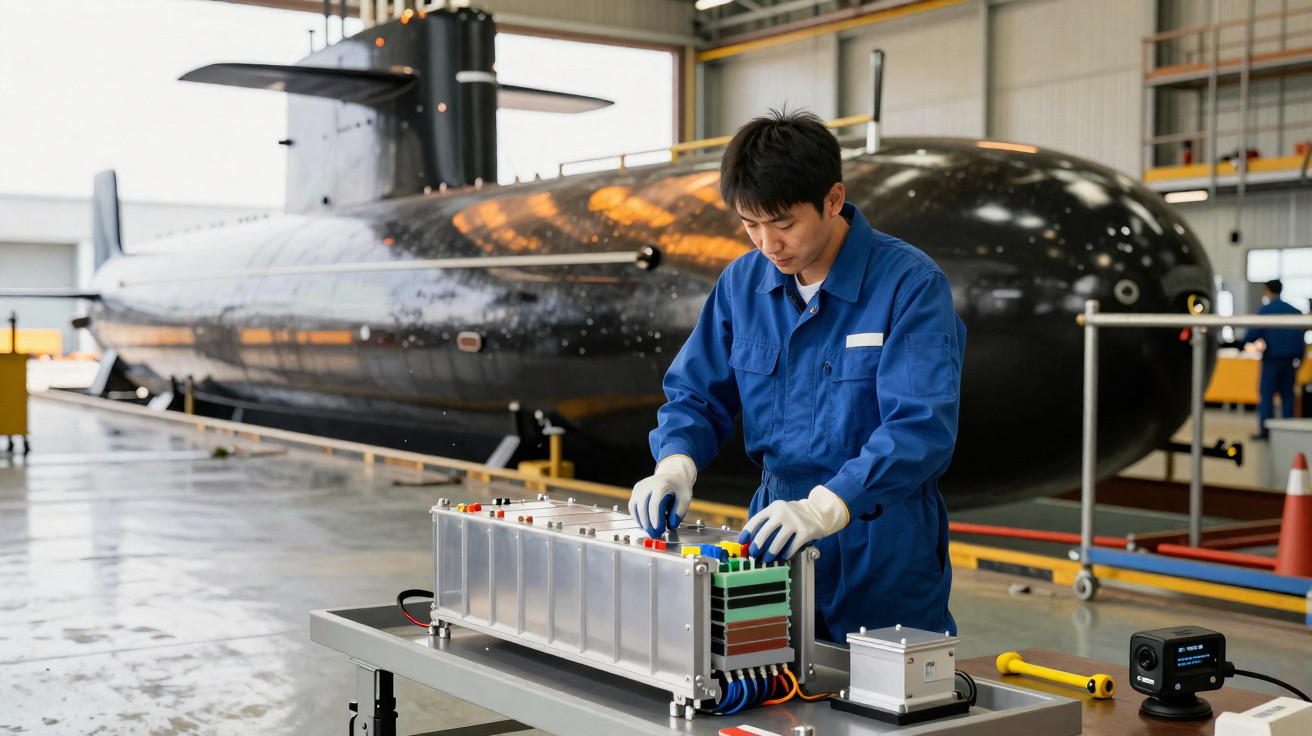
New waves of ultra-quiet, battery-powered submarines are starting to shift naval thinking - and the moment could scarcely be more disruptive.
For years, nuclear attack submarines represented the peak of undersea dominance. Today, a rapidly advancing challenger is taking shape: sophisticated lithium-ion and, soon, solid-state batteries that aim to deliver long endurance, strong speed and near-silent running without the complexity of a reactor.
The quiet revolution challenging nuclear submarines
Across much of the Cold War, the pecking order was clear. Nuclear-powered submarines sat firmly at the top, while conventional diesel-electric boats were viewed as a tier below - excellent for coastal defence, but constrained by range and the time they could remain submerged.
That distinction is beginning to fade as battery advances - largely driven by electric vehicles and consumer devices - move into naval service. Japan signalled the change first with a striking decision: it abandoned air-independent propulsion (AIP) on its newest submarines and committed fully to lithium-ion batteries.
Lithium-ion turned conventional subs from short-breath hunters into fast, long-distance predators that can stay quiet for weeks.
Germany’s TKMS and France’s Naval Group have since introduced their own lithium-ion concepts. Beyond that sits the next major step already being developed: solid-state batteries. They are expected to be lighter, pack more energy into the same space and improve safety - allowing far more usable power to be installed within an unchanged hull.
Japan’s Taigei class: blueprint for the post-nuclear era?
JS Sōgei and the all-electric gamble
Japan’s sixth Taigei-class submarine, JS Sōgei (SS-518), launched in 2025, demonstrates how far this approach has progressed. Formally, it is a conventional diesel-electric submarine. Operationally, its propulsion concept resembles an “underwater Tesla” far more than a Cold War-era diesel boat.
- Displacement: around 3,000 tonnes
- Length: roughly 84 metres
- Six 533 mm torpedo tubes
- Propulsion: 100% lithium-ion battery for submerged running
- Diving speed: about 20 knots
High-efficiency 12V25/31 diesel engines recharge the batteries through a highly optimised snorkel arrangement. The key issue is not only top speed, but the reduced time the submarine must expose a snorkel to replenish power - historically the Achilles’ heel of non-nuclear designs.
For detection and engagement, the Taigei class fields a contemporary ZQQ-8 sonar suite with flank arrays, a towed array and non-penetrating masts, alongside Type 18 torpedoes and Harpoon missiles. The design supports “sprint and drift” operations: move quickly into a patrol area, then stop and wait with a signature that is exceptionally hard to pick up.
The aim is simple: nuclear-like performance for regional missions, without the strategic and political baggage of a reactor.
Why lithium-ion changes the game
Set against traditional lead-acid systems, lithium-ion gives naval architects a markedly expanded set of options:
- Far higher energy density for the same volume
- Higher sustained submerged speed
- Much faster charging cycles
- Lower acoustic signature because the sub relies more on batteries, less on noisy diesel
China’s Yuan-class and South Korea’s KSS‑III submarines typically pair AIP with conventional batteries or early-stage lithium solutions. Japan’s Taigei class makes a different call by removing AIP altogether and leaning on batteries alone. That decision reflects a doctrinal tilt: away from extremely slow, days-long creeping, and towards agile, higher-speed manoeuvre and rapid repositioning in contested environments such as the East China Sea.
Solid-state batteries: when conventional subs go truly long-range
From lithium-ion to solid-state power packs
Solid-state cells swap the liquid or gel electrolyte for a solid material. While the underlying engineering is still being perfected, the expected advantages are already widely recognised:
- Lower weight for the same capacity
- Two to three times higher energy density
- Reduced fire and thermal runaway risk
- Faster charging
- Higher peak power output for bursts of speed
On platforms such as the French Scorpène or Japan’s Taigei, those gains would translate into endurance and speed patterns that begin to converge with nuclear-powered submarines - at least across realistic mission durations.
| Characteristic | Current lithium-ion | Estimated solid-state | Nuclear propulsion |
|---|---|---|---|
| Sustained submerged speed | 7–10 knots | 10–15 knots | 20–25 knots, almost indefinitely |
| Endurance | 60–80 days | 120–160 days | Years, limited by crew and maintenance |
| Range | 20,000–25,000 km | 40,000–50,000 km | Effectively unlimited |
| Recharge / refuelling time | About 1 hour | Under 1 hour with higher charge rates | Reactor refuelling every 10–15 years |
Naval Group has already promoted an updated Scorpène for Indonesia featuring lithium-ion batteries, alongside a claimed submerged endurance of 80 days. If solid-state batteries reach service at scale, that endurance figure could plausibly be doubled - pushing mission length into the same practical bracket as many nuclear patrols.
Is “unlimited” nuclear endurance still a trump card?
The traditional case for nuclear attack submarines is simple: they do not meaningfully run short of power within tactical timeframes. However, the crew does. Food supplies, spare parts, fatigue and mental health set hard limits on continuous time at sea.
- Logistics and resupply force regular returns or rendezvous
- Mechanical systems demand maintenance windows
- Crew morale and rotation cap continuous deployment
As a result, many navies plan for 60–120 days of intensive operations whether the submarine is nuclear-powered or not. Within that planning horizon, a top-tier conventional submarine equipped with solid-state batteries could be a compelling proposition:
- Much lower acoustic signature than a reactor-powered vessel
- Acquisition costs reportedly around one-fifth of a nuclear boat
- Operating costs per sea hour said to be roughly ten times lower
- Sufficient speed for coastal defence and blue-water patrols
For many regional navies, the question is not “nuclear or nothing”, but “how close can we get to nuclear performance without the nuclear headaches?”.
Europe and Asia racing for battery supremacy
German TKMS: stealth and hybrid concepts
Thyssenkrupp Marine Systems - known for the Type 212 and 214 - is shifting emphasis away from fuel-cell AIP and towards high-density lithium-ion packs and hybrid power arrangements. Forthcoming Type 212CD boats and the proposed 216 concept are intended to hold higher speeds while preserving the German hallmark: exceptionally low sonar detectability.
Japan’s industrial duo: Mitsubishi and Kawasaki
Mitsubishi Heavy Industries and Kawasaki Heavy Industries underpin Japan’s rapid move to lithium-ion. The Oryu and Taigei classes became the first operational submarines anywhere to remove lead-acid batteries completely. Japanese shipbuilders are now working on tighter internal packaging and megawatt-class charging systems to enable future solid-state adoption.
South Korea’s Hanwha Ocean and DSME heritage
South Korea is pursuing domestically developed, high-density battery systems for the KSS‑III programme. Later “Batch III” submarines are expected to progress beyond conventional lithium-ion, incorporating higher-power electric drives and stronger underwater sprint performance - with ambitions for some of the highest sustained non-nuclear speeds in Asia.
Four competing technologies, four different roles
| Technology | Main strength | Main weakness | Relative cost | Typical role |
|---|---|---|---|---|
| Lead-acid + AIP | Extreme stealth at very low speed | Slow, limited power | Low | Coastal and chokepoint defence |
| Lithium-ion | High speed and extended endurance | Recharge windows still tactically sensitive | Medium | Anti-submarine warfare, ocean patrol |
| Solid-state | Endurance roughly doubled, speed boosted, safer cells | Costs remain high, tech still maturing | Medium | Long-range missions, “budget” alternative to nuclear |
| Nuclear | Almost unlimited power and speed | High cost, higher signature, political constraints | Very high | Strategic deterrence, global power projection |
Risks, constraints and what could go wrong
This surge in underwater battery adoption brings its own set of risks. Lithium-ion is associated with thermal runaway, and submarines pose unique challenges: confined spaces, high pressure and very limited firefighting options. Solid-state batteries should behave more safely, but full naval-scale qualification still lies ahead.
There is also a strategic consequence to consider. If non-nuclear submarines become less expensive, extremely quiet and genuinely long-ranged, more countries may pursue them. That could increase the chance of congested, difficult-to-detect encounters beneath the surface in areas such as the South China Sea or the Mediterranean.
Key terms and future scenarios
Two technical terms are likely to recur throughout this discussion:
- AIP (air-independent propulsion): systems such as Stirling engines or fuel cells that let a diesel-electric sub stay submerged for days at low speed without snorkelling.
- SSK vs SNA: SSK usually denotes a conventional attack submarine, while SNA or SSN refers to nuclear-powered attack boats.
A plausible near-term outcome is the rise of mixed fleets. Major powers may retain a nucleus of nuclear submarines for strategic tasks and long-range escort duties, while adding solid-state SSKs for regional patrol, chokepoint control and covert intelligence-gathering in shallower waters.
For smaller navies, solid-state propulsion could act as a bridge to blue-water capability. A state that cannot - or chooses not to - run a nuclear programme might still field submarines able to deploy for multiple months, transit long distances and execute high-speed ambushes along key shipping routes.
If solid-state batteries hit their projected performance, nuclear propulsion will not vanish, but it may start to look like a specialist tool rather than the automatic gold standard.


Comments
No comments yet. Be the first to comment!
Leave a Comment