
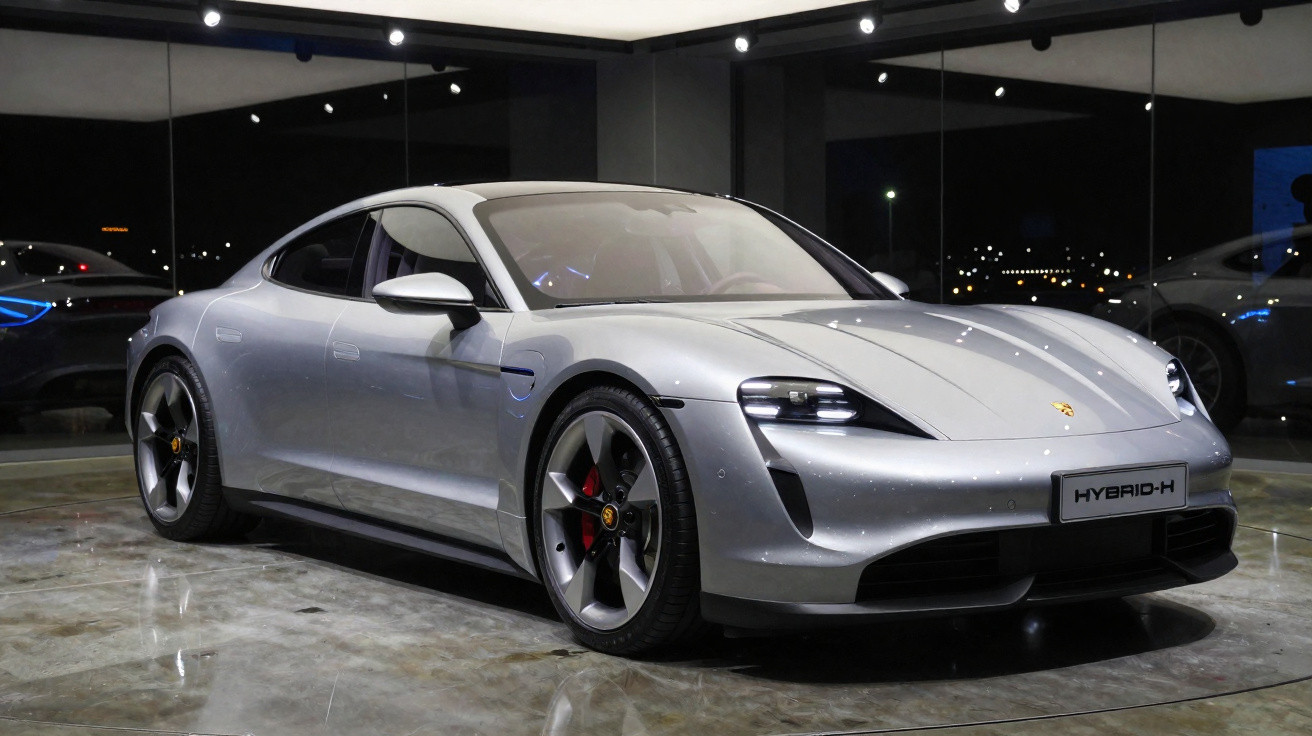
Porsche is reportedly working on a gear lever that is meant to do both: deliver the ease of an automatic for everyday driving while also offering a genuine H-pattern shift gate for drivers who want to be more involved. The sports car manufacturer is aiming to slow the move away from the traditional manual gearbox without sacrificing efficiency or modern electronic control.
Why Porsche still hasn’t let go of the manual gearbox
Manual transmissions are gradually disappearing from configurators. Even in sports cars, most buyers now choose an automatic - at Porsche, typically the PDK dual-clutch transmission. It changes gears more quickly, can reduce consumption in standardised test cycles, and makes it easier to meet increasingly strict CO₂ targets.
Anyone ordering a 911 with a manual today is in the minority. For the manufacturer, every classic manual variant requires its own homologation, its own emissions and consumption testing, and therefore extra cost. At the same time, for enthusiasts, a key piece of brand identity is tied to an H-gated gear lever.
"Porsche is looking for a way to preserve that typical manual-shift moment - without turning back technical progress."
A newly published patent from Germany shows how the company wants to manage this balancing act: a gear lever that can electronically change its behaviour - sometimes a comfortable selector, sometimes a sporty manual-style H-gate.
The patent in detail: one lever, two personalities
On 30 August 2024, Porsche filed a “gear selection mechanism for a vehicle transmission” with the German patent office; the document was published on 5 March 2026. At its heart is a shift-by-wire system. The lever is not mechanically linked to the gearbox; instead, it sends electronic signals to the control unit.
The key idea is that the engineers use that freedom to let the lever operate in two clearly defined modes - automatic, or in the style of a traditional manual transmission.
How the automatic mode is intended to work
When locked, the lever functions like the selector in a modern automatic. The driver moves it only forwards or backwards to choose the familiar drive positions:
- D for driving forwards
- N for neutral
- R for reverse
In this state, sideways movement is blocked. Sensors record the travel and direction, and the electronics translate those inputs into gear selection and transmission control. For stop-start city traffic or relaxed motorway cruising, that is all many customers need.
When it matters: H-pattern shifting at the press of a button
Things get interesting once the driver releases the lateral lock. A virtual H-gate then opens up, echoing a classic manual gearbox. The lever can now be moved left and right as well as forwards and backwards, allowing individual gears to be selected directly.
The patent describes how angle and position sensors continuously detect which “gate” the lever is in. Small electric motors and springs create tactile detents and resistance - as though there were a real shift rod and shift gate mechanism.
"The mechanism imitates the H-gate, but the decision is made entirely electronically in the control unit."
The result is a very direct, mechanical-feeling shift action, even though the connection to the gearbox remains purely virtual. In principle, the system could control a PDK, a conventional torque-converter automatic, or a future hybrid transmission.
Comparison with other solutions in the sports car segment
Porsche is not alone in pursuing this sort of idea. Swedish hypercar maker Koenigsegg already offers the CC850, a supercar whose multi-clutch transmission can physically switch between nine automatic ratios and six manually shifted gears.
In that case, the internal gearbox hardware changes. With Porsche, the core gearbox could remain the same. The new lever would be “just” a versatile interface that changes the vehicle’s character at the touch of a button.
| Feature | Porsche patent | Koenigsegg CC850 |
|---|---|---|
| Type of solution | Electronic gear lever (shift-by-wire) | Mechanically variable transmission architecture |
| Modes | Automatic operation and H-gate | Nine-speed automatic and manual six-speed shifting |
| Flexibility | Conceivable for PDK, automatic, or hybrid | Tailored specifically to the vehicle |
What it could mean for the 911, 718 and others
The patent does not say whether - or when - this dual-mode gear lever might reach production. While no specific model names appear in the documentation, the enthusiast community immediately thinks of the 911 and 718.
The potential benefit is particularly clear for these model lines:
- In everyday driving, with congestion and city traffic, you simply drive in D.
- On a country road or on track, you switch into the H-gate and get actively involved again.
- From the manufacturer’s perspective, efficient automatic technology can remain in place without losing the emotional appeal.
As is typical with patents, it mainly indicates what engineers are working on, not what is guaranteed to arrive. Even so, Porsche is sending a clear message that it is exploring new types of driving experience rather than treating the manual gearbox as something purely for the history books.
Technical background: why shift-by-wire is the key
The move towards shift-by-wire creates room for concepts like this. Because the lever no longer needs a mechanical connection to the gearbox, it can be programmed freely. Shape, travel, detents, and resistance can be varied by the electronics as desired.
Among other things, such systems offer these advantages:
- More freedom for interior design, because no rigid shift linkage is required
- Easier integration of driver assistance systems and automated driving functions
- The option to apply software updates to shift behaviour
- Precisely adjustable feedback, from smooth to very sporty
For drivers who grew up with a traditional gearbox, an artificially generated H-pattern could make the switch to modern technology emotionally easier. Your hand performs the same movements as before, even if the hardware behind it is a highly complex dual-clutch system or a hybrid module.
Who really benefits from a switchable gear lever?
The target audience is obvious: people who choose a sports car intentionally and are not guided solely by spec sheets. Many of them care about that moment when a gear engages and the engine speed drops.
Yet in day-to-day use, those same customers often still want the convenience of an automatic. So the blend of both is likely to be more of an emotional feature than an objective performance advantage. For brands like Porsche, where the driving feel is part of the identity, that can be decisive.
There is also another factor: a purely manual transmission has limited compatibility with assistance features and future levels of automation. A virtual H-pattern controlled by electronics can be disabled or adjusted when needed, without upsetting the safety architecture.
How convincing is the shifting illusion?
Ultimately, the crucial point will be whether the lever feels authentic. If it comes across as nothing more than a joystick, many fans will be irritated rather than impressed. Mechanical resistance, clearly defined gates, and distinct detents all have to be right for the brain to forget that it is only a simulation.
That is where the springs and small electric motors described in the patent come in. They are intended to provide tactile feedback reminiscent of familiar sports car gearboxes. In theory, Porsche could even vary it by drive mode - for example, softer in a comfort programme and firmer in a track mode.
This would move the manufacturer towards a new type of control concept: the hardware stays the same, while the driving feel can be tailored through software and configuration to individual taste. For many purists, a truly mechanical gearbox will remain irreplaceable. For most customers, however, this kind of hybrid lever could be exactly the right compromise.
Comments
No comments yet. Be the first to comment!
Leave a Comment