
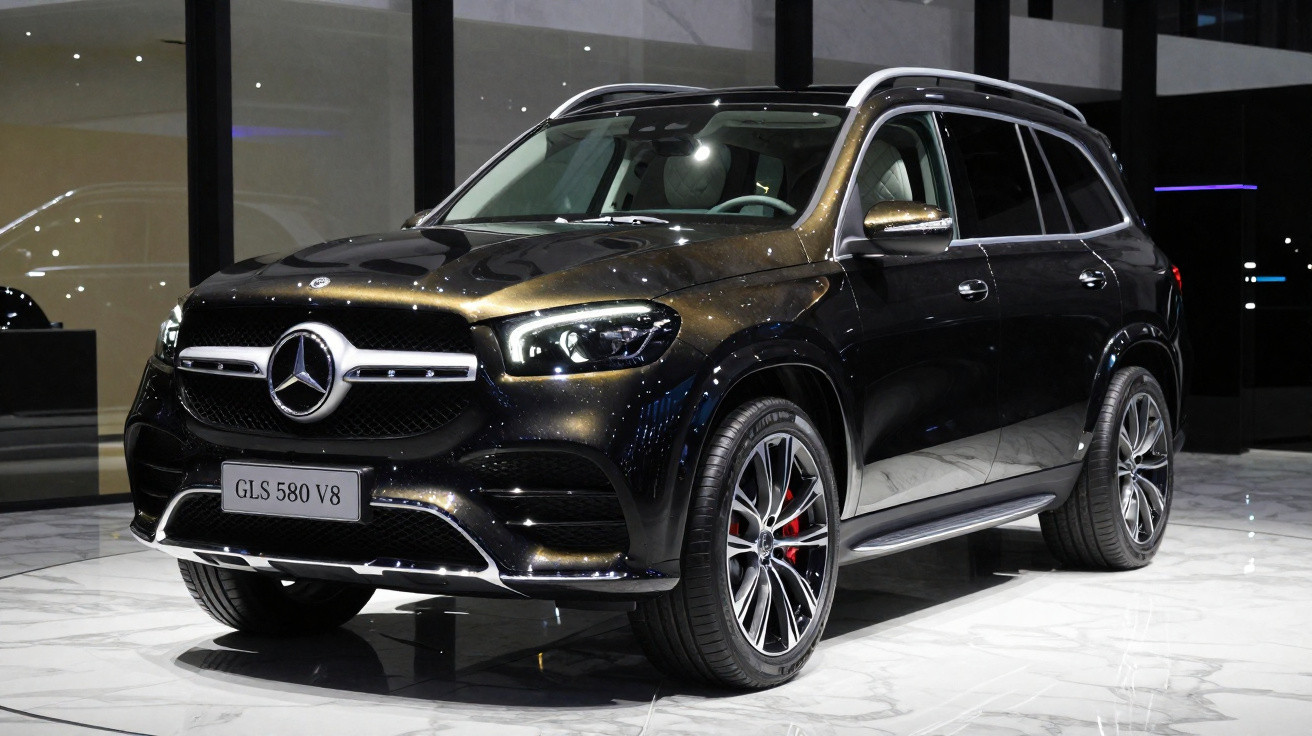
The Mercedes-Benz GLS has been refreshed for the second time in its current generation - the third iteration, introduced in 2019 - but on this occasion the updates go further than is normally the case.
On the outside, the revised model brings redesigned bumpers and headlights, along with a larger grille, much like the changes already seen on the GLE. And, as with the brand’s latest launches, star motifs are everywhere - whether as part of the light signature or used as the grille’s pattern.
At the rear, a black “mask” now links the two light clusters, incorporating the three-pointed-star badge in the middle, echoing what we saw on the new all-electric GLC.
Bigger changes inside
The most substantial revisions on the GLS 2026 are found in the cabin. The dashboard has been reworked and is now dominated, as standard, by the MBUX Superscreen - a continuous glass surface running the full width of the dashboard and housing three 12.3-inch displays - along with an 18-inch augmented-reality head-up display.
In the second row, the headline addition is a pair of 11.6-inch Full HD touchscreens, one for each passenger, enabling film playback and access to entertainment apps. A panoramic roof also becomes standard equipment. As before, maximum seating can reach seven occupants (across three rows).
From Diesel to V8
There are also updates under the bonnet. Entry to the range comes via the GLS 350 d 4MATIC, powered by a 3.0-litre straight-six Diesel producing 313 hp (230 kW). Above it sits the GLS 450 d 4MATIC, which uses the same layout but delivers more power: 367 hp (270 kW).
One of the key mechanical changes concerns the straight-six petrol engine in the GLS 450 4MATIC. The M 256 Evo - as the name suggests - is an evolution of the previous unit, featuring a new cylinder head, increased air intake and a revised exhaust system. While output remains unchanged at 381 hp, torque rises by 12% compared with the previous model - from 500 Nm to 560 Nm.
The biggest headline is reserved for the range-topping engine: a 4.0-litre twin-turbo V8. It powers the GLS 580 4MATIC and is the new M 177 Evo, first introduced on the 2026 S-Class, distinguished by the use of a flat-plane crankshaft… just like Ferrari uses in its engines. It produces 537 hp and 750 Nm (+20 hp and +20 Nm versus the previous M 176), yet uses (slightly) less petrol and delivers stronger performance. The 0–100 km/h sprint is dispatched in 4.7 seconds (-0.2 seconds versus before).
Unlike the GLE, the GLS is not available with plug-in hybrid powertrains. For the brand’s largest SUV, the only electrification on offer is the lightest form: a 48 V mild-hybrid system, fitted across all engines.
Here is the full powertrain line-up:
| Version | Drivetrain | Engine | Power | Torque | Notes |
|---|---|---|---|---|---|
| GLS 350 d 4MATIC | 4MATIC | 3.0-litre straight-six Diesel | 313 hp (230 kW) | Not stated | - |
| GLS 450 d 4MATIC | 4MATIC | 3.0-litre straight-six Diesel | 367 hp (270 kW) | Not stated | - |
| GLS 450 4MATIC | 4MATIC | Straight-six petrol (M 256 Evo) | 381 hp | 560 Nm | Revised head, intake and exhaust; torque +12% (from 500 Nm) |
| GLS 580 4MATIC | 4MATIC | 4.0-litre twin-turbo V8 (M 177 Evo) | 537 hp | 750 Nm | Flat-plane crankshaft; +20 hp / +20 Nm vs M 176; 0–100 km/h in 4.7 s (-0.2 s) |
When will it arrive?
The Mercedes-Benz GLS 2026 is expected to reach dealerships in the coming months. Pricing for the Portuguese market has not yet been announced, but do not expect it to undercut the €154,000 asked for the entry-level version of the current model.
Comments
No comments yet. Be the first to comment!
Leave a Comment