
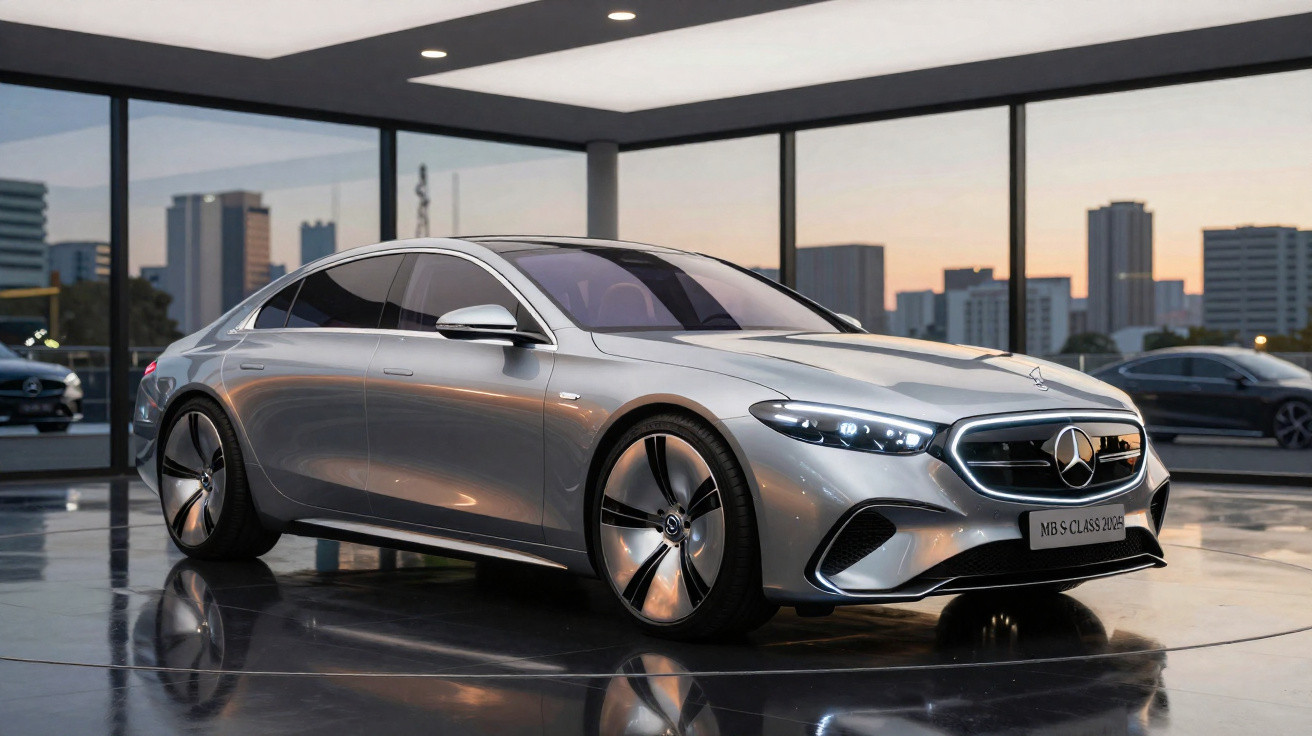
The CLA may have been the model that signalled the start of a new era at Mercedes-Benz, but when the three-pointed star needs to reassert itself in status and technology, it is always the Classe S that takes centre stage.
That has been the pattern across every generation: the biggest steps forward - particularly on the tech front - are typically introduced on the Classe S first, and only then filtered down to the rest of the range.
The newly unveiled 2026 update lands alongside Mercedes-Benz’s 140th anniversary, yet it is not a full model change. Instead, it is a comprehensive rework of the current car - the brand claims more than half of the components are new or revised - designed to keep the Classe S as the benchmark luxury saloon in an increasingly competitive, global market.
Without abandoning its core character, the Classe S 2026 focuses its changes where they matter most, though in the brand’s traditional understated manner. On the outside, the differences look restrained. The body design keeps its classic proportions, paired with the discreet sense of presence that has long defined the Classe S.
Updates include finer points such as a grille that is 20% larger, redesigned wheels, and an updated Manufaktur colour palette. The technology story starts with Digital Light, where each headlamp now incorporates more than 1.3 million “microscopic” mirrors.
These enable high-definition projections directly onto the road surface - for instance, guidance markings through roadworks. The system can also display additional visual warnings and driving support cues, particularly useful in complex urban settings or when visibility is poor.
New interior with plenty of luxury and technology
If the exterior is evolutionary, the cabin is where the change is far more dramatic. The Mercedes-Benz Classe S 2026 dashboard is completely new and follows the direction of the brand’s latest models by stretching the screen area across the full width of the interior: there is a 12.3" display for the instruments; the central touchscreen is 14.4" and is no longer vertically oriented; and the front passenger now gets a 12.3" display too. Also noteworthy is the new multifunction steering wheel, which returns to physical controls instead of haptic inputs, reflecting customer demands.
The MBUX system has undergone a structural update with greater use of artificial intelligence (AI), which the brand says delivers clear improvements in natural-language voice recognition. Navigation has been enhanced as well, with more ability to combine traffic data, topography and user habits. As a result, it can anticipate frequent destinations and tailor suggestions to the situation.
There is also fresh digital content, including entertainment and productivity apps, strengthening the idea of turning the Classe S interior into a place for work as well as relaxation. The electronic architecture has been reworked to support a broader range of remote over-the-air (OTA) updates.
In terms of materials, the aim remains to hold the reference standard. Leather, wood and metal trims now come in new combinations through the Manufaktur programme. The ambient lighting is also new, creating additional lighting themes. Luxury is evident in details such as the use of heated seat belts.
In the second row, the differences continue. There are more massage programmes available, and the brand points to more meticulous work on acoustic and thermal comfort, reinforcing the Classe S’s focus on those travelling in the rear. The back seats can become a genuine “meeting room on wheels”: 13.1" displays, smartphone-style controls, fast wireless charging, a fridge, folding tables, and even videoconferencing via Zoom or Teams.
Driver assistance and automation
Although this generation (W 223) of the Mercedes-Benz Classe S was the first to offer Level 3 autonomous driving as an option (Drive Pilot) - which already allows the driver to take their eyes off the road - the brand has dropped that option with this update. The reasons relate to restrictions on where it can be used, which led many customers to skip the system; it was also very expensive.
As a result, the Classe S now tops out at Level 2 autonomy, via the new MB.Drive Assist Pro. Despite the “downgrade”, it brings a wide range of advanced functions - including “point-to-point” automated driving in urban environments - leading the brand to describe it as Level 2++. However, it always requires driver supervision and, legally, the driver remains responsible in the event of an accident.
There is a catch: it is not available in Europe, and it is unclear when it will be, as it depends on regulatory approval. In China, for example, the system became available immediately and will reach the USA soon. The new Mercedes-Benz CLA and GLC can also be equipped with this system.
Automated parking has progressed too. MB.Drive Parking Assist can detect spaces on both sides of the vehicle and, for the first time, enables angled parking.
To help with tighter manoeuvres such as parking, every Classe S 2026 now comes with rear-axle steering up to 4.5°, with an option for the rear wheels to turn by up to 10°. In that configuration, the turning circle drops to just 10.8 metres, comparable with much smaller cars.
V8 surprise
One of the biggest surprises in the Mercedes-Benz Classe S 2026 may be the arrival of a new twin-turbo V8, the M 177 Evo. As the name suggests, it develops the previous unit, but adds a distinctive detail: a flat-plane crankshaft. That is a solution more commonly associated with supercars - it is what gives Ferrari V8s their soprano-like sound - than with luxury saloons.
Fitted to the S 580 4Matic, this new V8 paired with a 48 V mild-hybrid system produces 537 cv and 750 Nm at 2500 rpm, comfortably surpassing the outgoing engine. Alongside the flat-plane crank, Mercedes points to new turbochargers and a revised injection system as reasons for sharper response, greater smoothness and… efficiency gains.
Below the V8, the petrol line-up is built around inline six-cylinder engines. The S 450 uses a 3.0-litre unit with 381 cv and 560 Nm, while the S 500 raises the bar to 449 cv and 600 Nm. The star brand is also keeping a Diesel option, again based on an inline six-cylinder 3.0-litre engine. Two versions are planned: one with 313 cv and 650 Nm, and a more powerful one with 367 cv and 750 Nm.
While full electrification remains the EQS’s job - a 100% electric Classe S will only arrive in 2030 - the Classe S 2026 puts most emphasis on plug-in hybrid technology. There are two versions sharing the six-cylinder engine, the electric motor (120 kW or 163 cv) and a 22 kWh battery. What separates them is output and torque: 435 cv and 680 Nm for the S 450 e; and 585 cv and 750 Nm for the S 580 e - even more powerful than the twin-turbo V8. Electric-only range can reach up to 118 km.
When will it arrive?
For now, Mercedes-Benz has not announced a launch date for Portugal or pricing for the Classe S 2026. However, the luxury saloon can already be configured and ordered online in several countries, so further details should follow soon.
Comments
No comments yet. Be the first to comment!
Leave a Comment