
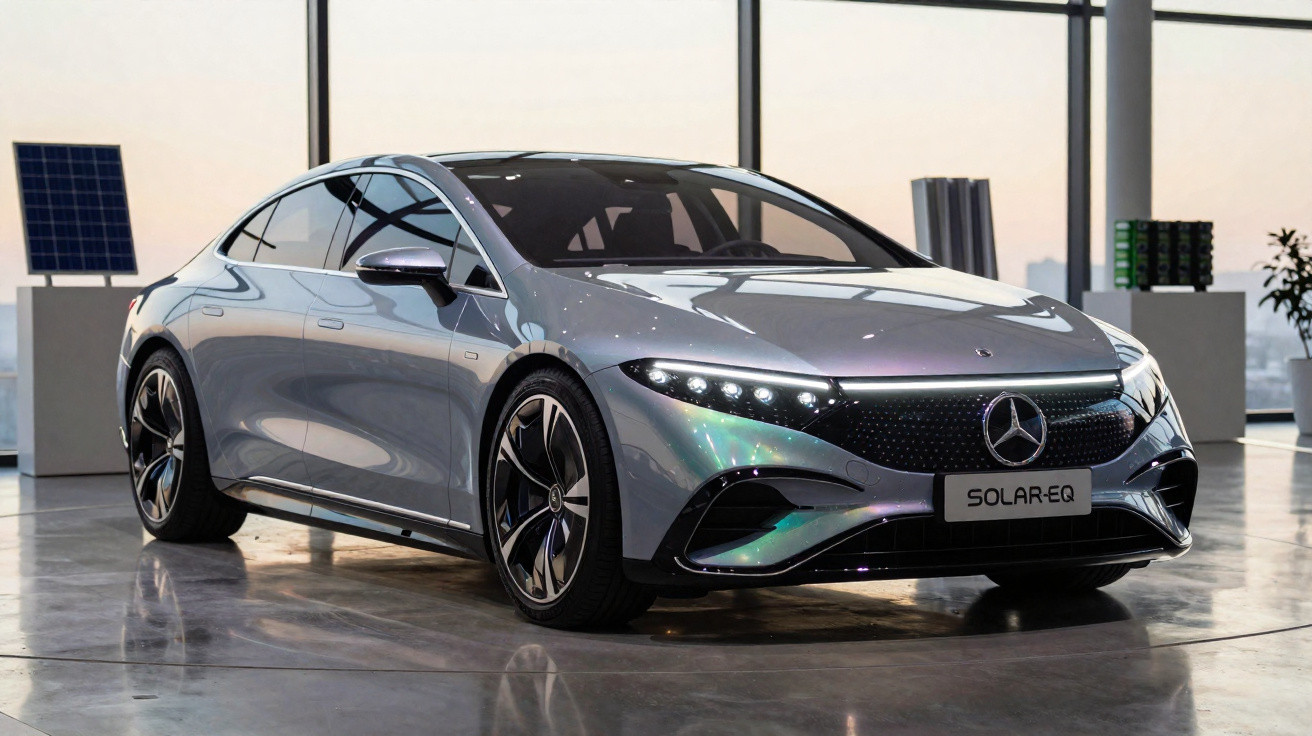
Mercedes-Benz is working on an innovative photovoltaic coating that is applied as part of a car’s paintwork and could change how electric vehicles generate and use energy. Demonstrated on the Vision Iconic prototype, this technology effectively turns the entire body into one large photovoltaic surface, capturing energy and feeding it straight into the battery of the vehicle’s electrical system.
How Mercedes-Benz Solar Paint works
The operating concept mirrors conventional photovoltaic cells, but in a microscopic layer: it is only five micrometres thick. In practical terms, that is about 20 times thinner than a human hair and it weighs just 50 g/m².
Even with such low weight and minimal thickness, Mercedes claims an efficiency above 20%. That is a striking figure for a flexible coating that can be laid onto curved surfaces and used across different materials. The brand has also released a video showing how the system works.
At the heart of Solar Paint is a blend of semiconductor nanoparticles suspended in a transparent binder. These particles absorb photons from sunlight and release electrons, producing an electric current-following the same principle as standard solar panels.
That energy is then carried via microconductors embedded within the paint layers and stored directly in the high-voltage battery, with no need for an additional buffer battery. This technical choice simplifies the architecture and reduces conversion losses.
Light transmission and colour flexibility
A further innovation lies in how light passes through the coating: around 94% of solar energy travels through the pigmented layers before reaching the active photovoltaic layer. This means the technology can be paired with any colour without undermining energy efficiency-so it does not restrict personalisation options, nor does it compromise the durability associated with more conventional finishes.
Real-world results
The technology is still under development, but Mercedes-Benz says that on a vehicle with around 11 m² of usable body surface area, the annual energy gain could equate to roughly 12 000 km of additional range in Stuttgart.
In cities with stronger sunlight, the potential benefit is even greater. For instance, in Beijing the figure could rise to 14 000 km, and in Los Angeles the gain could reach 20 000 km. All of this applies even when the vehicle is switched off, helping to maximise everyday use of available daylight.
Materials, sustainability and end-of-life recycling
The coating is also free of silicon and rare earths-two of the most critical materials in the photovoltaic industry. That improves sustainability and reduces the environmental footprint of manufacturing each vehicle, while also making recycling easier at the end of the vehicle’s life.
Energy efficiency and direct integration with the electrical system
By integrating the system fully into the vehicle’s high-voltage circuit, Mercedes-Benz removes redundant components and limits electrical losses, enabling the sun’s energy to be converted directly into usable power.
This approach can supply both auxiliary systems-such as climate control, sensors, or communications-and the electric motor itself, reducing the amount of energy that has to come from external charging.
With this technology, Mercedes-Benz moves closer to the idea of an energy self-sufficient car by turning sunlight into the “fuel” it needs to get moving-although it does mean leaving the car parked outside and “praying” for plenty of sun.
Comments
No comments yet. Be the first to comment!
Leave a Comment