
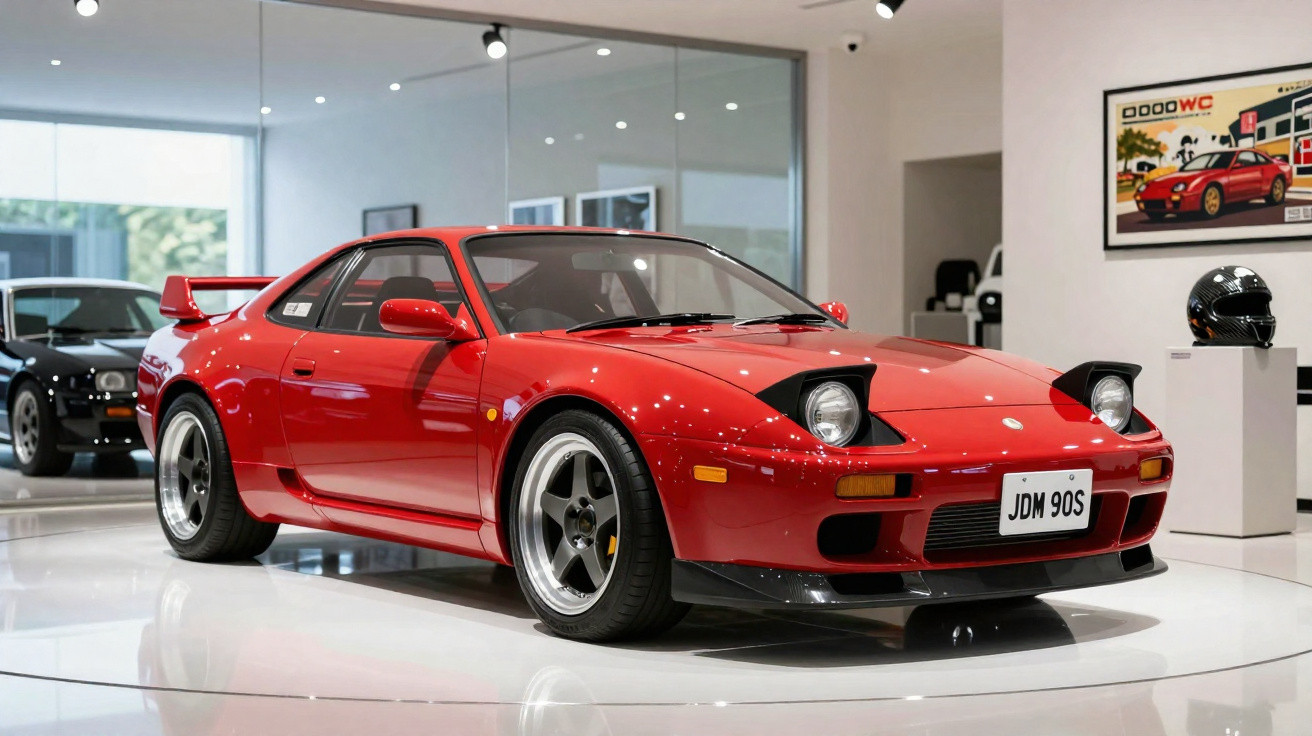
We are winding the clock back once again to revisit 1990s coupés - cars that were dream machines back then and, today, in many cases genuine cult classics. In the first part of this Special we focused on European models, but it is very likely that we have Japanese manufacturers to thank for the sheer number of coupés that existed in the final decade of the last century.
Fuelled by the economic “bubble” Japan experienced throughout the 1980s - until it burst dramatically in 1991 - it felt as though there was budget for anything and everything. Some of the Japanese car industry’s great heavyweights arrived in this period: Nissan Skyline GT-R, Honda NSX, Mazda MX-5, to name just a few.
And it did not stop there, as the coupés we have gathered here show. Some brands could even afford to run several coupés in their line-ups, spanning multiple segments and… budgets. Take Honda as an example: from the more attainable CRX to the anti-Ferrari NSX, via the Civic, Integra and Prelude - and even the Accord had a coupé.
Without further delay, here are the 1990s coupés from Japan.
Legends
The 1990s were a golden era for Japanese manufacturers in rallying (and beyond). It was the decade when we first saw a Japanese car win a world title in the WRC. It was also the decade of the epic Mitsubishi–Subaru rivalry (a duel that spilled onto the road). And it was the decade that created some of the biggest Japanese automotive legends - still resonating strongly with enthusiasts today thanks to what they achieved in rallying.
That is exactly the case with this opening pair of 1990s coupés: TOYOTA CELICA (1989-1993 and 1993-1999) and SUBARU IMPREZA (1995-2000).
Launched in 1989, the Toyota Celica (T180) was already the fifth generation of the Japanese coupé. The Celica’s status and visibility grew substantially thanks to its achievements in the World Rally Championship (WRC) with the previous generation. But it would be the T180 - or more precisely the ST185 (Celica GT-Four models, which formed the basis for the competition car, used their own code) - that would turn Toyota into a dominant force in the WRC.
It was with the Celica that Toyota managed it, too: it became the first Japanese model to win world titles in the WRC. A topic we have already explored in greater depth:
Despite its enormous competition success, the Celica T180’s road-car run was relatively short, lasting only four years. In autumn 1993, Toyota unveiled the sixth-generation Celica, the T200 - and, naturally, the GT-Four (ST205), which would be the most powerful Celica of all. It delivered 242 cv from the 3S-GTE: an in-line four-cylinder, 2,0 l, turbocharged unit - always with a manual gearbox and always with four-wheel drive.
Even so, it did not replicate its predecessor’s WRC glory. The Celica T200 stood out more for its much more aggressive styling, especially at the front, defined by four circular headlamps. It was a serious rival to Europe’s front-wheel-drive coupés, such as the Fiat Coupé or the Opel Calibra.
If the Celica reached high levels of acclaim thanks to the WRC, what can we say about the Subaru Impreza, one of the most revered Japanese models of all time?
The Impreza coupé did not appear until 1995, three years after the saloon and the unusual estate (not everyone even viewed it as one). The two-door bodyshell only made it into the WRC in 1997 (by which time the Impreza had already secured two manufacturers’ titles), taking advantage of the introduction of the WRC specification that replaced Group A regulations. And… it worked, giving Subaru its third (and final) manufacturers’ title.
To reflect that success - and also the brand’s 40th anniversary - Subaru released the Impreza 22B, one of the high points in the entire Impreza story. Limited to just over 400 units, it had a more muscular look (80 mm wider) than the WRX and WRX STi; the turbocharged four-cylinder boxer grew from 2,0 to 2,2 l (280 cv officially); the wheels increased from 16″ to 17″; and the overall outfit looked as though it had come straight from the competition Impreza WRC. Even today, it remains one of the most revered Imprezas.
Japanese alternatives
Japanese coupés were not only those that thrived in the harsh world of rallying. Just like European 1990s coupés, the Japanese offerings came in huge variety - as the next trio demonstrates: HONDA PRELUDE (1992-1996 and 1996-2002), MITSUBISHI ECLIPSE (1990-1995 and 1995-2000) and MAZDA MX-6 (1991-1997).
We will start with the model that was born a coupé and now lends its name to an SUV/crossover: the Mitsubishi Eclipse. It arrived in 1990 following a joint venture with Chrysler - a partnership that also created its “siblings”, the Plymouth Laser and Eagle Talon. With its sleek shape, the Eclipse reached Europe as an alternative to the Celica.
In Europe we only received the first two generations (D20 and D30), each with a lifespan of just five years. In North America, however, its career continued for two more generations. It was always a front-wheel-drive car, although the more powerful versions, using a turbocharged version of the 4G63 (4G63T), could be fitted with four-wheel drive.
4G63 sounds familiar? No surprise: it is the same engine that powered the Mitsubishi Evolution… and the L200! It really was used for everything.
Beyond its stylised bodywork (more linear in the first generation; more bio-design in the second) and the performance of the turbo versions, the Eclipse was not the sharpest-driving coupé out there - but that did not stop it building a loyal following. Its “15 minutes of fame” arrived with the first film in The Fast and the Furious franchise.
Honda also offered two generations during the 1990s (the 4th and 5th) of the Honda Prelude, positioned somewhere between the Civic Coupé and the super-NSX. Technically closer to the Accord, Honda hoped the Prelude could tempt customers away from the BMW 3 Series Coupé.
Even with Honda in strong form at the start of the 1990s - unbeatable in Formula 1, the NSX earning the anti-Ferrari label, VTEC engines screaming louder than the rest, and so on - the Prelude always seemed to sit slightly outside mainstream consumer preferences.
It is a shame, because it had plenty going for it and remains one of the most under-appreciated coupés of the era. Top versions came with a potent 2.2 VTEC (between 185 and 200 cv) and four-wheel steering, plus an exceptionally capable dynamic package across the board. Were its bold lines what held it back? Who knows…
The Mazda MX-6 also drew attention first and foremost through its styling. For all intents and purposes it was the coupé version of the contemporary Mazda 626, making it another front-wheel-drive car. Often described as very elegant, its flowing shape would only be surpassed by the Peugeot 406 Coupé - launched the same year the MX-6 bowed out.
More of a GT than an outright sports coupé, even when fitted with the most powerful 2.5 V6 and approximately 170 cv, the MX-6 still did not disappoint in terms of road manners.
However, it too passed many buyers by in Europe, including those who also overlooked its “brother”, the Ford Probe - which shared everything with the MX-6 apart from the styling, which was also decidedly futuristic. Mazda and Ford were closely linked in this period, which explains just how related the two models were. The Probe was Ford’s attempt to create a successor to the successful Capri, but the European market largely ignored it. Even so, it attracted more fans than its own successor, the Cougar, which we discussed in the first part of this 1990s coupé round-up.
The most radical
If we can label the previous trio as everyday-friendly coupés where styling was a major selling point, the HONDA INTEGRA TYPE R DC2 (1993-2001) added a predatory edge to the look. Closely related in engineering terms to the Civic, the Integra was in fact a family of models that also included a four-door variant.
Its legendary status, however, came from the coupé - specifically the Type R version, which reached us in 1998. Even now, many consider it the best front-wheel-drive car of all time, such was Honda’s engineers’ single-minded focus on extracting every last bit of potential from the model. We have already looked at this fantastic car in more detail, a truly unique proposition among 1990s coupés:
(Perhaps) unique
Last but not least… In any list of 1990s coupés it is impossible not to mention the one that may be the only car here conceived from the outset as a sports coupé, with its own dedicated base - rather than being derived from something more family-focused or everyday, such as doing the school run or the weekly shop.
The NISSAN 180SX (1989-1993) and NISSAN 200SX (1993-1998) had the right foundations for a proper sports car: a front-mounted longitudinal engine, rear-wheel drive and… two rear seats that were good for little more than carrying extra bags. Yes, the BMW 3 Series and Mercedes-Benz CLK share the same layout (and offer usable space for people in the back), but they were coupé derivatives of four-door saloons. These Nissan coupés were not.
Whether S13 or S14, they stood apart from rivals through rear-wheel drive and their well-honed handling. The 180 SX (S13), with pop-up headlamps, was sold in Europe with a 1.8 Turbo producing 180 cv. Its successor, the 200SX (S14), gained a new 2.0 l turbo engine, the SR20DET, with 200 cv. Their reputation and capability endured well beyond their showroom years.
In the finest Japanese tradition, fans modified them down to the last detail - finding an unmodified example is now close to impossible - and their layout makes them a regular sight in drift events.
I do not think we could have ended this reunion with 1990s coupés in a better way.
Comments
No comments yet. Be the first to comment!
Leave a Comment