
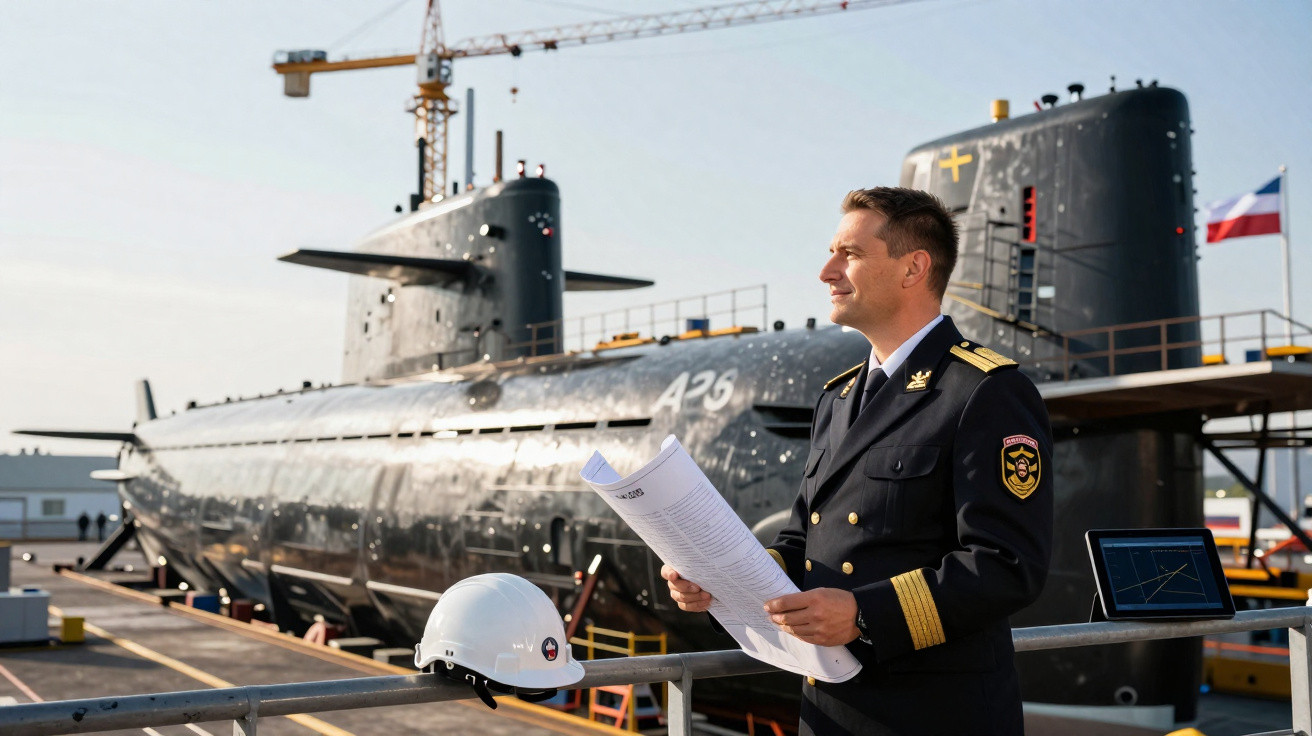
Poland’s government has chosen the bid submitted by Saab under the ORKA Programme, backed by the Swedish government, to provide the Polish Navy with three new A26 attack submarines. The move is intended to replace ORP Orzeł, the only Kilo-class submarine currently operating within Poland’s submarine force.
Saab stated that its package centres on new conventionally powered A26 submarines-already being built for the Swedish Navy-fitted with state-of-the-art technology, alongside offset options based on industrial collaboration and technology transfer. Saab has not yet signed any contracts or received formal orders; however, it will begin negotiations with Poland’s Armament Agency to take forward the decision that has now been announced.
“We are honoured to have been selected and look forward to the upcoming negotiations with the Armament Agency in Poland. The Swedish offer, with submarines designed for the Baltic Sea, is the right choice for the Polish people. It will significantly enhance the operational capability of the Polish Navy and benefit the Polish economy”, said Micael Johansson, Saab’s President and CEO.
The company will work alongside the Swedish Defence Materiel Administration (FMV) during the next stages of the procurement process, in coordination with the Polish authorities.
Statement from the Polish government
Poland’s Deputy Prime Minister and Minister of National Defence, Władysław Kosiniak-Kamysz, confirmed the selection of the A26 in an official statement, saying: “A crucial day for Poland’s security and for our Navy. Poland will buy three submarines from Sweden. This decision establishes a new security architecture in the Baltic Sea”. He also highlighted that the contract will create new opportunities for the country’s economy and defence industry, adding: “The ORKA programme has been a priority for our government from the beginning. We are keeping our word”.
The state of the Polish Navy’s submarine “fleet”
After the retirement of the Norwegian-origin Kobben-class submarines, the Polish Navy operates only ORP Orzeł, a Kilo-class boat in service since 1986. The submarine returned to service in 2024 following an extended period of inspections, repairs and maintenance that began in 2014. While in the Gdynia shipyard, structural damage was identified that required hull plate replacement and other work. The vessel also suffered a fire in 2017 during battery unloading, which delayed its handover back to the Polish Navy.
In its official notice marking the return to service, the Navy reported that ORP Orzeł “carried out underwater trials at periscope depth, full dives to various depths and navigation at snorkel depth”.
Even so, repeated issues meant that modernisation plans for the submarine-covering integration of the SUBTICS system, new periscopes, an upgraded sonar and F-21 torpedoes-were cancelled, leaving the ORKA Programme as the primary route to rebuild Poland’s submarine capability.
International competition for the ORKA Programme
In recent years, multiple international firms sought to position themselves as alternatives to supply the Polish Navy with a new generation of conventionally powered submarines. In September 2025, France’s Naval Group and Poland’s PGZ reached industrial cooperation agreements-including technology transfer, local production and engineering support-to promote the Scorpène-class submarines as a solution for renewing Poland’s fleet.
The strengths of the Scorpène family rest on options to be fitted with air-independent propulsion (AIP), the SUBTICS combat system, and the ability to launch torpedoes and missiles. The proposal also included the possibility of construction in Polish shipyards.
In parallel, South Korea’s Hanwha Defense also attempted to advance its new KSS-III Batch II submarines, at a time when South Korea had become a relevant partner for Poland in land and air procurements. However, progress in the naval sphere moved at a different pace, and no agreements were concluded in the submarine domain.
Next steps
With the A26 selected, Poland will move into a new negotiating phase to settle technical specifications, timelines and industrial cooperation arrangements. The stated aim is to bring in three attack submarines with AIP technology, modern combat systems and missile-launch capability, underpinning a structural shift in the country’s naval defence.
Images for illustrative purposes.






Comments
No comments yet. Be the first to comment!
Leave a Comment