
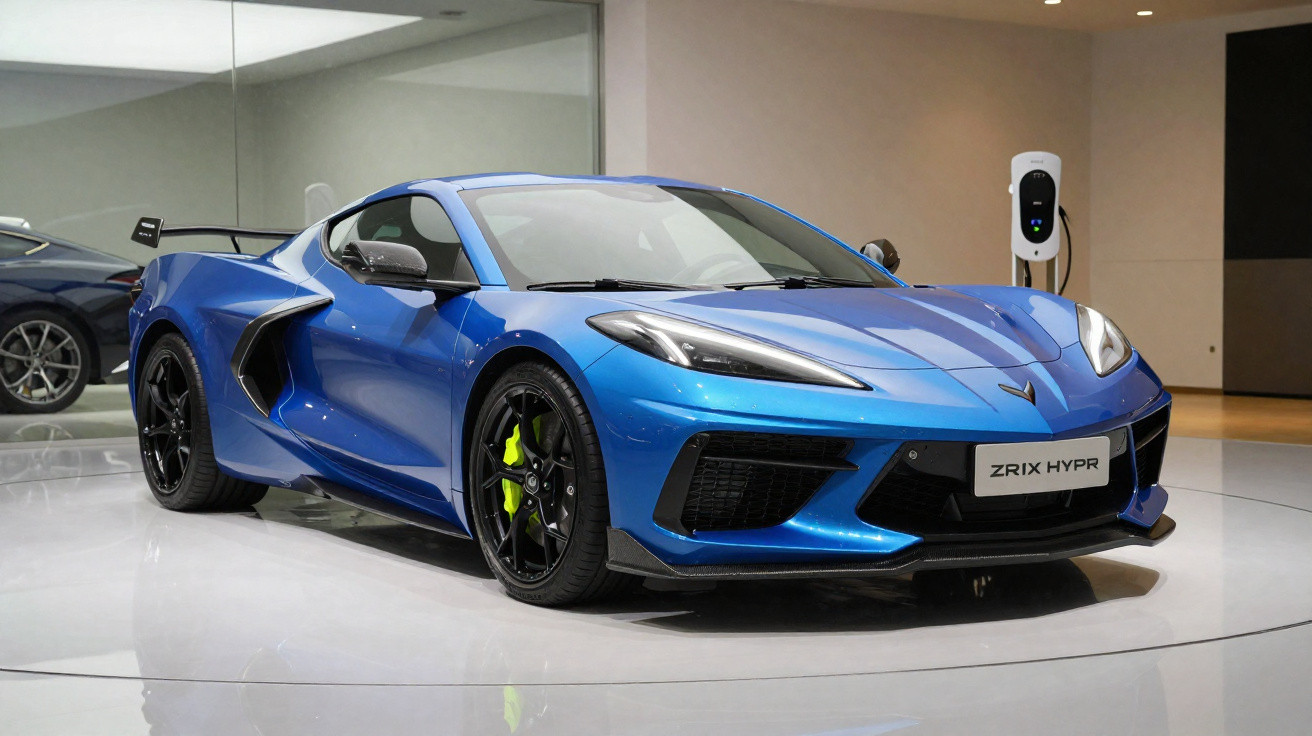
The Corvette is one of the best-known sports cars on the planet, with its story beginning back in the 1950s.
With the eighth generation, the Corvette shifted into supercar territory by adopting a rear mid‑engine layout. Now, with the Corvette ZR1X, Chevrolet claims it has built a “true American hypercar”.
Chevrolet Corvette ZR1X power and performance figures
The Chevrolet Corvette ZR1X becomes the most powerful version in this model’s history, quoting 1267 cv (1250 hp) of maximum combined output. It is “combined” because the ZR1X is a hybrid.
Chevrolet’s starting point was the ZR1, which uses a 5.5‑litre twin‑turbo V8. To that, it adds an electrified front axle (carried over from the E‑Ray, the hybrid Corvette), featuring a 138 kW (188 cv) electric motor and 197 Nm of torque.
The V8 uses two 76 mm turbochargers to reach 1078 cv at 7000 rpm and produce 1123 Nm from 6000 rpm. With assistance from the electrified front axle, peak combined output rises to 1267 cv.
With four-wheel drive and a seven-speed dual-clutch gearbox, the brand states it can sprint from 0 to 96 km/h (60 mph) in under two seconds.
In the quarter mile (402 metres) - a favourite benchmark in the US - it is said to run in under nine seconds, with the Corvette ZR1X exceeding 240 km/h. Because the electric portion of the powertrain only delivers power up to 160 mph (257 km/h), the top speed should match the ZR1’s, at 375 km/h.
Competition-inspired hybrid system
As mentioned, the ZR1 underpins the Corvette ZR1X, but the electrified hardware required the fitment of a 1.9 kWh battery (the same as the E‑Ray), mounted centrally. It also brings a dedicated energy-management system that can tailor power delivery across three separate modes: Endurance, Qualifying and Push-to-Pass.
It also debuts PTM Pro, which switches off all driving aids while keeping regenerative braking active on the front wheels and maintaining traction control under acceleration, aimed at extracting maximum circuit performance. Thanks to this approach, the hybrid system does not need to be plug-in, relying instead on energy recovery during deceleration and braking.
Brakes, body styles and ZTK Performance package
On the braking side, the Corvette ZR1X comes with an Alcon braking system that includes the largest carbon-ceramic discs ever fitted to a Corvette: 419 mm in diameter. These are clamped by 10‑piston front callipers and six‑piston rear callipers.
Chevrolet says the setup can generate 1.9 G of deceleration between 290 km/h and 190 km/h.
Buyers will be able to choose between two ZR1X versions: a coupé and a convertible with a hardtop. Optionally, the ZTK Performance package can be specified, bringing stiffer suspension and semi-slick tyres - Michelin Pilot Cup 2R rather than the more road-focused Pilot Sport 4S.
The Corvette ZR1X can also be made more aggressive visually with a set of carbon-fibre aerodynamic components, highlighted by the huge rear wing. Together, these pieces can generate more than half a tonne of downforce at the ZR1X’s top speed, and they are included with the ZTK Performance package.
The cheapest hypercar in the world
Production of the Chevrolet Corvette ZR1X begins later this year, and the first cars could be delivered before the year ends.
Chevrolet has not yet confirmed pricing, but US media are pointing to a base price of around 200 thousand dollars, roughly 175 thousand euros.
That would make it a “bargain” compared with the hypercars Chevrolet is measuring itself against. And unlike those rivals, it will not be a limited-run model.


Comments
No comments yet. Be the first to comment!
Leave a Comment