
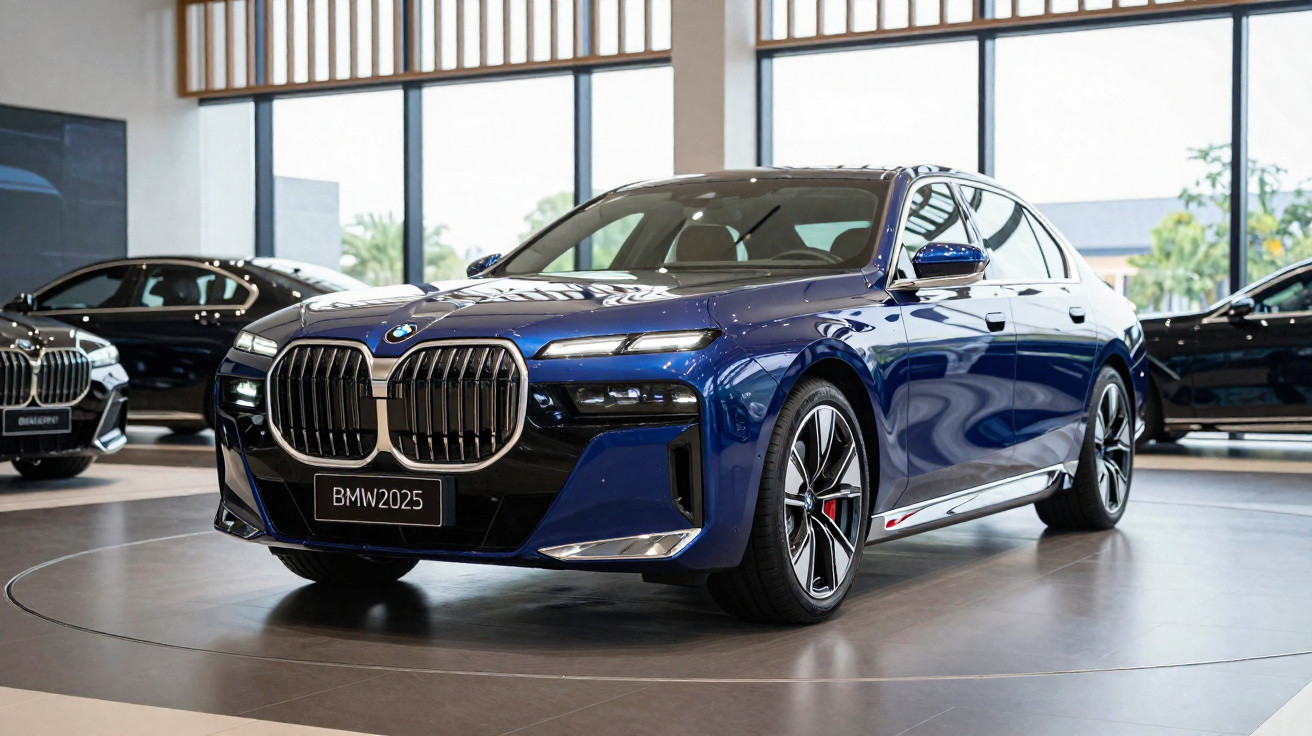
BMW Group’s 2025 results in a tougher global market
2025 proved a demanding year for many carmakers, shaped by worldwide pressures ranging from geopolitical and trade tensions to intensifying competition from new entrants out of China. The BMW Group (BMW, MINI and Rolls‑Royce) managed these choppy conditions more effectively than many peers, and still finished 2025 with resilient overall results.
Even so, it did slip back compared with 2024-yet the decline was notably smaller than that seen at rival Mercedes‑Benz or fellow German brand Porsche.
Group revenue fell by 6.3% versus 2024, reaching €133.45 billion. The drop in profit was smaller: the BMW Group posted net profit of €7.45 billion, down 3% year on year.
Operating margin, however, held steady at 7.7%. This can be explained in part by a €2.5 billion reduction in expenditure tied to research, development and production, alongside other administrative costs.
The company also pointed to several pressures on performance, including a 12.5% sales decline in China, the impact of additional US tariffs, and currency volatility-most notably against the dollar, the won (South Korean currency) and the renminbi (Chinese currency).
Despite those headwinds, the BMW Group increased sales in Europe and the Americas by 7.3% and 5.6%, respectively. That helped offset the loss in China, leaving 2025 with a marginal overall sales rise of 0.5%, to 2 463 681 units.
Electrification boosted BMW Group sales
The BMW Group has been among the most outspoken supporters of keeping internal combustion engines, yet it has also-somewhat ironically-been able to sell more electric vehicles than its usual rivals, Mercedes‑Benz and Audi. In 2025, the BMW Group’s battery‑electric deliveries climbed again, up 3.6% to 442 056 units, accounting for 17.9% of the group’s total sales. Mercedes, for instance, saw its electric sales fall.
Including plug‑in hybrids as well, the group delivered 642 071 electrified vehicles-meaning one in every four vehicles sold was electrified. In Europe, the figure was even stronger: 40% of sales on the “old continent” were electric vehicles and plug‑in hybrids.
Brand-by-brand highlights: BMW, MINI and Rolls‑Royce
Looking at the brands individually, within BMW the 5 Series was one of the key drivers of growth, recording an increase of more than 25% compared with 2024, alongside the X2, whose sales rose by 33%.
For MINI, total sales reached 288 279 units (+17.7%), with the Countryman finishing as the brand’s best‑selling model last year. At the top end of the range, Rolls‑Royce remained broadly stable, delivering 5664 units, a slight decline of 0.8%; the most in-demand models were the Cullinan and the fully electric Spectre.
20 electric models by the end of 2026
In 2026, the BMW Group is preparing to strengthen its push into electrification. According to Oliver Zipse, the group’s Chief Executive, “by the end of the year we will offer 20 fully electric models”. Of these, the largest share will come from BMW, which will be part of the new Neue Klasse model family.
The starting point was the iX3, but this programme will also include a further 39 new and updated models due to reach the market by the end of 2027. Next up is the new BMW i3-the first electric 3 Series.
Zipse says that “with our broad range of electrified vehicles, we are ensuring a strong competitive position. We will maintain the pace of innovation as we introduce Neue Klasse technologies across our entire portfolio”.
Alongside new model launches, the group remains focused on cutting costs. It continues to expect a year with challenging conditions-tariffs and raw-materials impacts, as well as a cooling used-car market-but is forecasting stable global sales. It also expects to keep the same share of electric vehicles in total sales as it achieved in 2025.

Comments
No comments yet. Be the first to comment!
Leave a Comment