
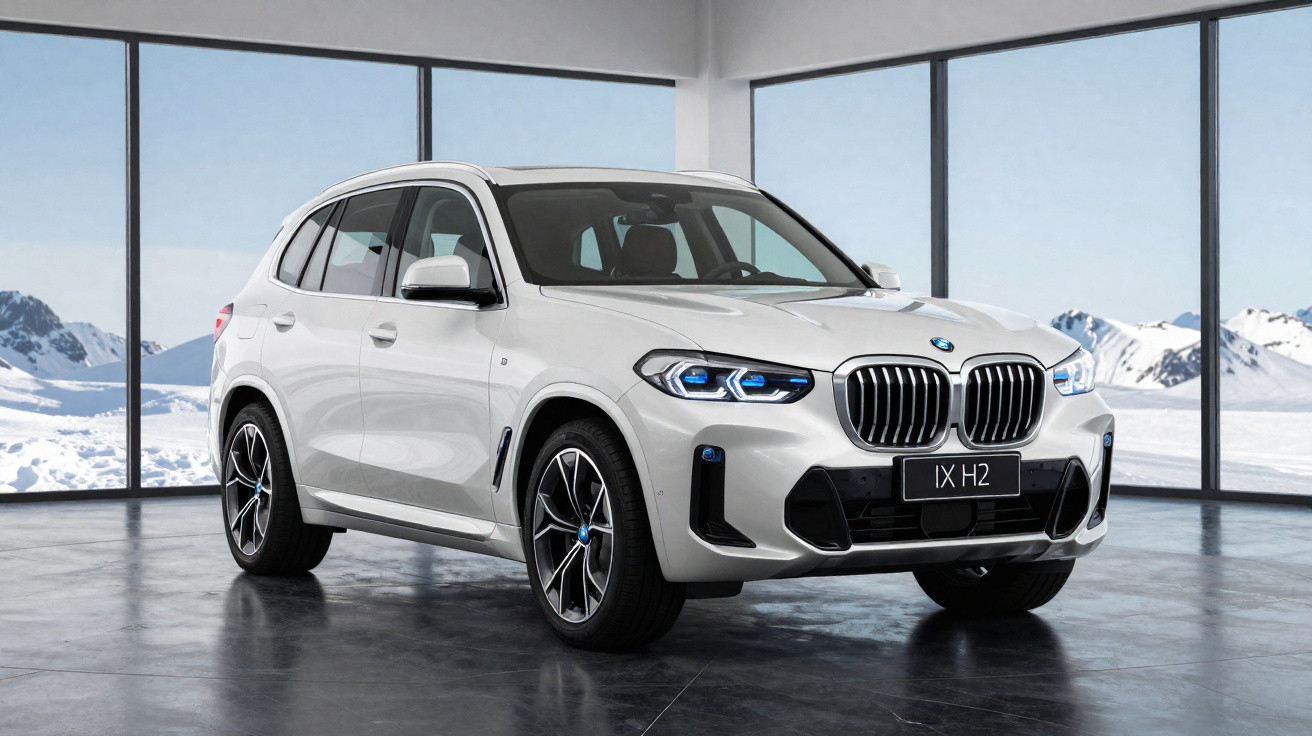
BMW is once again taking a serious look at hydrogen as a route to cleaner car mobility. We drove a prototype of the iX5 Hydrogen on public roads close to the Arctic Circle, and came away genuinely impressed by the way this SUV behaves. A first small production run is scheduled before the end of the year.
Our drive took place at the BMW Group’s winter proving ground, a 28-hectare facility built for the kind of testing where true chassis balance and drivability are quickly exposed.
That is especially the case here because several sections of the route run across a frozen lake-one of almost 9,000 in this part of the world-near Arjeplog in northern Sweden, around 55 km south-west of the Arctic Circle.
The Munich-built SUV never hesitates: it copes with the most awkward surfaces with a mild rear slide that remains easy to manage, helped by proper winter tyres that deliver the traction and grip required.
Switching into B mode also proves valuable, making it easier to tighten the line and reduce any excessive “loose rear end” sensations in this rear-wheel-drive electric SUV.
Before we continue to dissect the BMW iX5 Hydrogen’s road manners, it is worth setting the scene.
Looks can be deceiving…
Aside from various extra components in the cabin, everything feels remarkably familiar-even though there is very little “normal” about this X5. This is a prototype called the iX5 Hydrogen: a hydrogen fuel-cell electric vehicle (FCEV) first shown to the public at the Frankfurt Motor Show in 2019.
From behind the wheel, the differences versus the iX-BMW’s other large electric SUV-are hard to spot, as the iX5 feels just as untroubled on the ice as it does on snow-covered roads.
It achieves this without the usual drawback of dramatically reduced range in sub-zero temperatures or when the climate control is running continuously.
The iX, the iX5 Hydrogen and the X5 plug-in hybrid (PHEV)-the model that provided the technical basis for this prototype-all tip the scales at the same 2.5 tonnes. That mass also helps explain why the BMW iX5 Hydrogen can feel slightly restrained in Comfort mode (where the steering also comes across as a touch vague).
What feels straightforward from the driver’s seat is anything but. Countless components must be matched precisely if the end result is to feel coherent and capable.
With the BMW iX5 Hydrogen, Bavarian engineers are exploring fresh approaches on several fronts. Their target is particularly ambitious: a fuel-cell passenger car with a peak output of 275 kW (374 hp), which would make it the most powerful fuel-cell system ever fitted to a light passenger vehicle. Continuous power, however, is far lower at 125 kW or 170 hp.
To make that level of performance possible, an electric turbocharger handles the supply of pressurised oxygen, enabling hydrogen to react with oxygen and generate electricity. One of the major hurdles is ensuring that “the fuel cell works immediately”, explains technician Robert Halas.
3 to 4 minutes for 500–600 km
The core of the fuel-cell system sits in the engine bay. It is roughly the size of a three-cylinder combustion engine and weighs about 180 kg.
Two carbon-fibre tanks store hydrogen at 700 bar. They are positioned under the rear seat and along the central tunnel (the transmission tunnel in a combustion X5) in a T-shaped layout. Together they hold 6 kg of hydrogen, enabling a range of 500 km to 600 km, with a full refill at an H2 station taking just three to four minutes.
The most powerful hydrogen fuel-cell system
At BMW, driving dynamics remain non-negotiable. That is why a 150 kW high-voltage battery with a 2.3 kWh capacity is installed beneath the boot floor. It acts as an energy buffer to lift system output to 275 kW (374 hp) for a limited time when extra performance is required-or simply desired. Press the Sport mode button and enjoy it… while it lasts.
Drive comes from BMW’s fifth-generation electric motor, which powers the rear axle. Running solely on the battery, the hydrogen fuel-cell iX5 can cover 10 km to 15 km. The notable trait of this battery is how quickly it can both deliver power and accept charge, with the cells replenishing at the same rapid pace.
The iX5 Hydrogen reaches 100 km/h in under seven seconds and can then continue to a top speed of 190 km/h. To keep that surge consistently available, the fuel-cell system maintains the high-voltage battery so its state of charge stays between 60% and 80%.
Beyond that, the BMW iX5 Hydrogen carries no practical penalties: the boot is as spacious as in the X5 xDrive45e plug-in hybrid, and the air-suspension chassis provides more than enough comfort.
Juergen Gueldner, Vice President BMW Hydrogen Fuel Cell Technology and Vehicle Projects, points to a particular source of pride: “it is the fact that the fuel cell responds to accelerator pedal inputs without any delay”.
This marks BMW’s second attempt at developing an FCEV, following the 5 Series Gran Turismo project in 2015, which also represented the first collaboration with Toyota in this area.
Compared with that earlier programme, the German–Japanese partnership has significantly increased energy density in this iX5 Hydrogen. Toyota cells are combined with a fuel-cell module and software supplied by BMW.
A further boost to the experimental drivetrain comes from the latest, fifth generation of BMW’s eDrive system, which underpins the concept.
The key distinction is that, instead of drawing energy from a high-voltage battery system as the iX does, electricity is produced by cells that convert compressed hydrogen into electrical power (with a converter then adjusting voltage so it can be used by the electric motor).
A matter of chemistry
The chemistry brings hydrogen and oxygen atoms together, yet simply filling a container with those gases will not result in water forming on its own. That only happens when hydrogen and oxygen molecules are excited-sped up so they collide with greater energy-allowing water to be created.
Setting hydrogen fuel-cell EVs (FCEVs) alongside battery EVs (BEVs) and combustion-engined vehicles helps clarify why the technology has not yet become the dominant answer to the much-coveted carbon-neutral future-the holy grail of the third millennium.
Although hydrogen’s energy density per kilogram is roughly three times that of petrol, it is the lightest element, so it must be heavily compressed to achieve useful density (and even then it still falls well short of petrol’s energy density).
That is why hydrogen is not an ideal route for internal-combustion engines, which are less efficient than electric motors. Against a battery-electric vehicle, however, fuel-cell systems have clear strengths because they can supply adequate quantities of electricity.
Even when nearly empty, a fuel-cell module continues to generate high voltage-unlike batteries. This is why battery management is so critical, and why preventing the charge level from falling below a defined threshold is absolutely vital for both service life and overall operation.
Small-series production this year
Anyone assuming the BMW iX5 Hydrogen is merely a playful engineering exercise is mistaken.
By the end of the year, BMW plans to build a small series of this hydrogen fuel-cell SUV. By the end of the decade, the expectation is that fuel-cell versions will cost about the same as equivalent battery-electric models, while being 100 kg lighter and offering comparable range.
A few months later, an all-wheel-drive iX5 Hydrogen is also planned, adding a second electric motor on the front axle, mounted beneath the fuel-cell module.
Under BMW’s strategy, battery-electric and fuel-cell vehicles should share the same platforms, because those synergies keep costs under control. A car’s fuel cell is not fundamentally different from a truck’s, platinum content is being reduced step by step, and the material is sourced by recycling catalytic converters from internal-combustion vehicles.
Infrastructure expansion
Coexistence between hydrogen and battery-electric mobility also appears realistic. According to the Hydrogen Council study “Roadmap to zero Emissions”, the CO₂ balance of battery EVs and fuel-cell EVs is not dramatically different when the full lifecycle is considered.
What is more, battery EVs require electricity to be generated close to the grid, whereas hydrogen can be moved over long distances by ship or pipeline.
The United Arab Emirates has been exploring the use of solar power to produce green hydrogen for some time, and has established a working group with Germany.
Whether generated from solar or wind, hydrogen’s major advantage is that it can be used not only as a “fuel”, but also as stored energy.
On one hand, the extensive existing pipeline network should make it possible to allocate certain sections to hydrogen. On the other, companies such as Linde Engineering are investigating how to send both gases through the same pipes and then separate them at the destination using membranes. A first pilot plant has already been opened in Dormagen, Germany.
BMW supports AFIR (the Alternative Fuels Infrastructure Regulation), which is intended to ensure the hydrogen refuelling network becomes widespread enough that the distance between stations along key traffic corridors is no more than 150 km.
Even that does not go far enough for the Munich brand: if BMW gets its way, those gaps should be cut to under 100 km by 2027.


Comments
No comments yet. Be the first to comment!
Leave a Comment