
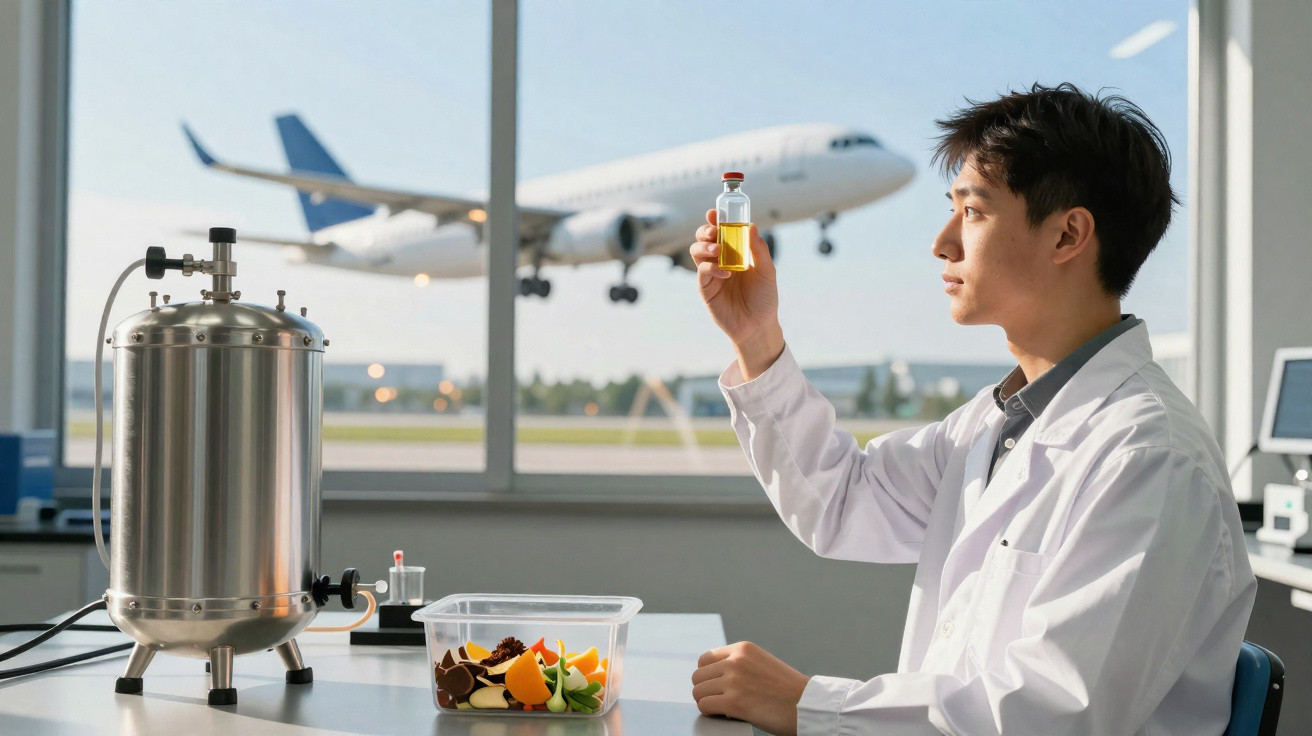
Flying an airliner on organic waste? US researchers have now shown that, at least in theory, it can be done - and that the resulting fuel can meet aviation’s existing standards.
Civil aviation is hardly a model pupil on environmental performance. Globally, the sector accounts for a meaningful share of greenhouse-gas emissions (“around 2%” of CO₂, according to the Air Transport Action Group). For several years, a wave of efforts has aimed to make commercial aviation cleaner: hydrogen propulsion, adjusting flight paths to limit contrails, and synthetic fuels such as HEFA.
So far, none of these approaches has managed to balance profitability with energy performance, and the industry is still looking for the right formula. That is why the work led by engineers at the University of Illinois at Urbana–Champaign is attracting attention: they have demonstrated a way to convert food waste into a genuine aviation fuel. Their study, published on 30 October in Nature Communications, puts forward a proposal that is new in the history of civil aviation.
Our bins: tomorrow’s kerosene?
For Yuanhui Zhang, an engineer at the University of Illinois and the study’s lead author, the aim was less about inventing a “miracle fuel” than proving that organic matter could, chemically, compete with fossil kerosene. “In a linear economy, we produce, we consume, then we throw away. In this project, we recover energy and materials to create a useful product,” he explains.
What he calls the “missing link of the circular paradigm” builds on a well-established principle widely used in fields such as geochemistry: hydrothermal liquefaction (HTL). In just a few hours, this process mimics what the Earth takes millions of years to do - turning organic material into crude oil.
From food waste to biocrude: the HTL route
To achieve this, the researchers gathered food-production residues from agri-food factories and then subjected the material to extreme temperature and pressure. The outcome was a biological crude oil - a blend of oils, water and carbon-based compounds - which still requires refining.
Catalytic upgrading into aviation-grade bio-kerosene
Once this oil had been produced, the team refined it using catalytic processing (hydrotreating) with cobalt and molybdenum - two metals used in the petroleum industry to remove impurities. This stage strips out water, salts and ash, as well as unwanted atoms such as sulphur, nitrogen and oxygen that would otherwise compromise combustion. The end product is a bio-based kerosene that is indistinguishable from the conventional kerosene used in aviation.
Is aviation ready to move beyond oil?
This kerosene also complies with all standards set by the sector’s two key watchdogs: the American Society for Testing and Materials (ASTM) and the Federal Aviation Administration (FAA). The achievement is worth underlining: few bio-based fuels satisfy the combined requirements of both bodies straight away, given that they enforce some of the world’s most demanding evaluation protocols.
The next - and far more difficult - issue is industrial viability. Producing a few dozen litres of biofuel in a laboratory is one thing; supplying entire commercial fleets is another. Even if the kerosene developed by these engineers works, integrating it into a heavily regulated industry will not be straightforward. Aviation operates under strict certification and reliability rules and is arguably the least experimental-friendly environment.
“Our job is to solve the scientific and engineering problems. It’s up to industry to take over,” Zhang says. Scientific progress on its own will not keep jet engines running; it must be matched by sufficient capital and at least a baseline willingness from industrial players.
That means time, investment and industrial commitment will be needed for Zhang’s team’s work to find real-world use one day. It would be a shame for this kerosene to remain a prototype, especially given that sustainable aviation fuels (SAF) of this kind have already shown their potential. If deployed widely, they could cut the carbon footprint of flights by up to 80% while remaining compatible with existing engines and supply chains. If airlines intend to keep their aircraft flying over the coming decades, they will have no real alternative: they will have to learn to do without oil, whether they like it or not.






Comments
No comments yet. Be the first to comment!
Leave a Comment