
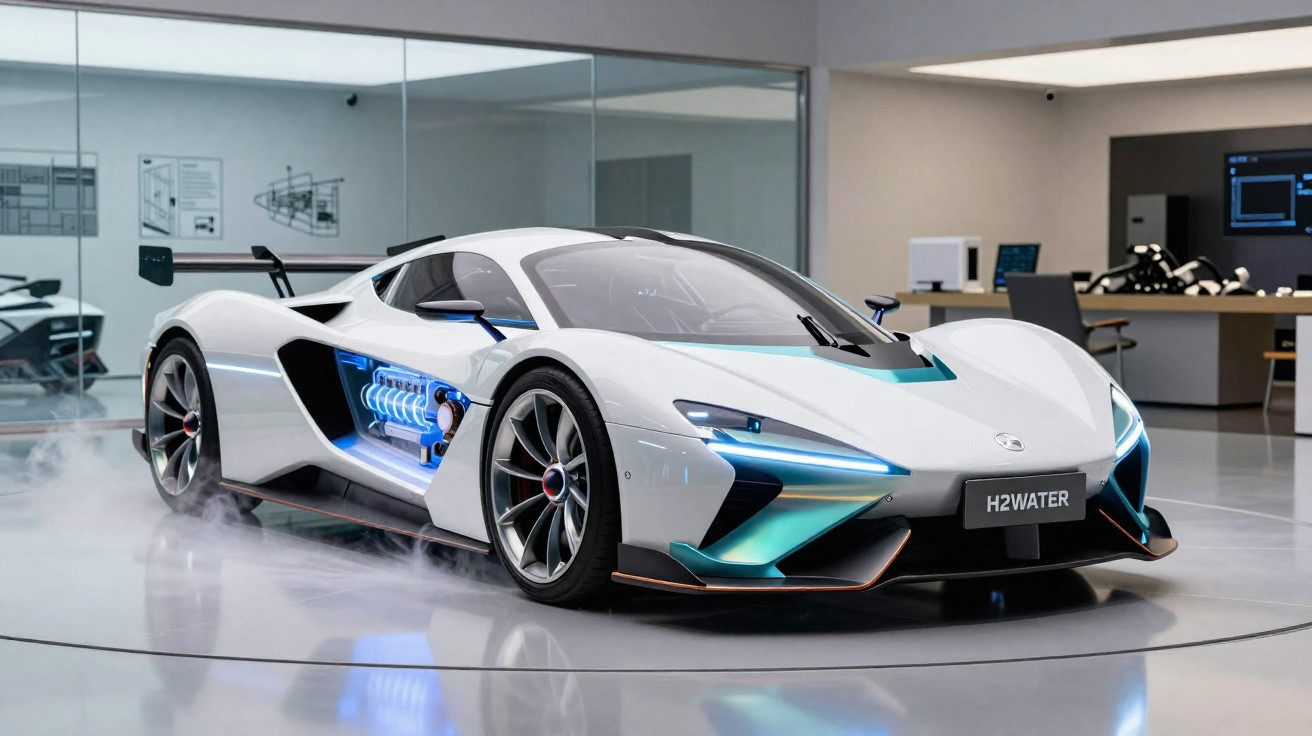
A motorsport supplier has unveiled a combustion engine that runs largely on hydrogen while deliberately injecting water into the combustion chamber. The idea is designed to deliver strong pull yet operate almost climate-neutrally. It raises an uncomfortable question for the industry: have car makers committed too early to the battery-electric route alone?
What’s really behind the “engine with water”
Despite headlines about an “engine that runs on water”, this is, strictly speaking, a hydrogen combustion engine that uses water only as a supporting measure. The developer is AVL Racetech, the motorsport-focused division of Austrian powertrain heavyweight AVL.
The unit produces around 400 horsepower and revs to as much as 6,500 rpm. That puts it in the territory of powerful petrol engines in the performance and luxury segments - but without burning petrol or diesel.
"The engine uses hydrogen as fuel and employs warm water to tame combustion and make it more efficient."
Hydrogen enters the cylinders much like it would in a conventional internal combustion engine, where it mixes with air. On top of that, the system injects hot water. Together, this pairing is intended to tackle several technical hurdles that have held back hydrogen-only combustion engines to date.
How water injection works
Water in an engine sounds like a recipe for catastrophic damage. With AVL’s concept, the opposite is the point: the engineers add controlled, small quantities of heated water, finely atomised and delivered directly into the combustion chamber.
Greater control over combustion
Hydrogen ignites readily and can be prone to pre-ignition and knock. Water injection effectively acts as a temperature manager inside the cylinder:
- Lower temperature: As the water evaporates, it absorbs heat and slightly cools the combustion chamber.
- More even burn: The flame front spreads in a more controlled manner, and the pressure rise becomes gentler.
- Protection against knock: Uncontrolled auto-ignition (“knock”) can largely be suppressed.
- Higher compression: The engine can run at higher pressures, improving efficiency.
The aim is a hydrogen engine that remains stable and efficient under high load and at high revs - without relying on complex, extremely expensive special alloys or imposing severe limits on performance.
The turbopump’s role
At the heart of the system sits an advanced turbopump. Its job is to supply both water and hydrogen at precisely metered quantities and pressures. The design draws on technology from spaceflight and motorsport, but is intended for continuous use in a road car.
"The turbopump turns the hydrogen engine into a precisely controlled high-performance unit - rather than a delicate laboratory experiment."
AVL says the engine fits into familiar powertrain layouts: the gearbox, prop shaft and drive shafts remain much like they do with combustion drivetrains, making integration into existing vehicle platforms easier.
Why this could become awkward for the car industry
For years, most investment has flowed into pure battery-electric vehicles and electric motors. Hydrogen has largely been treated as a niche answer, or primarily as a fuel for fuel-cell lorries. A high-output hydrogen combustion engine with usable efficiency challenges that picture.
An opportunity for manufacturers with combustion-engine expertise
In particular, established manufacturers with deep engine know-how could benefit from such a concept. Many components, production lines and the accumulated expertise around pistons, crankshafts and cylinder heads could continue to be used - only the fuel would change.
That could mean:
- lower transition costs than a complete move to dedicated EV platforms,
- continued use of existing supply chains,
- shorter development cycles for new models.
Especially in segments requiring sustained high output - heavy SUVs, vans, pick-ups and sports cars - a hydrogen engine can play to its strengths, because batteries can quickly run up against limits imposed by weight and charging times.
Is it a threat to pure EVs?
Whether battery-electric cars would genuinely lose market share depends on several factors that cannot yet be fully judged:
| Aspect | Hydrogen engine | Battery-electric car |
|---|---|---|
| Energy efficiency (well-to-wheel) | generally worse, with losses during electrolysis and transport | very high, electricity goes straight into the battery |
| Range / refuelling | long range, fast refuelling | range more limited, charging time depends on infrastructure |
| Infrastructure | few filling stations, high build-out effort | charging network growing quickly, home charging possible |
| Raw materials | less battery material, but hydrogen production and distribution equipment required | high demand for lithium, nickel and cobalt depending on cell type |
Even if the engineering proves convincing, one key question remains: where does the hydrogen come from - and how clean is it in reality? Only so-called “green” hydrogen made using renewable electricity delivers real climate benefits. For now, there simply isn’t enough of it.
Historical predecessors and what’s different this time
The idea of burning hydrogen is not new. Manufacturers such as BMW developed engines in the 2000s that could run on petrol or liquid hydrogen. Those projects faded away because the tanks were complex, consumption was high, and the infrastructure was virtually non-existent.
This latest approach differs chiefly in three ways:
- Water injection: It boosts efficiency and enables higher loads without harming the engine.
- A focus on sport and racing applications: In those areas, performance and rapid refuelling matter more than absolute efficiency.
- New climate requirements: Governments are urgently looking for additional ways to cut CO₂ - not solely via batteries.
That brings a scenario closer in which hydrogen engines shine mainly in niche roles: motorsport, heavy vehicles and perhaps long-distance fleets. For a typical small city car, a pure battery-electric vehicle is still likely to be the better fit.
What still needs to be tested
AVL itself stresses that the engine remains in development and the testing phase. Lab figures and dyno charts can look impressive, but they say little about durability and real-world costs.
"Only long-term testing on the road and in hard racing use will show whether the hydrogen engine is more than an exciting prototype."
Open questions include:
- How long will the turbopump and injection system last under real operating conditions?
- How expensive will the full package be compared with modern turbo petrol engines and EV drivetrains?
- How safely can hydrogen tanks be integrated into mass-market vehicles?
- Who will invest in a dense network of hydrogen filling stations in parallel?
Without infrastructure, even the best engine offers limited value. Building a filling-station network requires billions in investment and clear political frameworks.
Terms and background: hydrogen, efficiency, CO₂
At first glance, hydrogen can look like a miracle solution: when burned or used in a fuel cell, it ideally produces only water. But the climate impact depends entirely on how it is made.
In broad terms, people distinguish:
- Grey hydrogen: produced from natural gas, with high CO₂ emissions during production.
- Blue hydrogen: also from natural gas, but with some CO₂ captured and stored.
- Green hydrogen: made by electrolysis using electricity from wind, solar or hydro - climate-friendly, but expensive.
Only if this new engine runs on green hydrogen will it meaningfully reduce emissions. Otherwise, the issue is merely shifted from the vehicle to the production plant.
Another factor is efficiency: every energy conversion step costs you. Electricity to hydrogen, transport, compression, combustion - losses occur at each stage. A battery-electric car uses electricity more directly, which is why it is clearly more efficient on paper. The hydrogen engine, in return, scores on range, refuelling time and the ability to keep using established technology.
How drivers could benefit
For motorists, a production-ready hydrogen combustion engine might feel almost unremarkable - and that would be part of its appeal. The driving experience would resemble that of a strong petrol car: engine note, gear changes (or an automatic), quick fuel stops and familiar operation. Only the fuel would be different.
Potential advantages include:
- long journeys with refuelling stops that take just a few minutes,
- hardly any local pollutant emissions, and with green hydrogen, scarcely any CO₂,
- no winter range anxiety caused by battery chemistry cooling down,
- appeal for people who still struggle to embrace full electric drive.
On the other hand, there are higher energy losses across the chain, and the question of whether enough green hydrogen will be available for transport, industry and heating. Many sectors would be competing for a limited resource.
The most interesting part may be how manufacturers weave the concept into their strategies. One plausible future is a three-pillar powertrain landscape: battery-electric cars for short and medium distances, hydrogen for lorries and high-load passenger cars, and synthetic fuels for the existing vehicle fleet. This new engine is a reminder that the classic piston drivetrain is not out of the running - but what goes into the tank may change for good.


Comments
No comments yet. Be the first to comment!
Leave a Comment