
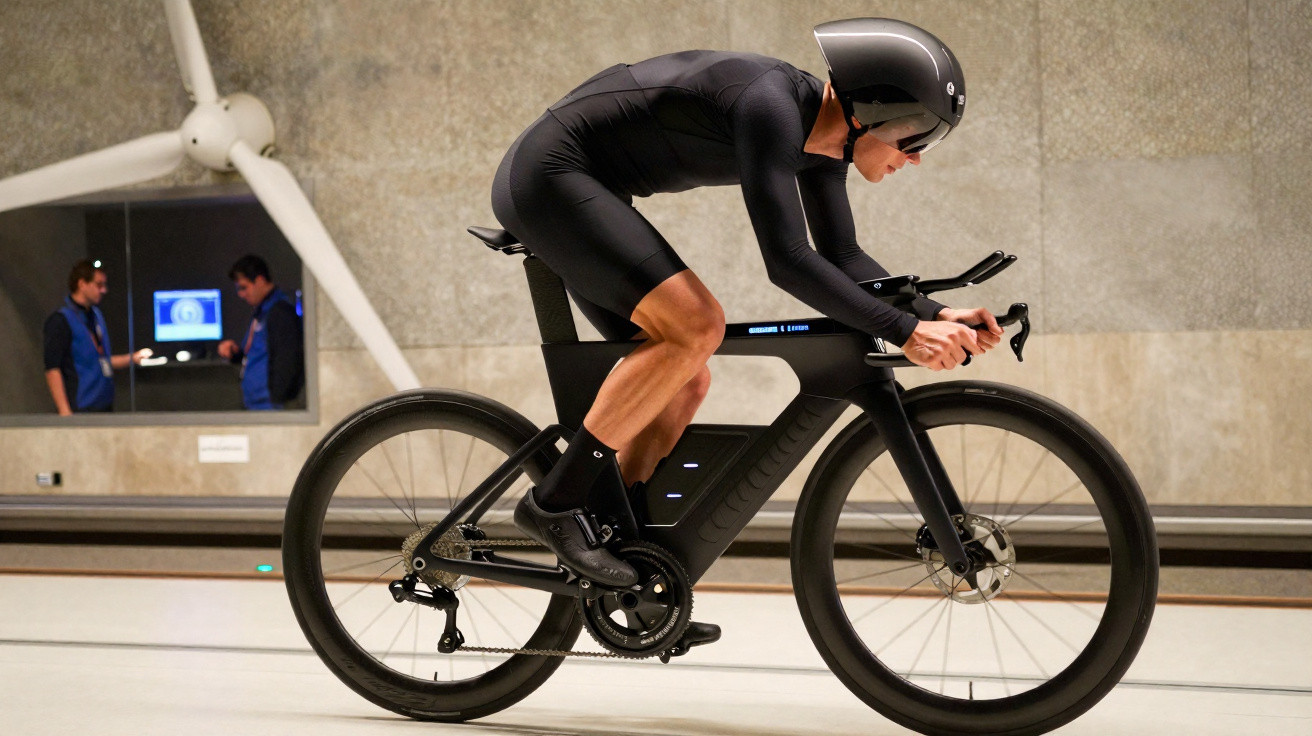
Decathlon and its performance brand Van Rysel have unveiled a concept that pushes the term E-Bike into new territory. Rather than a 25 km/h everyday commuter, this is a high-speed project designed with an ambition of up to 150 km/h - controlled, but uncompromising. So what is it, who would ever need it, and which ideas might filter down into normal bikes?
A research bike designed to break every rule
The project is called the Van Rysel FTP², and it is deliberately not intended for production. There is no price, no on-sale date and no road approval. Instead, it is a rolling technology laboratory, shown at the VeloFollies show in January 2026.
"The idea: electrically double an amateur athlete’s sustained power - in other words, for one hour, literally turn them into a different athlete."
In cycling, FTP stands for “Functional Threshold Power”: the maximum power a rider can sustain for roughly an hour. FTP² means doubling that threshold. Van Rysel’s engineers set out to explore what an “upgraded” human could do when the technology is designed relentlessly in the rider’s favour.
Project lead Wim Van Hoecke describes the bike as intentionally rule-breaking. It is not simply a motor inside a frame, but a fully integrated system spanning drivetrain, aerodynamics, chassis, clothing and even shoes. The aim is a high-speed ecosystem, not just a fast bicycle.
Brutal drive: Mahle motor with up to 850 watts
At the heart of the FTP² sits a specially developed Mahle-M40 motor. Where everyday pedelecs typically run at 250 watts nominal continuous power and are electronically limited to 25 km/h, this configuration plays in a different division.
- Peak output: up to 850 watts
- Torque: 105 Nm
- Battery: 580 Wh integrated into the down tube
- Cooling: cooling fins on the battery to prevent overheating
Up to 25 km/h the prototype follows the familiar limits. After that, the restriction is removed. On level ground, the developers talk about 70 to 80 km/h. On long descents, the headline 150 km/h is theoretically possible - assuming the rider can still cope mentally and physically.
A bespoke control programme is designed to stop the drive system or battery being overloaded. The software manages energy delivery so the motor can provide maximum assistance without overheating. In essence, the system has more in common with a small racing motorbike than a city pedelec - except your legs still have to contribute.
High-tech cockpit: closer to a race car than a bike
The rider’s workstation mirrors the powertrain: little about it feels like a classic road bike cockpit, aside from the handlebar itself.
Inside the stem unit sits a Hammerhead display that consolidates key information: speed, power, battery level, motor mode and gear selection. Crucially, the rider does not need to move their hands away from the bars - at speeds beyond 70 km/h, that is a matter of self-preservation.
From the cockpit, several systems can be operated:
- The SRAM Red AXS electronic shifting
- The Mahle motor’s assistance levels
- The special shoes’ electric lacing system
The last item sounds almost like science fiction: the shoes tighten via a motor, controlled wirelessly from the handlebar. This means the shoe fit can be adjusted on the move - tighter for sprints, slightly looser for calmer sections.
Shoes instead of pedals: radical power transfer
The clearest sign of the bike’s experimental mindset is a detail that is usually mundane: the pedals. On the FTP², they disappear entirely.
"The shoes are bolted directly to the crank – they are the pedals themselves."
The shoe sole has a fixed interface that threads into the crank like a standard pedal. No clip-in mechanism, no cleats, no conventional hardware. Power transfer is rigid with virtually no play, as if it were a solid metal component.
According to Van Rysel, the complete system weighs around 500 grams. Its external shape is based on NACA aerofoil profiles from aviation - the kind of forms used for wings. The objective is to further reduce drag around the rider’s feet.
The lacing mechanism is motor-driven, and the rider can set tension with micrometre-level precision from the cockpit. The intention is that no watt is wasted because the foot “floats” inside the shoe. The downside: for now, mounting and dismounting requires assistance because the shoes are fixed in place. The team is still working on a more practical solution.
Aerodynamics as “armour” for 150 km/h
Beyond 80 km/h, air becomes an opponent - and a genuinely dangerous one. The FTP² concept therefore treats the rider not only as an athlete, but as an integral part of a single aerodynamic body.
Helmet with an additional aero shell
The system includes a dedicated helmet made up of a certified base helmet and an extra aerodynamic outer shell. This add-on was created with aero specialist Swiss Side. It is intended to guide airflow around the head more deliberately and reduce turbulence at very high speeds.
A suit as “aerodynamic armour”
Van Rysel refers to the race clothing as aerodynamic armour. Developed with the high-speed textile atelier Jonathan & Fletcher, it combines protection with airflow optimisation.
The fabric tracks body movement without creasing, while also helping shield the rider from the immense pressure of the airstream at 80 to 150 km/h. Anyone who has crashed at 60 km/h on a road bike can imagine the forces involved when that speed effectively doubles.
Frame, components and weight: a race machine dressed as an E-Bike
The frame and fork are built from substantial carbon fibre, developed in-house. Even with motor and battery, the overall system weight comes in at around 15 kilograms. For a concept with this kind of power density, that is notably light.
Another noteworthy detail is an integrated light signature within the frame, adding both visibility and a distinctive look. If a production model ever followed, this could easily become a recognisable design cue.
Among the parts fitted are:
- Swiss Side Hadron 850 aero wheelset
- Fizik Argo Vento Adaptive saddle
- SRAM Red AXS electronic shifting
Each component has to do two jobs: tolerate high speeds while keeping mass as low as possible. The result is an E-Bike that visually nods towards a time-trial bike, but technically goes far beyond that template.
No production run planned - but technology for future E-Bikes
Anyone reaching for their wallet will have to put it away again. Decathlon is explicit: the FTP² remains a research object. Test rides are planned on secured routes under controlled conditions. A sale would not be compatible with current traffic regulations anyway.
Even so, the project matters for the broader market. Several elements could be adapted, such as:
- the clean integration of the battery into the down tube
- the frame’s light signature
- the shaping of fork and cockpit for improved aerodynamics
- software concepts for intelligent power management
That is the strategic point: what looks like an extreme concept today can appear tomorrow - in toned-down form - on a city or gravel E-Bike. Manufacturers use prototypes like this to trial ideas that would be too risky in a normal development programme.
How dangerous is this - and where are the opportunities?
150 km/h on two comparatively narrow tyres sounds like madness. Critics will question whether an experiment like this can be justified. The team points to testing in protected environments, specialist protective clothing and carefully selected riders.
Even so, a broader question remains: where does sporting performance end and motorised transport begin? In the E-Bike space in particular, the boundaries are increasingly blurred. Concepts like this force lawmakers and governing bodies to think about sensible categories.
On the other hand, extreme projects often generate genuinely useful innovations:
| Area | Potential benefit for everyday bikes |
|---|---|
| Aerodynamics | Less air resistance, more range with the same battery size |
| Software control | Smoother, more efficient assistance and longer battery life |
| Component integration | Cleaner appearance, fewer wear parts, lower maintenance |
| Safety concept | Better helmets, clothing and lighting for daily use |
What E-Bike riders can take from it
If you ride a conventional E-Bike today, you will never encounter 150 km/h - and that is a good thing. The interesting part is the thinking behind the machine. Smart software that precisely meters power can make even a relaxed commuter bike feel more refined. More aerodynamic frame shapes can increase range without needing a larger battery.
For sport-focused riders, it is becoming clear that the line between a road bike, a time-trial machine and an E-performance bike is getting less distinct. Assisted training approaches - where the motor only supplements tightly defined power zones - could make training plans more exact. FTP-based systems are well suited to that because they are directly tied to a rider’s personal limit.
Ultimately, Decathlon’s concept demonstrates one thing above all: E-Bikes are nowhere near being technically “finished”. What is dismissed today as a wild study could look completely normal in five years’ time - just with far less than 150 km/h on the speed readout.
Comments
No comments yet. Be the first to comment!
Leave a Comment