
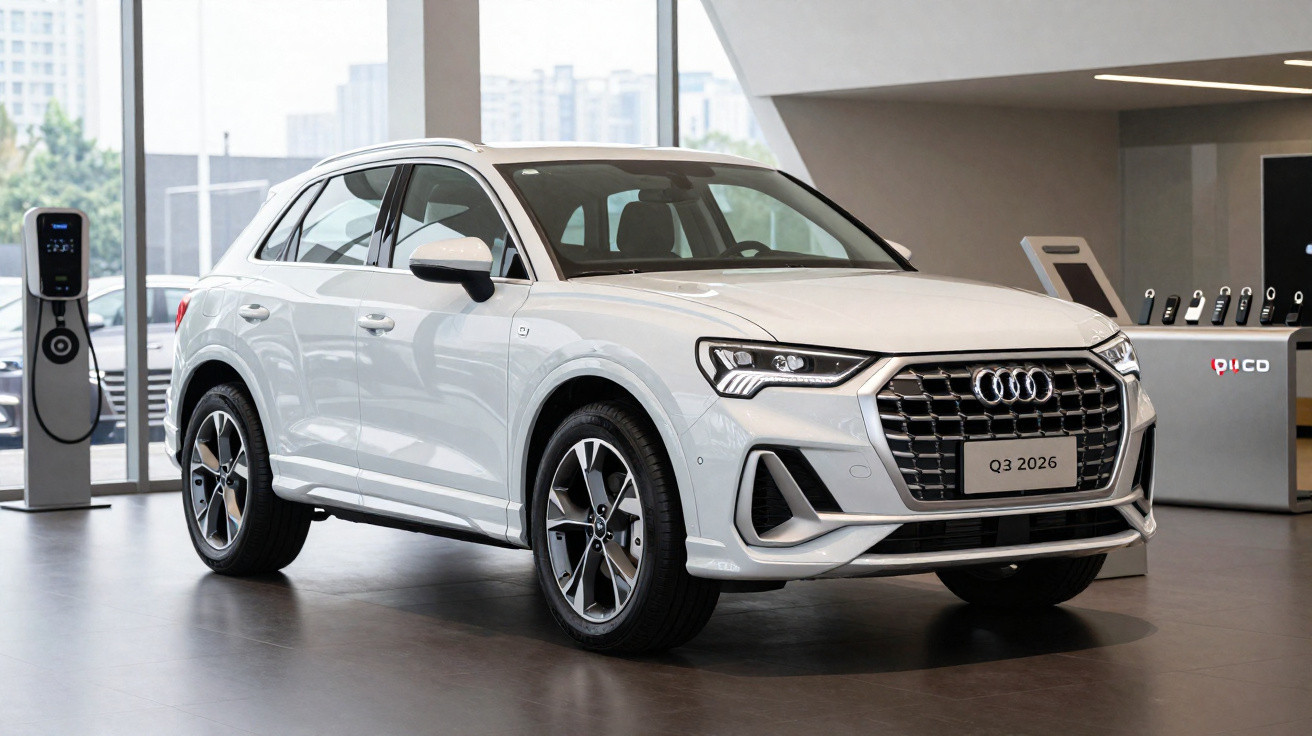
After several sluggish years, Audi has been picking up pace quickly over recent months. Following the A5, the A6 e-tron and the combustion A6, and also the Q5, attention now turns to the third generation of the Audi Q3.
Audi cannot afford a mis-step with the Q3: this compact SUV keeps increasing its share of the brand’s overall sales. It is therefore no surprise that, during development, nobody wanted to “step onto thin ice” - and that caution applies equally to styling and technology.
This third chapter in the Q3 story - the first generation arrived in 2011 and the SUV has already surpassed two million units sold - results in a model that is more up to date, a touch bolder, and with some fresh ideas compared with its successful predecessor.
Even so, if you were anticipating a dramatic “leap forward” (as Audi’s claim suggests), you may come away slightly underwhelmed - particularly given how clearly that was achieved with the recently unveiled A5 and A6.
In line with the latest Audi design language
Visually, it is an appealing package and it borrows cues from Audi’s newest releases - we struggle to recall the last “ugly” Audi - with well-judged proportions and familiar technology.
Under the skin, it uses the MQB evo platform, which also underpins models such as the Volkswagen Tiguan and the CUPRA Terramar. The latter is built in the same plant as the Q3, in Győr, Hungary.
In keeping with current trends, there is now a light bar running the full width of the rear, along with very slim (and sophisticated) LED headlights at both ends. Up front, these sit above a Singleframe radiator grille that continues to take on an ever more dominant role.
At the rear, however, the continuous light strip with illuminated rings is only offered on certain versions. That is a pity, as it would make the Q3 line-up more appealing overall. Digital lighting technology here is the most advanced available in any model in this market segment.
Plug-in hybrid with up to 120 km of range
At launch, the engine range will be restrained. There will be one Diesel option (2.0 TDI) and one petrol option (1.5 TFSI mild-hybrid), both producing 150 cv and driving the front wheels.
There is no fully electric version - that role is filled by the Q4 e-tron - but drivers who prefer battery-assisted driving will be catered for by a plug-in hybrid, the Audi Q3 e-hybrid.
Unlike its closest BMW and Mercedes-Benz rivals, though, this hybrid will be offered only with front-wheel drive - something that will disappoint many customers in northern Europe. Total output is 200 kW (272 cv) and 400 Nm, delivered by pairing an 85 kW (116 cv) electric motor with the 1.5 TFSI engine producing 130 kW (177 cv).
The battery pack offers 19.7 kWh usable (25.7 kWh gross) and comprises 96 prismatic cells, split across four modules and mounted under the bodyshell. It has been engineered to enable a purely electric range of up to 120 km.
A little later, at the start of 2026, the range will be broadened with two stronger petrol engines, both 2.0 TFSI units: 204 cv/320 Nm and 265 cv/400 Nm. Both come with quattro all-wheel drive and are paired with a seven-speed dual-clutch automatic gearbox.
The significantly more powerful S and RS versions are expected to follow in mid-2026.
Three suspension set-ups available
The Audi Q3 2026 will allow buyers to choose from three suspension options: the standard set-up, a sportier configuration, and a third with electronically variable damping. This last option uses new dampers with dual valves, allowing compression and rebound to be controlled independently. Wheels can range from 17″ to 20″.
With variable damper control, the suspension continually adapts to the road surface and driving style, taking into account factors such as steering angle, braking and acceleration. Damping is adjusted in fractions of a second at each wheel, independently.
Audi’s engineers set out to widen the gap in suspension behaviour between Comfort and Sport driving modes. And the optional progressive steering makes responses to the driver’s inputs more direct towards the extremes of steering-wheel lock.
Debut of double glazing
Among the new technology highlights are customisable LED matrix headlights, as well as the fitment of double glazing at the front. The Q3 is the first Audi in the compact range to offer this feature, helping to make the cabin quieter.
Inside, there are two displays measuring 11.9” (instrument cluster) and 12.8” (central infotainment screen, based on Android Automotive), plus a head-up display, a Sonos sound system, and multiple driver-assistance systems.
At first glance, the materials, seats and controls in the Audi Q3 2026 leave a positive impression. There are more ambient-lighting choices and greater scope for colour customisation in the cabin. The area between the front seats also offers more open storage, helped by moving the transmission selector to a stalk on the steering column.
Boot capacity ranges from 488 litres to 1386 litres, and it can be increased further thanks to rear seats that slide along rails by 15 cm and also allow backrest angle adjustment. Finally, the Q3’s towing capacity is 2.1 tonnes.
Audi Q3 2026 arrives in the final quarter
The new generation Audi Q3 reaches the market in the final quarter of the year, and all signs suggest prices will start slightly below €50,000. For the Q3 e-hybrid, it will sit above that threshold.


Comments
No comments yet. Be the first to comment!
Leave a Comment