
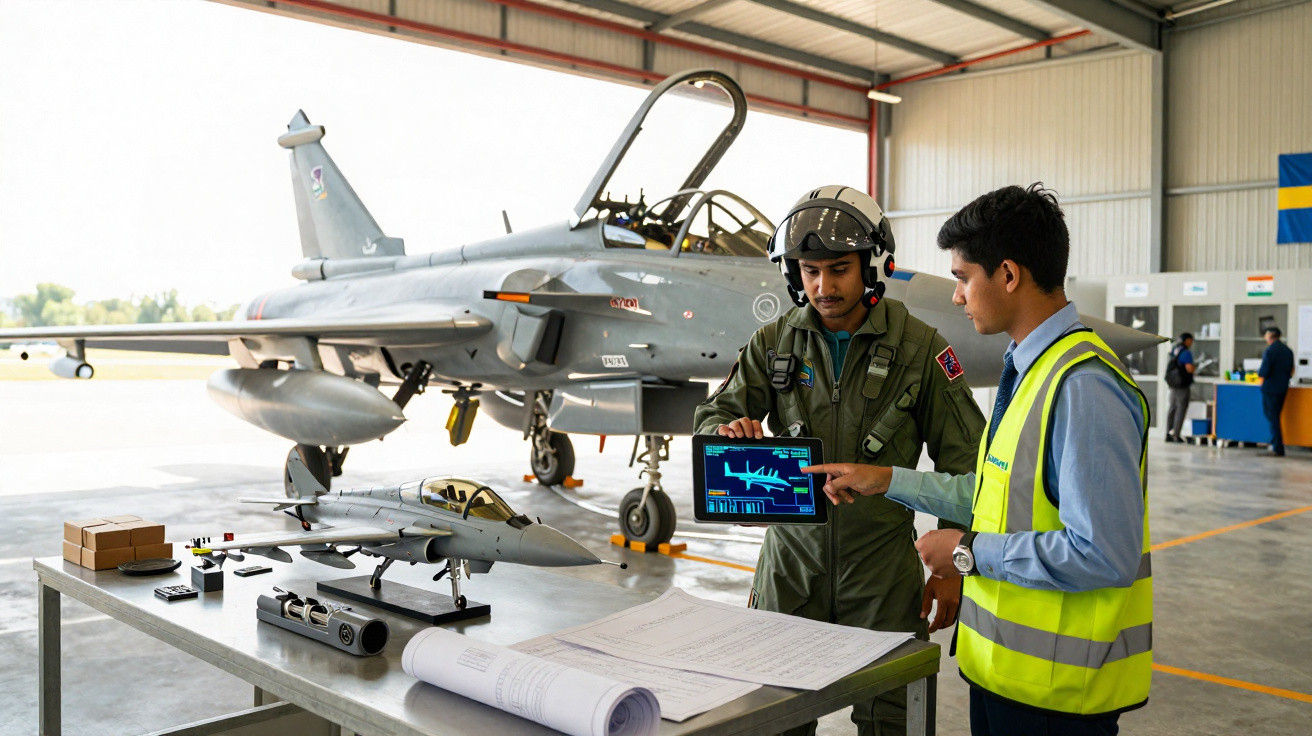
Local reporting indicates that Swedish manufacturer Saab is again advancing an offer to supply the Indian Air Force with Gripen E/F fighter aircraft, this time pairing the proposal with several pathways for domestic production in an attempt to win backing in New Delhi. Through this renewed approach, Saab is seeking to recover ground after an earlier contest ended with the Dassault Rafale being chosen-an outcome that represented a significant commercial opportunity linked to an estimated requirement of about 114 aircraft intended to expand the country’s number of operational squadrons.
Saab’s new push for the Gripen E/F in India
The latest signal of this initiative came from Saab’s current Gripen marketing director and vice president for the aeronautics business, Mikael Franzen, who said: “In our contacts with the Indian government, we have proposed the creation of the most advanced aerospace industrial plant in the world, encompassing design, production, and multi-layer maintenance.”
In subsequent comments, Franzen argued that the Gripen distinguishes itself from other contenders on the market because it offers advanced technology that can work alongside India’s existing platforms, while also being positioned as a cost-effective option-one that would allow the Indian Air Force to acquire aircraft quickly and in substantial numbers.
Delivery timeline, Swedish-built first batch and local manufacturing
On the question of speed, Saab’s outline suggests the service could take delivery of the first aircraft in the third year following contract signature. The plan would start with an initial lot of roughly 18 aircraft built in Sweden, continuing there until the necessary conditions are established in India to move production locally.
For the aircraft produced domestically, India would also have the scope to incorporate national technologies. Once the local requirement had been fulfilled, the approach could additionally open the door to exports.
Capability claims: electronic warfare, weapons integration and Artificial Intelligence
As part of his case for the Gripen as a high-end combat platform suited to India, Franzen highlighted that-beyond the ability to build it in large volumes-the aircraft would be supplied with the most recent electronic warfare updates and would be able to integrate a broad range of weapons.
Another feature emphasised is the incorporation of Artificial Intelligence technology. Although this is still under development, Saab maintains that it gives the platform a pioneering edge when compared with other options.
From an industrial perspective, Saab has also indicated it is prepared to ensure the technology transfer required to deliver the programme-an aspect New Delhi has traditionally treated as central when procuring new systems. Strengthening the offer on the economic side, the Swedish company suggested that working with Indian partners could bring in more than 300 industrial participants of different sizes, which could then use the experience gained to support indigenous projects.
It is also worth noting that, if agreed, this would not be the only military-industrial effort connecting India and Saab. A prominent example is the collaboration centred on Carl-Gustaf M4 recoilless rifles, manufactured in the state of Haryana via Saab FFVO India Pvt Ltd. As with the Gripen concept, domestic production has helped shorten manufacturing and delivery timelines, while also giving India a way to keep facilities active through export arrangements serving the weapon system’s more than 40 users.
Images used for illustrative purposes
You may be interested in: India officially unveiled its new LR-AShM hypersonic missile during the Republic Day parade


Comments
No comments yet. Be the first to comment!
Leave a Comment