
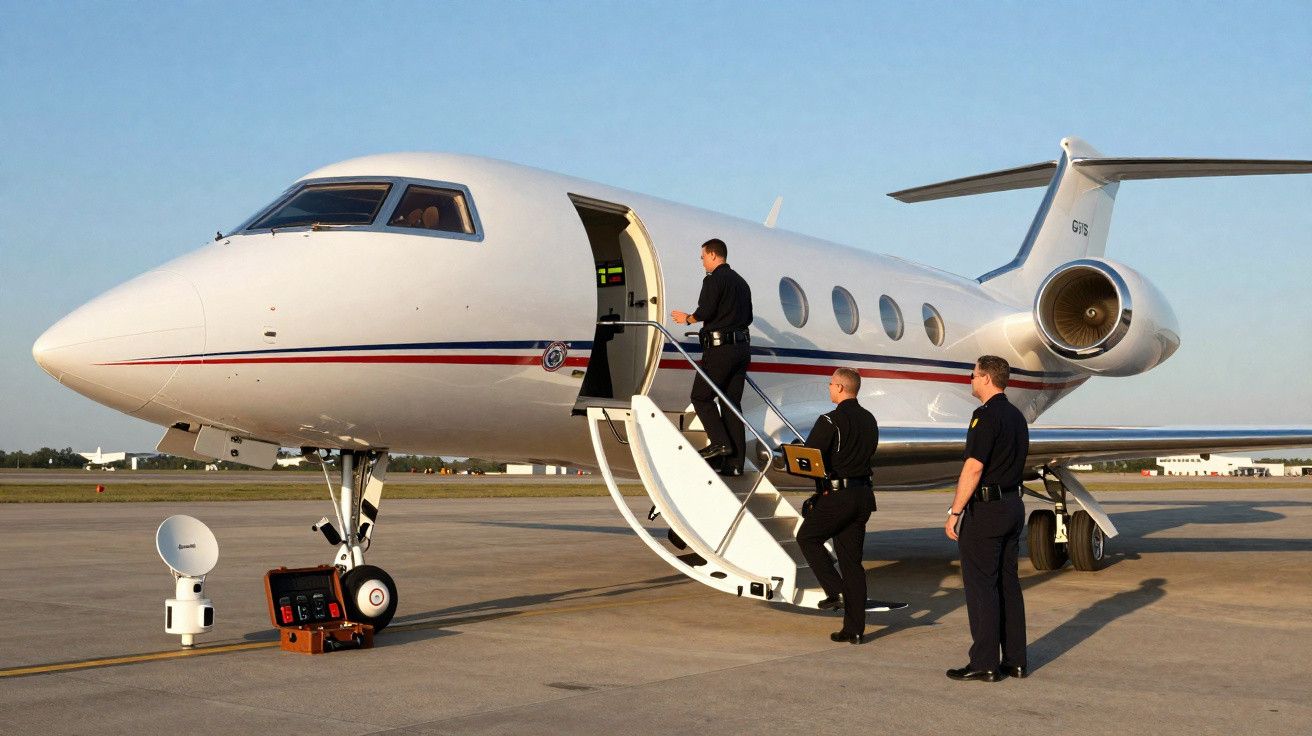
The US Department of Homeland Security (DHS) is beginning to roll out a new generation of long‑range executive and command aircraft, and the first clear indication is a Gulfstream G700 in a bold blue‑and‑white scheme that reads far more like a head‑of‑state transport than a routine patrol asset.
The first sighting of DHS’s new Gulfstream
The aircraft was photographed this week at Savannah/Hilton Head International Airport in Georgia, which is where Gulfstream is headquartered and where its principal production line is based.
Operating on the test callsign “Gulf Test 96”, the jet is believed to be one of two G700s ordered for the US Coast Guard, which falls under DHS.
Within DHS and the Coast Guard, the aircraft is labelled a Long Range Command and Control Aircraft (LRCCA). The designation points to a combined mission: providing comfortable long‑distance transport for senior leaders while doubling as an airborne element within national emergency planning.
The new G700s are meant to act as flying offices, crisis command posts, and diplomatic shuttles for America’s homeland security leadership.
Public delivery timelines have not been announced. However, earlier Coast Guard planning paperwork indicated a target of 31 December 2025 to have the aircraft operating.
A livery that looks almost presidential
What has drawn immediate attention is less the aircraft itself and more its finish.
Instead of the Coast Guard’s familiar white paint with orange and blue diagonal stripes, this G700 wears a white upper fuselage over deep blue, separated by red and gold pinstripes.
“United States of America” is emblazoned along the side, and the tail carries a large, sweeping US flag.
Two insignia are especially noticeable: the DHS crest positioned just aft of the main cabin door, and the Coast Guard emblem on the engine nacelle-visual cues that tie the aircraft to both the department and the service.
The colour scheme closely mirrors a recent 737 Boeing Business Jet and echoes a livery once proposed for the next Air Force One.
Aviation observers will recognise the similarity. A Boeing 737 Business Jet with US civil registration N471US appeared late last year in an almost identical scheme, and tracking has linked it to flights consistent with Coast Guard LRCCA patterns, including trips to Europe, the Middle East and the Caribbean.
Why the Coast Guard needs the G700
The Coast Guard already flies two Gulfstream‑derived LRCCAs: the C‑37A and C‑37B. These are based on the older Gulfstream V and G550, both of which are no longer manufactured.
Those aircraft are frequently tasked as VIP transports for the Secretary of Homeland Security, other senior DHS officials and top Coast Guard leadership. They also support continuity‑of‑government planning-the framework designed to keep federal functions running after a major attack or disaster.
In a procurement justification published last year, DHS and the Coast Guard set out why the G700 was preferable to purchasing another pre‑owned G550, citing several practical gains:
- Longer range to enable non‑stop transoceanic operations
- Faster cruise speed to shorten journey times
- Increased seating for staff and protective details
- Up‑to‑date avionics capable of supporting advanced communications suites
Opting for an in‑production aircraft also reduces dependence on the unpredictable second‑hand market for older Gulfstreams, a theme repeatedly emphasised in the supporting documentation.
Inside: luxury cabin meets secure command hub
As Gulfstream’s flagship, the G700 is marketed to ultra‑high‑net‑worth customers and heads of state, with an airframe engineered around long‑range comfort and a premium cabin experience.
DHS appears set to take full advantage of that baseline while integrating a substantial layer of specialised systems.
Beyond its plush interior, the G700 is expected to field a secure communications suite tied into classified networks and next‑generation satellite links.
The acquisition paperwork mentions an “exacting follow‑on cabin refresh”, implying a bespoke VIP interior configured for government requirements rather than a standard corporate layout.
A key detail is a specified “Starshield installation”-a government‑oriented version of SpaceX’s Starlink satellite internet service. Starshield is intended to provide encrypted, resilient connectivity wherever the aircraft has a view of the sky, aligning with the way the US military has been incorporating SpaceX communications into operations.
What Starshield actually means in practice
For a G700 LRCCA, Starshield is not about passengers watching films online.
Instead, it is intended to enable secure video calls, live intelligence feeds, diplomatic coordination and potential command‑and‑control data connections, including in remote areas or during fast‑moving emergencies.
That effectively turns a VIP aircraft into a mobile headquarters. Senior officials can remain connected to Washington, synchronise cross‑agency action, or oversee border security responses while travelling to disaster zones or overseas capitals.
Political backlash over cost and timing
In Washington, the G700 purchase-estimated at between $170m and $200m for both aircraft once modifications are included-has prompted criticism.
Some members of Congress have challenged DHS leadership on both the price and the timing, pointing out that approvals advanced during an extended government shutdown when other activities and programmes were under constraint.
The commonly cited price of a “green” (unfitted) G700 before any VIP interior work or mission systems is around $70m–$80m per aircraft. High‑specification cabins, secure communications packages and custom paint schemes can push totals higher.
Congress has responded by demanding detailed monthly reports on every long‑range jet trip, down to justifying the mission and listing any alcohol consumed on board.
A Joint Explanatory Statement linked to a current Homeland Security appropriations measure directs DHS to record:
- The official purpose for each LRCCA flight
- How the journey connects to a core statutory mission
- Whether alcoholic beverages were used and who supplied them
This level of scrutiny reflects a broader concern about optics: executive aircraft, growing budgets and political travel are routinely controversial, particularly where luxury interiors are involved.
A broader surge in US executive aircraft
The G700 is part of a wider effort to expand and refresh US government VIP and special‑mission fleets.
Within DHS, the little‑explained 737 Business Jet N471US has already flown routes that closely resemble Coast Guard C‑37B patterns. Its appearances in locations such as Amman, Jordan-where the Secretary of Homeland Security met King Abdullah II in December-highlight its developing role as a high‑visibility transport platform.
Across the Potomac, the US Air Force is managing a parallel transition. The delayed VC‑25B effort, which will deliver the next pair of “Air Force One” aircraft based on Boeing 747‑8i airframes, has driven additional stopgap acquisitions.
| Aircraft | Base type | Primary role |
|---|---|---|
| G700 LRCCA | Gulfstream G700 | DHS/Coast Guard VIP & command |
| C‑37A/B | Gulfstream V / G550 | Existing DHS/USCG LRCCA |
| N471US | 737 Business Jet | Unacknowledged DHS VIP transport |
| VC‑25B | Boeing 747‑8i | Future Air Force One |
The Air Force has purchased two former Lufthansa 747‑8s as training aircraft and as sources of spare parts for the VC‑25B fleet. It is also converting a heavily modified ex‑Qatari VVIP 747‑8i into a “bridge” aircraft intended to cover the gap while the main programme progresses.
That approach carries its own hazards: turning a unique, luxury‑configured airframe into an interim presidential aircraft to demanding schedules is both technically complex and politically fraught.
What “long range command and control” really implies
On paper, LRCCA can sound like bureaucratic shorthand. In practical terms, it brings three separate functions into a single aircraft:
- VIP transport: Moving cabinet secretaries, agency heads and senior officers quickly between continents.
- Crisis command post: Conducting secure briefings, hosting teleconferences and issuing direction while airborne.
- Continuity asset: Serving as an airborne alternative if fixed infrastructure is damaged or disabled by attack or disaster.
In a major cyberattack affecting Washington, for instance, a DHS G700 equipped with Starshield connectivity could operate as a moving control centre, drawing on alternative networks and co‑ordinating border and emergency actions from the air.
During an intense hurricane season, the same aircraft could shuttle between impacted states, allowing leaders to visit affected areas while staying connected to live situational reporting and interagency calls.
Balancing risk, optics and capability
Placing senior decision‑makers aboard an aircraft with long range, strong communications and a functional workspace has clear operational upsides. Hours in transit can be converted into productive working time, and in emergencies, speed can be decisive.
The political vulnerability is the perception that these aircraft are benefits first and capability second-especially when the interiors originate in corporate‑jet luxury rather than the austere environment of military transports.
That friction helps explain why legislators have focused on specifics such as alcohol use and destination reporting: they are visible markers for the public of whether an aircraft is serving official needs or providing high‑end convenience.
For DHS and the Coast Guard, the emerging G700 fleet will act as a proving ground. If the aircraft are demonstrably tied to disaster response, sensitive diplomacy and emergency preparedness, the criticism may ease. If they are not, the “new Gulfstream jet” risks becoming a symbol of Washington excess rather than a necessary element of national security infrastructure.






Comments
No comments yet. Be the first to comment!
Leave a Comment