
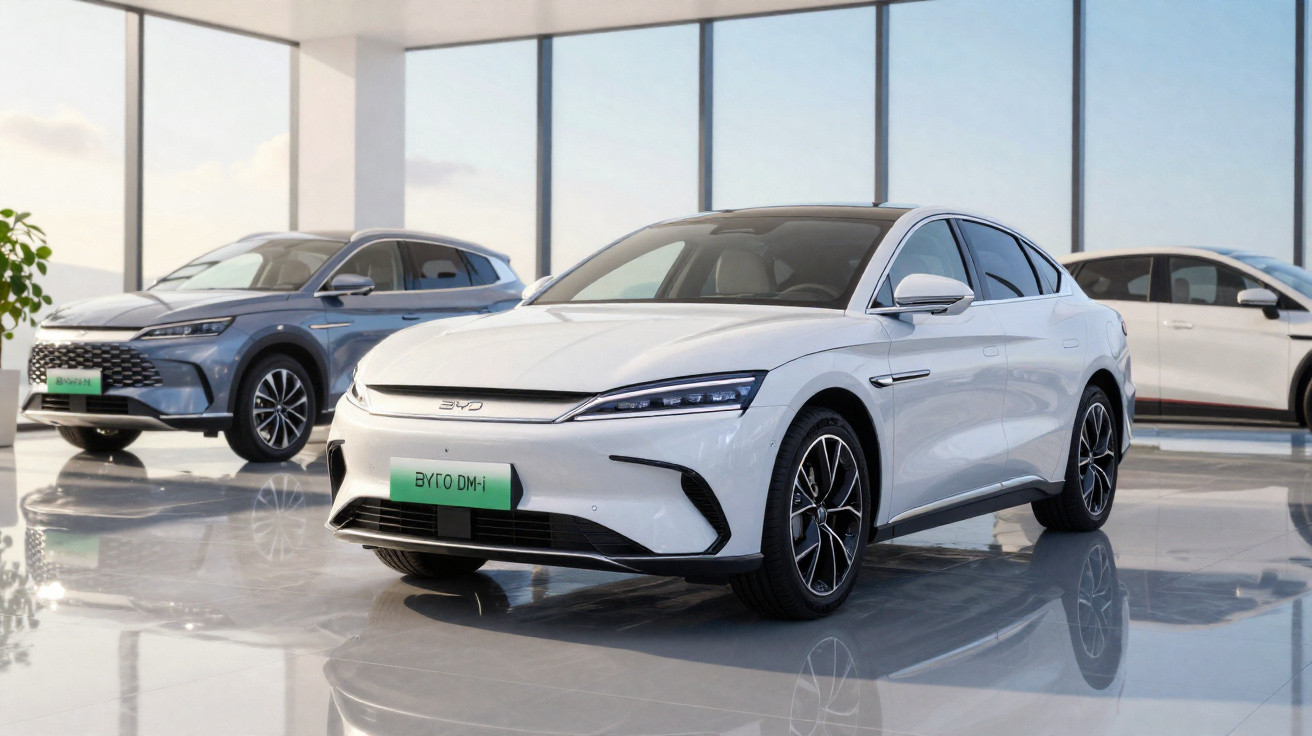
BYD has been building cars for just over two decades, yet it keeps setting new growth records. It leads the market in China and, in 2025, it became the world’s top electric-car maker, overtaking Tesla. In Europe (including Portugal), momentum is strong too: it sold 186 612 vehicles, up 276% versus 2024, and in January 2026 it leapt again, rising a further 173% compared with the same month a year earlier.
BYD’s European growth is being driven by plug-in hybrids
That surge in Europe is not being powered by full battery-electric models as originally planned, but by plug-in hybrids. This pivot can be read as a way to soften the impact of European tariffs on EVs built in China. Regardless, the strategy has proven effective: the BYD Seal U DM-i was Europe’s best-selling plug-in hybrid in 2025, ahead of the Volkswagen Tiguan.
The plug-in hybrid push will continue through 2026. Even so, BYD has not sidelined its fully electric models, with updates on the product side and changes in where vehicles will be built.
Plug-in hybrids everywhere
To keep its European expansion on track in 2026, BYD will lean even harder on its DM-i (Dual Mode – intelligent) technology. The year started with the Atto 2 DM-i, described as the only plug-in hybrid in its segment and now the most affordable entry point into BYD’s DM-i line-up.
Pairing a 1.5-litre petrol engine with an electric motor, it delivers a combined maximum of 156 kW (212 hp). With an 18 kWh battery, it claims up to 90 km of electric-only driving (WLTP) and more than 1000 km of total range. In Portugal, pricing starts at 33 990 euros, and we have already driven it.
Four more BYD plug-in hybrids expected in 2026
A further four BYD plug-in hybrid introductions are anticipated for 2026. Above the Atto 2, the BYD Sealion 5 DM-i should arrive: a C-segment SUV that sits between the Atto 3 and the larger Seal U. It uses the same drivetrain as the Seal 6 DM-i, with 212 hp combined and electric range that can reach 85 km. Its arrival in Portugal has not yet been confirmed, but it is already on sale in the UK.
Moving further up the range, BYD will offer the BYD Sealion 8 DM-i, a large SUV with up to seven seats. It is already available in some international markets in two versions: a front-wheel-drive model with 272 hp and a 19 kWh battery; and an all-wheel-drive version with 488 hp and a 35.6 kWh battery. It is positioned as a family-oriented plug-in hybrid alternative in a class shaped by cars such as the Hyundai Santa Fe, while keeping the emphasis on strong electric range and efficiency.
Dolphin G: BYD’s first Europe-led model
How central plug-in hybrid tech has become to BYD’s European ambitions is also highlighted by the Dolphin G (an internal name; the final one has not been confirmed), due closer to the end of the year.
It will be the first BYD developed with Europe as the primary target rather than an adaptation of a China-market model. Based on the fully electric Dolphin, it will use the Atto 2 DM-i drivetrain. The aim is straightforward: to take on cars such as the Volkswagen Golf e-Hybrid, one of the segment’s plug-in hybrids with the longest electric-only range.
Finally, BYD is set to enter Europe’s pick-up segment with the Shark. It will also be a plug-in hybrid, featuring four-wheel drive, almost 430 hp and a 29.58 kWh battery. It should deliver around 70-80 km of electric range on the WLTP cycle. It will face a tough challenge in a market dominated by the Ford Ranger.
Battery-electric models haven’t been forgotten
While plug-in hybrids are doing the heavy lifting for growth, fully electric cars remain a key pillar of BYD’s European plan. There are no entirely new EV nameplates, but two core models have been refreshed. The BYD Dolphin has been updated mainly in equipment and software. The line-up has been streamlined to the most powerful, longest-range version only, with prices starting at 35 990 euros.
The BYD Atto 3 has changed more substantially: it is now rear-wheel drive, more powerful, and it gains a higher-capacity battery, pushing electric range to more than 500 km.
BYD production shifts to Hungary and Turkey
The other major BYD development for its European EV business is not a new model, but a new manufacturing footprint. The brand plans to begin production at its new plant in Szeged, Hungary, in the first half of the year. The Dolphin Surf and Atto 2 are among the models indicated, and installed capacity could reach 300,000 units per year. In parallel, the Turkish facility is expected to start building the Seal U DM-i and, possibly, the Sealion 5 towards the end of the year.
This is another response to tariffs on EVs imported from China, and a strategic move to improve price competitiveness while strengthening local presence. BYD entered Europe as an electric-car brand. It is now growing as a plug-in hybrid specialist. Next, it is preparing to build cars as a European-based manufacturer.
Comments
No comments yet. Be the first to comment!
Leave a Comment