
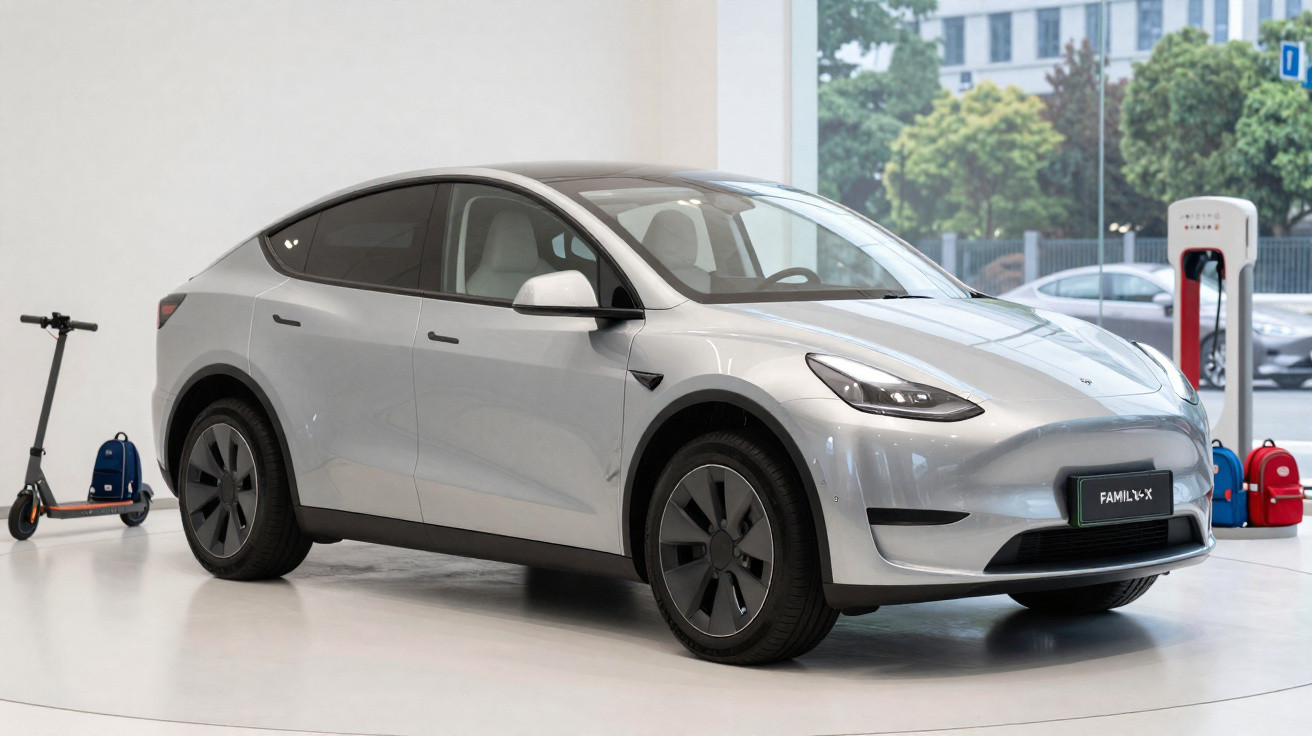
Elon Musk has reignited the rumour mill: Tesla is said to be working on a new family car - larger than anything it currently offers, sharp-edged and futuristic, and explicitly not a traditional van.
Tesla appears to be heading into a model handover. As the Model S and Model X gradually move towards the end of their lifecycle, Elon Musk has hinted at a new, extra-large family SUV. In a brief but widely noticed remark on X, the Tesla boss suggested something far more eye-catching is on the way - a clear message to anyone who has been asking for a sensible people carrier for years.
Elon Musk makes it clear: no boring family van
The spark was a discussion on X, where a user pressed Musk to finally build a proper family vehicle in a minivan style. Demand for practical, seven-seat electric cars is strong - particularly among families who often end up choosing hybrid MPVs or large petrol/diesel SUVs.
Musk’s reply was characteristically short and assured. He signalled that Tesla won’t simply release a conventional family van; instead, it wants to build something that looks and feels more distinctive and emotionally appealing.
A standard family car isn’t enough for Musk - Tesla is planning a large SUV that deliberately distances itself from classic vans.
That stance deliberately separates Tesla from brands whose EV strategies lean heavily on practical but visually unremarkable family transport. Musk’s preference is for a vehicle that combines usefulness with theatre - while also reinforcing the brand’s image.
The end of Model S and Model X creates space for something new
By summer 2026, the Model S and Model X are expected to be phased out step by step. The Model X, with its falcon-wing doors and optional third row, was an early example of what a fully electric SUV could be. Today, though, the concept no longer feels quite as fresh alongside newer rivals.
Many owners complain that the third row is tight and that space is not used as effectively as it could be. Competing manufacturers now tend to favour more box-like shapes, greater rear headroom and easier access to third-row seats. This is precisely where Tesla seems to want to improve - and to clear the stage for a new flagship.
More space, sharper edges, more usefulness
Everything points to a vehicle that would be noticeably bigger than the Model Y, with styling closer to the Cybertruck. The idea is not a straight copy of the angular pick-up, but more of a sibling built on similarly tough underpinnings.
What’s being discussed includes:
- Body size in the league of the biggest US-market SUVs
- Up to seven genuinely usable seats with improved legroom
- A heavy-duty build that can cope with tough use and towing
- Cybertruck-inspired design cues, but toned down for everyday driving
That would fill a gap Tesla has effectively left itself: between the relatively compact Model Y and the unconventional Cybertruck, there is currently no truly large, conventional family SUV.
Cybertruck as the foundation: an extra-large family car made from steel
Ironically, the technical starting point could be the very pick-up that has divided opinion more than almost any other: the Cybertruck. Its steel structure and modular layout give Tesla a rugged platform that could support different body styles - including a three-row SUV.
The Cybertruck’s structure can carry huge loads, offers plenty of space and is engineered for hard work - ideal ingredients for an extra-large family SUV.
For Tesla, the appeal is obvious. Development costs could fall because major components - battery, drive units and basic structure - already exist. At the same time, a dedicated EV platform can enable a roomier cabin than many combustion SUVs, because there’s no engine block taking up space at the front.
Focus on the US market: taking on Rivian and Cadillac
That would place Tesla firmly in the profitable North American XL SUV segment. Vehicles such as the Rivian R1S and the Cadillac Escalade IQ are often seen as benchmarks among large electric SUVs, blending lifestyle and off-road-inspired looks with luxury and vast interior space.
A new Tesla SUV built on Cybertruck foundations could land squarely in that territory:
- Positioned at the higher end on price, but below traditional luxury brands
- A full EV platform rather than a converted combustion-car architecture
- Software features such as “over-the-air” updates and Autopilot
- Ranges that make long family journeys realistically manageable
Design chief Franz von Holzhausen has already suggested customers should “wait and see” what Tesla is planning. That implies the programme may be further along than Musk’s minimal public comments would suggest.
Why the long Model Y barely matters
A logical question is why Tesla doesn’t simply roll out a long-wheelbase Model Y in high volumes worldwide. In some markets - including Australia and Thailand - there is already a Model Y with an extended wheelbase and an optional third row.
Even so, Musk has made it clear this version is not a priority for the US - and possibly not for Europe either. The reasoning appears strategic: Tesla is not aiming for “a bit more space”, but for an entirely different class of vehicle.
Rather than a lightly stretched bestseller, Tesla is apparently planning a true heavyweight - clearly positioned above.
An extra-large SUV would not only offer higher margins; it would also sharpen Tesla’s premium positioning again and create a clear separation from the Model Y, which has increasingly settled into the mainstream mid-market.
What it could mean for Europe and Germany
It remains uncertain whether a vehicle this large would arrive in Europe in the same form. Multi-storey car parks are tighter, environmental regulations are tougher, and the public debate around very large SUVs in city centres is more heated than in many parts of the US.
Still, Tesla could eventually introduce a slightly scaled-back, Europe-friendly version. One plausible approach would be a three-row SUV with a slightly shorter body and an improved turning circle. In Germany, in particular, many families are looking for an electric car with genuinely usable seven seats - without it resembling a delivery van.
Practical questions for families: range, charging, day-to-day use
For family buyers, the unglamorous details often matter more than the wow factor:
- Range: Holiday trips with a roof box, pushchair and luggage consume energy quickly. A large battery would be essential.
- Charging speed: If you’re at a charger with three children in the car, you don’t want a long wait.
- Cabin layout: ISOFIX points, flexible seating and storage for buggies and sports kit determine real-world usability.
- Towing capacity: Many want to pull a caravan, horsebox or boat trailer using electric power.
This is exactly where Tesla could shine if the new SUV inherits the Cybertruck’s toughness while delivering the comfort expected of a family vehicle.
How the electric family-car segment could shift
The move away from classic vans towards large electric SUVs has been building for years. Drivers like the higher seating position, the perceived security, and the option to venture beyond tarmac occasionally. By contrast, even brilliantly practical vans can end up looking like commercial vehicles.
A new Tesla SUV with seven proper seats could increase pressure on manufacturers still leaning heavily on plug-in hybrid MPVs and diesel seven-seaters. If Tesla delivers a package that combines range, charging infrastructure and genuine space, many established brands would need to rethink their offerings.
There is also a downside. Very large electric SUVs face growing criticism because they require more materials, more energy and more road space. Tesla would therefore need to balance carefully how such a heavyweight fits within the wider line-up - between the more mass-market Model Y and the highly polarising Cybertruck.
For anyone watching closely, it is worth remembering terms like “platform” and “structure”: sharing a common base across models reduces costs and can speed up innovation. If Tesla leverages the Cybertruck architecture intelligently, an angular pick-up and a family SUV could become part of a broader modular approach - benefiting customers through lower costs, more variants and quicker model updates.
Comments
No comments yet. Be the first to comment!
Leave a Comment