
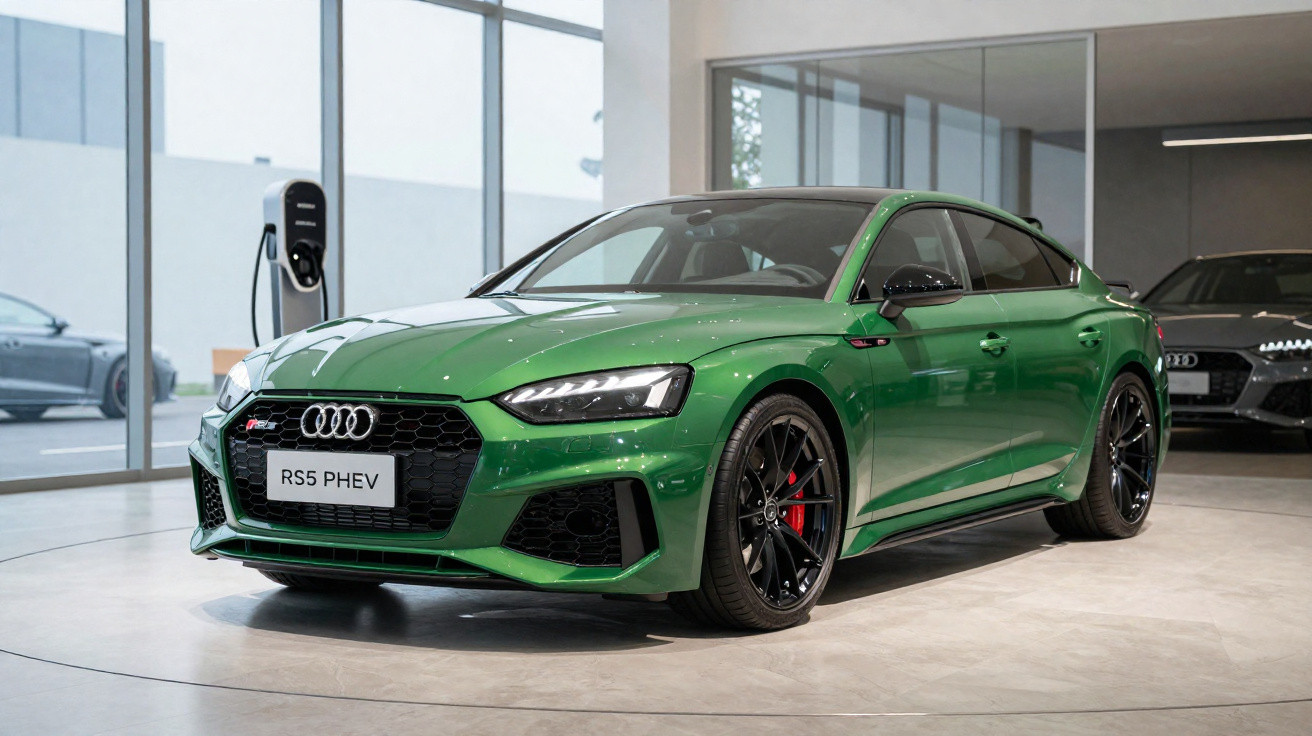
The Ingolstadt icon is getting a plug: Audi is turning the RS 5 into a plug‑in hybrid - and asking its fans a fundamental question.
Performance cars are under growing pressure: tougher CO₂ limits, rising fuel costs and the prospect of driving bans. And now Audi is making a move many would once have called unthinkable, giving the RS 5 a high-output plug‑in hybrid set‑up. Some will see it as a long-overdue step towards the future; others will view it as an attack on what has defined the RS legend for decades.
V6 biturbo plus E‑power: what’s inside the new drivetrain
For the first time in the history of the RS badge, Audi is pairing the RS 5 with a plug‑in hybrid powertrain. Up front sits a 2.9‑litre V6 biturbo, supported by a powerful electric motor. Together, the two units produce around 639 PS (470 kW) and up to 825 Nm of torque.
That leaves previous pure-combustion versions clearly behind. The last RS 5 with a V6 biturbo delivered 450 PS; older V8 models may be remembered for their sound, but in outright output they now look outgunned. The new focus is maximum shove while posting far better official test figures.
“More power than ever before, less CO₂ than ever before - Audi is trying to square the circle between racer genes and climate rules.”
On paper, the combined standard fuel consumption is listed at roughly 3.8 to 4.5 litres per 100 kilometres. Stated CO₂ emissions remain below 100 g/km under WLTP. In day-to-day use it will be higher, but the intent is obvious: the RS 5 is meant to impress not only at the lights, but also on fleet averages.
Electric range: a commuter car in RS trim
At the heart of the plug‑in system is a battery with more than 25 kWh of capacity. That enables the RS 5 to cover several dozen kilometres in pure EV mode. Drive into town in the morning, head home again in the evening - for many drivers, that can be done without waking the combustion engine at all.
In everyday terms, that means:
- locally emission-free driving in low-emission zones and city centres,
- quiet cruising through residential streets instead of a cold-start roar,
- noticeably lower fuel costs if you charge regularly.
If you can plug in at home or at work, you may end up using the RS 5 for much of the week like a heavy electric car. It’s only out on A-roads or the motorway that the V6 typically steps in and turns the mild-mannered commuter setting back into the familiar RS bruiser.
0–100 in about 3.6 seconds: does the RS 5 still have bite?
For long-time followers, the key question is whether the character survives once hefty batteries and extra control units come along for the ride. Audi’s answer is delivered in hard numbers: 0 to 100 km/h is said to take around 3.6 seconds. That pushes the RS 5 into territory that used to be reserved for supercars.
Quattro all-wheel drive remains central to the recipe. Using Dynamic Torque Control, the system can vary how power is sent to the rear axle. Torque can then be metered to individual wheels, helping the car fire out of bends with greater stability and sharper agility.
“The hybrid drivetrain isn’t just a CO₂ alibi - it’s a genuine performance booster: extra punch off the line, instant electric torque and more precise power distribution.”
The electric motor also helps mask the turbo lag that naturally comes with a V6. When accelerating out of tight hairpins or overtaking, maximum torque is available with minimal delay. That “electric shove in the back” shapes the new driving feel at least as much as the familiar V6 soundtrack.
Design: broad shoulders, a hard stare - but with a plug
Visually, the new RS 5 doesn’t soften its image. Wide arches, large air intakes, a dominant Singleframe grille area and a distinctive light signature make it immediately clear this isn’t just any plug‑in hybrid.
Without the charge port in the wing, you’d barely suspect the electrification. The proportions still look right, whether as a traditional saloon or as an Avant. The estate version in particular is likely to be the sought-after choice in German-speaking markets: room for family and dog, yet 639 PS under your right foot.
| Feature | Previous RS 5 | New RS 5 plug‑in hybrid |
|---|---|---|
| Engine | V6 biturbo or naturally aspirated V8 | V6 biturbo + electric motor |
| System output | approx. 450 PS | around 639 PS |
| 0–100 km/h | ~4.0 s | ~3.6 s |
| Electric range | none | several dozen kilometres |
| CO₂ (WLTP) | well over 200 g/km | < 100 g/km |
Revolution or betrayal? How the fanbase is reacting
With this RS 5, Audi is stepping straight into an emotional argument. Purists mourn the big-capacity naturally aspirated engines, where every sweep of the rev counter was celebrated acoustically. To them, a battery pack and charging cable feel like a stylistic break. Their view is that sports cars should smell, vibrate and shout - not whirr.
On the other side are buyers who already have one foot in the electric era. They want serious performance, but without guilt every time they pull up at the pump. For that group, the new RS 5 is a clear proposition: a reasonably sensible commuter during the week, and a ferocious corner hunter at the weekend.
“The new RS 5 divides opinion - and that’s exactly how deep the change in the performance-car segment has become.”
The competitive landscape is telling, too: BMW is also moving the M5 to a powerful plug‑in hybrid, while Mercedes‑AMG is increasingly blending its performance models with electric components. Audi isn’t taking an eccentric detour; it’s lining up with a clear industry direction.
Internal power struggle: how close does the RS 5 get to the RS 6?
With this output and a sophisticated chassis, the RS 5 edges uncomfortably close to its bigger sister, the RS 6. Where the RS 6 wins on space and long-distance comfort, the RS 5 now presents itself as the more agile, lighter and more tax-friendly alternative.
For many customers, the choice may soon be:
- do I genuinely need the RS 6’s maximum load space,
- or is the sportier, cheaper RS 5 enough, with almost the same punch?
The fact that the RS 5 now offers real electric range also makes it more workable for city use and everyday life. Anyone who uses their car not only for track days but also for nursery runs, DIY-store trips and the office car park will find a much broader range of use cases than before.
Why manufacturers are leaning on plug‑in power
Behind the technical theatre sits hard regulation. EU CO₂ fleet targets are piling pressure on manufacturers. Traditional V8 performance cars with high consumption drag brand averages up mercilessly - and fines loom. Plug‑in hybrids, by contrast, look strong in the standard test cycle because it includes many phases in EV mode.
For performance models like the RS 5, that creates a double benefit: they count for less in the official balance sheet while still delivering halo appeal. At the same time, Audi is easing customers towards the idea that pure combustion engines in this segment will fade out in the medium term. Europe’s announced 2035 goodbye to the internal combustion engine hangs like a countdown over every new launch.
What buyers should know: opportunities and pitfalls
If you’re considering a hybrid rocket like this, a few realities are worth keeping in mind:
- Charging infrastructure: the plug‑in advantage only shows if you charge the car regularly. Without a charging routine, consumption rises noticeably.
- Weight: the battery and hybrid hardware add extra kilos. On the limit on track you will feel it, even if the suspension hides a lot.
- Residual values: plug‑in models could be seen as a transitional technology in a few years - a risk, but also an opportunity if pure combustion cars face even more political pressure.
- Tax and charges: the low CO₂ figures can noticeably reduce costs for company-car drivers and corporate fleets.
The word “hybrid” still unsettles plenty of prospective buyers. Broadly speaking, plug‑in hybrids can be charged externally, can travel longer distances on electric power alone, and usually offer far more electric output than a mild hybrid. The RS 5 applies that idea consistently: in everyday use it can behave like a large EV, only waking the V6 when you actually want it.
Overall, this is an RS 5 that polarises more than ever. It is quicker, stronger and objectively more efficient, yet it also carries the heavy legacy of growling V8s. Whether it’s seen as a way of preserving RS DNA through a transition period - or as a definitive break - will be decided in car parks, pubs and the used-car market over the next few years. One thing is certain: you can’t ignore this hybrid RS.
Comments
No comments yet. Be the first to comment!
Leave a Comment