
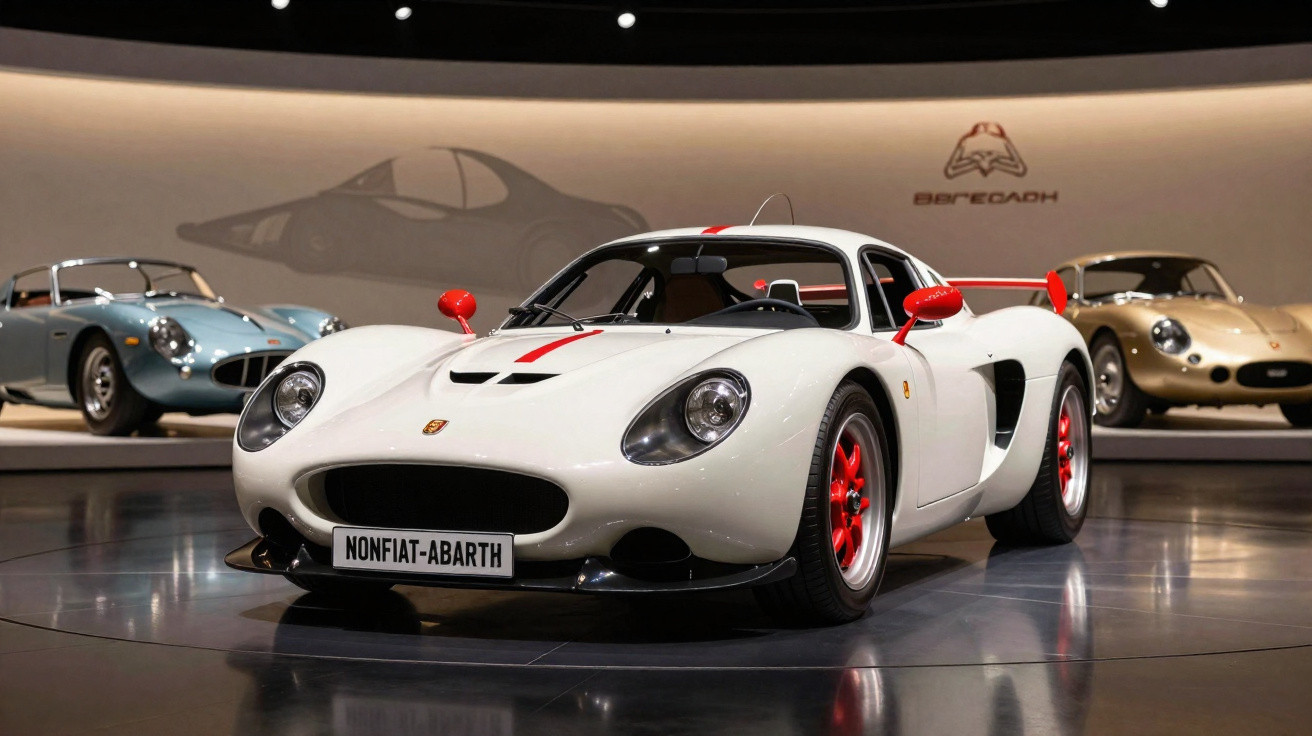
Abarth was founded in 1949 by the Italo-Austrian Carlo Abarth. The marque became famous for two things: first, the scorpion badge, and second, the way it spent much of its history turning sensible Fiats into cars capable of serious performance and big hits of adrenaline.
Still, don’t be misled by Abarth’s (long) association with Fiat. Although the company focused on reworking models from the Italian brand almost from day one-and was ultimately bought by Fiat in 1971-the relationship was never exclusive.
Whether acting as a tuner or a manufacturer in its own right, the scorpion also managed to “sting” brands such as Porsche, Ferrari, Simca and Alfa Romeo-and, of course, it even built its own models.
Here are 9 non-Fiat Abarths, plus one “extra”:
Cisitalia 204A Abarth Spider Corsa
Interestingly, the first model to carry the Abarth name was also the last to be badged Cisitalia (a marque that would go bankrupt not long afterwards). Launched in 1948, just five examples of this sports car were built.
Created with racing firmly in mind, the Cisitalia 204A Abarth Spider Corsa racked up 19 victories. It was also the car in which the legendary Tazio Nuvolari claimed his final win, at the wheel of the Cisitalia 204A Abarth Spider Corsa.
Under the bonnet sat an engine derived from the unit used in the Fiat 1100, fitted with twin Weber carburettors and producing 83 bhp. Paired with a four-speed manual gearbox, it could push the 510 kg Cisitalia 204A Abarth Spider Corsa to 190 km/h.
Abarth 205 Vignale Berlinetta
After leaving Cisitalia behind, Carlo Abarth turned his attention to building cars under his own name. His very first was the striking 205 Vignale Berlinetta, which used the same Fiat four-cylinder engine as the Cisitalia 204A Abarth Spider Corsa.
The bodywork was built by Alfredo Vignale, while the styling was penned by Giovanni Michelotti. In total, only three units of this compact coupé were produced, and it tipped the scales at around 800 kg.
Ferrari-Abarth 166 MM/53
Styled by Carlo Abarth and developed from the Ferrari 166, the Ferrari-Abarth 166 MM/53 remains the only Ferrari to have received the Abarth touch. It was commissioned by racing driver Giulio Musitelli, who competed with the car. Beneath Abarth’s body sat a Ferrari V12 with just 2.0 l of displacement and 160 bhp.
Porsche 356 Carrera Abarth GTL
In September 1959, Porsche partnered with Carlo Abarth to build, initially, 20 competition cars based on the 356B. The end result was the 356 Carrera Abarth GTL, engineered to take on rivals in the GT class.
Lighter than the standard car it was based on-and wearing distinctive bodywork designed and manufactured in Italy-the “Porsche-Abarth” used air-cooled, four-cylinder boxer engines: 1.6 l units producing 128 bhp to 135 bhp, and 2.0 l versions delivering 155 bhp to 180 bhp.
Although the 356 Carrera Abarth GTL achieved strong results in the events it contested, Porsche chose to terminate its contract with Abarth once the first 21 cars were completed. The reason was straightforward: quality issues in the earliest prototypes, combined with initial delays, left a lasting impression on Porsche and led to the split.
Abarth Simca 1300 GT
When Simca decided it wanted a faster version of the modest 1000, the French brand quickly turned to Carlo Abarth. The agreement saw Abarth build several prototypes based on the Simca 1000, and the outcome was something very different from the original car: the Abarth Simca 1300, built between 1962 and 1965.
It gained a new, far more aerodynamic (and more overtly sporting) body, plus a new engine: the small 0.9 l 35 bhp unit was replaced by a 1.3 l producing 125 bhp. From the 1000, little carried over beyond the chassis, suspension and steering, as the brakes were upgraded to discs on all four wheels.
The result was a compact sports car weighing just 600 kg (200 kg less than the Simca 1000) and capable of an impressive 230 km/h. It was followed by the 1600 GT and 2000 GT; the latter featured a 2.0 l engine with 202 bhp, enabling it to reach 270 km/h.
Simca Abarth 1150
The second entry from the Abarth–Simca partnership is the spicier take on the Simca 1000. Unlike the 1300 GT, the approach here was less extreme: the Simca 1150 was essentially an improved version of the humble French model.
Introduced at the end of 1964, it remained on sale only briefly, as Chrysler’s purchase of Simca led to its disappearance in 1965. Offered in four versions, output ranged from 55 bhp up to 85 bhp, with intermediate options delivering 58 bhp and 65 bhp.
Autobianchi A112 Abarth
Built from 1971 to 1985, the Autobianchi A112 Abarth was created primarily to take on the Mini Cooper and its Italian counterpart, the Innocenti Mini.
There were seven versions of the Autobianchi A112 Abarth in total, and 121,600 units of the mischievous city car were produced. It launched in 1971 with a 1.0 l engine producing 58 bhp, and went on to appear in multiple variants-most notably those fitted with a five-speed manual gearbox or a 1.0 l unit making 70 bhp.
Abarth 1300 Scorpione SS
Manufactured between 1968 and 1972 by the Italian firm Carrozzeria Francis Lombardi, the Abarth 1300 Scorpione SS went by several names. Over its lifetime it was known as the OTAS 820, Giannini and, naturally, Abarth Grand Prix and Scorpione.
Unveiled at the 1968 Geneva Motor Show, the Abarth 1300 Scorpione SS would become the last product developed by Abarth while it was still an independent marque (it would be acquired by Fiat in 1971).
Technically, it featured a 1.3-litre inline four-cylinder engine with twin Weber carburettors, producing 100 bhp, matched to a four-speed manual gearbox. It also had independent suspension on all four wheels and four disc brakes.
Lancia 037
Following its purchase by Fiat, Abarth was tasked with preparing and developing the group’s competition cars. One prime example is the Lancia 037, the last rear-wheel-drive car to win the World Rally Championship.
With a rear mid-mounted engine, a tubular subframe, independent suspension and two huge bonnets (front and rear), this “monster”-developed by Abarth together with Lancia and Dallara-also spawned a road-going homologation model, the 037 Rally Stradale, with 217 units built.
Another Lancia developed by Abarth was the 037’s successor in rallying: the mighty Delta S4. Like its predecessor, it too came with a road version for homologation purposes, the S4 Stradale.
Abarth 1000 Monoposto
Designed entirely by Carlo Abarth in 1965, the Abarth 1000 Monoposto delivered the brand’s hundredth world record and went on to set four world records in total. Carlo Abarth himself drove it and, at 57 years old, undertook a strict diet-losing 30 kg-so he could fit into the tiny cockpit.
Powering this highly aerodynamic single-seater was a 1.0 l Fiat engine derived from the unit used in Formula 2 in 1964. The twin-cam engine produced an impressive 105 bhp, enough to propel the single-seater’s mere 500 kg.
Abarth 2400 Coupé Allemano
OK… this final car is derived from a Fiat-the 2300-but its one-off bodywork and the fact it was one of Carlo Abarth’s favourites (it served as his daily car for several years) earned it a place in this selection.
Shown in 1961, the Abarth 2400 Coupé Allemano was an evolution of the 2200 Coupé based on the Fiat 2100. The design was handled by Giovanni Michelotti, while production was carried out by the Allemano workshop (hence the name).
Under the bonnet was a straight-six fitted with three twin-choke Weber carburettors, capable of producing 142 bhp. The Abarth 2400 Coupé Allemano also featured a completely redesigned exhaust system.
Curiously, even though production ended in 1962, Carlo Abarth decided to take an example of the Abarth 2400 Coupé Allemano to the 1964 Geneva Motor Show-such was the affection he had for the car.
Comments
No comments yet. Be the first to comment!
Leave a Comment