
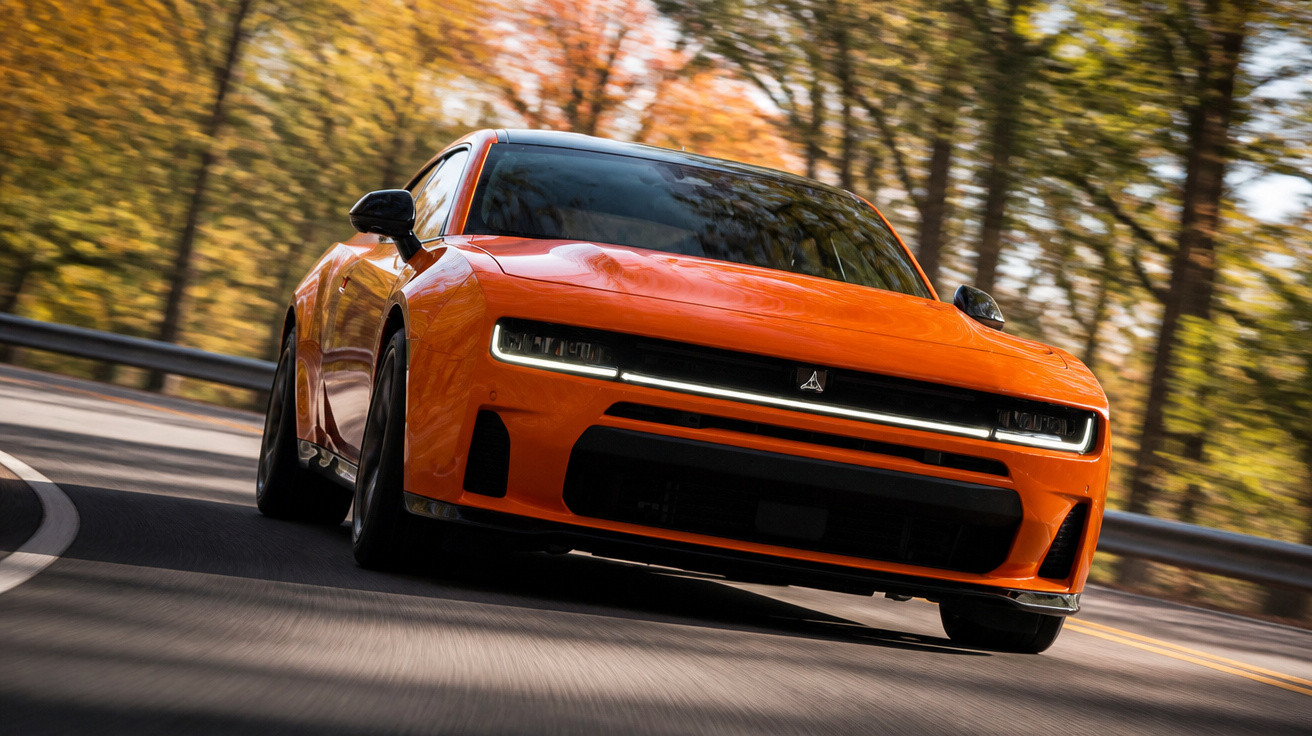
ICE is back with a brand new edition, huh?
Absolutely. Dodge’s newest Charger only arrived on the road last year, debuting first as the attention-grabbing Charger Daytona - the so-called “EV muscle car” that drew a fairly divided response. Now it’s the Sixpack’s turn: a Charger powered by a twin‑turbo straight‑six.
Is this because the Charger EV is bad?
No - not in the slightest. This was always how Dodge intended to roll things out, although the Daytona undeniably launched with the odds stacked against it. Converting the Dodge faithful to an EV was always going to be a huge ask, no matter how much better it might be than a combustion alternative. Even so, everyone wanted to know whether an electric car could truly deliver the muscle-car experience.
In practice, the Daytona is genuinely persuasive. In Scat Pack form, it offers nearly 700hp, and it pairs that shove with a ride that’s far smoother and more composed than you might expect - more than capable of satisfying spur-of-the-moment drag-race urges. It also turns in with more competence than we anticipated, if we’re honest. That said, it was soundly beaten in the court of public opinion, and its cringe-inducing faux exhaust soundtrack hardly helped.
Taken as a whole, the Charger Daytona is stronger than the critics (and, oddly, Dodge itself) have made it seem - to the point that Dodge appears to have downplayed the Daytona’s EV nature so much that its website barely even highlights it. With that, and the brand’s renewed lean into old-school attitudes, it feels like the right moment to uncork a Sixpack.
What are the details?
The Dodge Charger Sixpack uses a 3.0‑litre twin‑turbo straight‑six producing 550 horsepower (about 410 kW) and 531lb ft of torque (around 720 Nm). Drive is sent to all four wheels via an eight‑speed automatic gearbox - at least to begin with. This is the “high output” version; a “standard output” model is due later next year for the cheaper R/T, using the same engine but with 420hp (about 313 kW).
We say “to begin with” because the Charger can apportion torque in several ways depending on what the driver wants. In its default setting it sticks to a 50/50 split, but switch into Sport and it moves to a 40/60 balance biased to the rear. And if the concept of a four-wheel-drive muscle car makes your skin crawl, there’s a single button that sends all the power to the rear.
Underneath, it sits on a multi‑link aluminium suspension setup, while Brembo brakes handle stopping duties.
What are the big differences between the Sixpack and the Daytona?
A couple of key points are worth flagging straight away. First, this latest Charger was engineered from day one as a “multi‑energy” car, so it isn’t a case of cramming batteries into a redundant transmission tunnel or anything similarly compromised. Building it as ICE or BEV wasn’t a last-minute pivot in either direction. As a result, the finished cars end up very close in overall concept, though the differences that do exist are inevitable. The Daytona’s delivery and character shift slightly because of the EV platform’s power and torque, and it also carries that unfortunate sound pack - something the Sixpack simply doesn’t require.
Park them next to each other and the family resemblance is obvious: both have slippery, aero-led surfaces and a distinctive look that nods to Charger heritage. At the nose, the Sixpack’s front fascia is opened up to pull in as much cooling air as possible for its hard-working engine (and its brakes). It also gets a bonnet bulge stamped “Sixpack”, rather than the Daytona’s smoother pass‑through bonnet channel. From there rearwards the themes stay familiar, although the Sixpack now wears twin exhaust tips tucked into the rear diffuser.
Inside, telling them apart is difficult - the main giveaway is the absence of the BEV’s push‑to‑pass “powershot” button on the steering wheel. The interior itself is a modern interpretation inspired largely by the 1968 Charger, with a layout that’s purposeful, driver-oriented and straightforward to use. Expect sporty seats with fixed headrests, a contemporary spin on the pistol‑grip shifter, a 12.3in driver display, plus either a 10.25in or 16in digital driver display that you can tailor with a few quick button presses.
One more thing: both versions are seriously heavy. That mass shapes how they differ from one another, and it’s also central to the way each behaves - which brings us neatly to how the Sixpack drives.
So wait, can it actually take a corner?
The stereotype that American muscle cars can’t handle hasn’t been completely erased, but this new Charger is far more capable than many will expect. Right away, the steering comes across as sharp, and that responsiveness stays consistent across the different modes. It’s helped along by strong road feel - the car relays what the surface is doing clearly. With the default 50/50 split, the Sixpack feels settled and predictable; and although Sport’s rear bias isn’t dramatic, it gives the vibe of a rear‑drive car with big safety nets (namely the front axle) ready to haul you back out of trouble.
Dodge’s launch-event test for the Charger was a blast along the notorious “Tail of the Dragon” - an 11‑mile (about 17.7 km) stretch of mountain tarmac straddling the Tennessee–North Carolina border. A chunky, wide muscle car tackling 318 nausea-inducing bends? Why not.
On that demanding, constantly changing ribbon of road - especially with the weather shifting - the Charger felt stable and reassuring. Muscling a weighty car through endless hairpins was never going to be effortless, but the accurate steering helped build confidence. If anything held it back most, it was the sheer width and how it straddled the lane; the brakes and the gearbox were the next biggest limitations.
On a route like this, we’d have preferred more initial bite from the brakes to match how quickly situations develop, and we also wanted a quicker-reacting gearbox. Here, even when shifting manually, it struggled to keep up with split-second changes. The half‑paddles, incidentally, are easy to lose among the other controls behind the wheel.
But can it daily?
Arguably the Charger’s most understated trait - something especially evident on the Charger Daytona - is just how adaptable it is. It’s not a crossover or a hatchback, but the four‑door will carry a family in reasonable comfort, with plenty of space left in a cargo area that’s almost comically long - as though it’s quietly pretending to be a hatch.
Passenger volume is quoted at 103 cu ft (about 2.92 m³), while the boot offers 22.7 cu ft (around 0.64 m³). Fold the rear seats down and total cargo capacity rises to 37.3 cu ft (approximately 1.06 m³) - conveniently enough for a full set of wheels, should you fancy taking your dancing shoes to the track. Combined with the all-wheel drive, it’s set up to be a genuine all-rounder rather than a toy reserved for weekends.
What’s the final takeaway?
The Dodge Charger Sixpack puts a surprisingly versatile spin on the classic muscle-car recipe, giving drivers a wide range of choices. Where a modern rival like the Ford Mustang is determined to stick rigidly to its established blueprint, the newest Charger is adaptable enough to suit whatever role it’s asked to play - from a solid, dependable daily to a drift-happy rear-led plaything, and just about everything in between.
That flexibility also covers door count and powertrain. Two‑door Charger Sixpacks start at $54,995 and are available for delivery now, while the four‑door can be ordered for an additional $2,000. The Charger Daytona is also on sale at $59,995, and the $49,995 Charger R/T Sixpack remains on course to arrive next year.

Comments
No comments yet. Be the first to comment!
Leave a Comment