
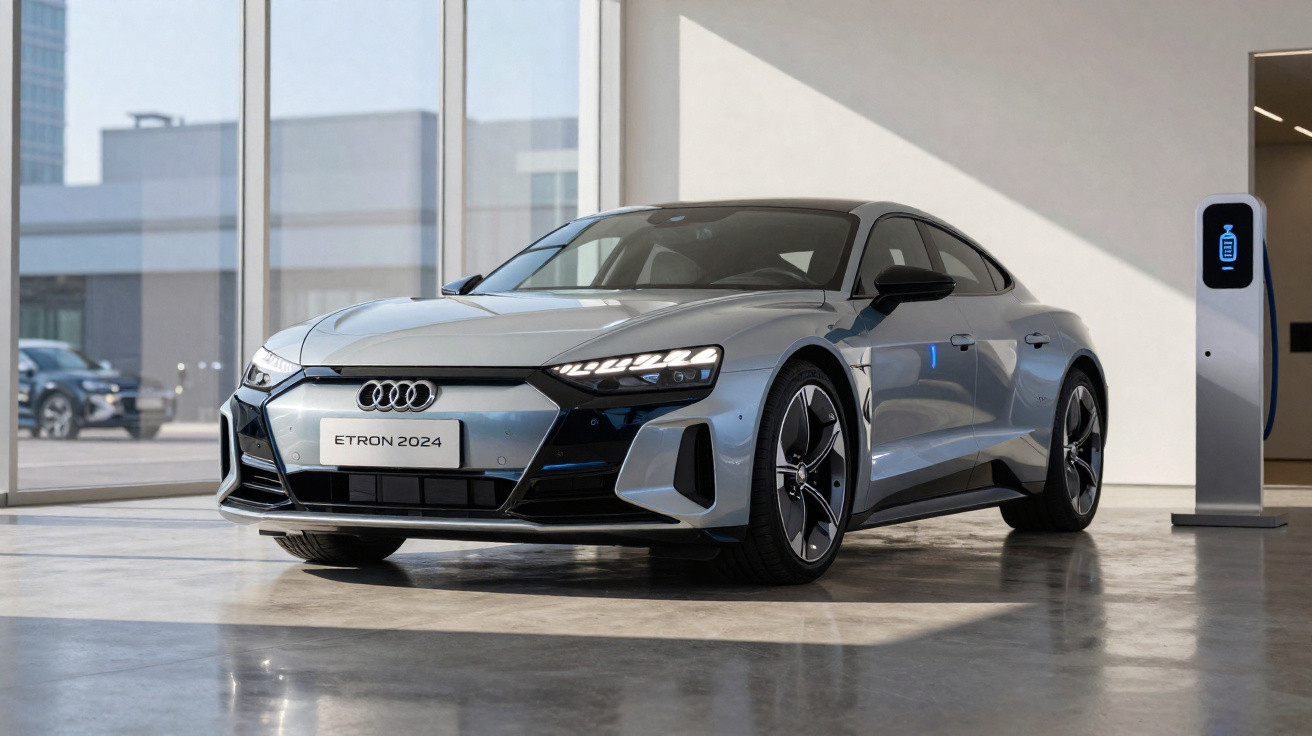
The Audi e-tron GT 2024 follows the same path as its "cousin", the Porsche Taycan - with which it shares its entire technical foundation - arriving with longer range, quicker charging speeds and more power… far more power.
At the same time, the line-up has been reorganised and, for now, it is reduced to three versions wearing Audi’s sportiest badges: S, RS and RS Performance.
All three variants use two electric motors (one per axle). The entry-level S e-tron GT immediately raises the bar with 500 kW of power, equivalent to 680 hp - that is 34 hp more than the previous RS e-tron GT. It completes the 0–100 km/h sprint in just 3.4 s and reaches a top speed of 245 km/h.
The RS e-tron GT lifts output to 630 kW (857 hp), but it is the RS e-tron GT Performance that steals the headlines with 680 kW (925 hp), making it the most powerful road-going Audi ever by a wide margin.
Audi claims the RS e-tron GT accelerates to 100 km/h in a scant 2.8 s, while the RS e-tron GT Performance cuts that to 2.5 s. Top speed is set at 250 km/h for both.
Another key update for the Audi e-tron GT 2024 is a standard boost function on the RS and RS Performance. It enables a temporary 70 kW (95 hp) increase for 10 seconds. Activation is via the left control satellite on the steering wheel, and there is even a visible countdown in the cockpit.
Bigger battery, but lighter
As already seen on the Taycan, the Audi e-tron GT has shed weight in several areas. The rear-axle motor is 10 kg lighter, and the battery has also slimmed down by 9 kg - even so, the battery still weighs 625 kg.
The weight reduction is notable because capacity has increased to 97 kWh net (105 kWh gross), up from the previous 84 kWh net (93 kWh gross). As expected, range benefits too, now reaching up to 609 km (WLTP combined cycle).
Beyond the larger-capacity battery, Audi has also raised DC charging power for the e-tron GT 2024 to a peak of 320 kW, which is 50 kW more than before. It takes just 18 minutes to move the battery state of charge from 10% to 80%.
Dynamic improvements
There are further changes that mirror what we have seen on the Porsche Taycan, including new steel brake discs and the adoption of a two-chamber/two-valve air suspension, which provides a wider spread of damping adjustment.
Optionally, the e-tron GT can be specified with Porsche’s active suspension system, which promises to virtually eliminate body movement in corners, under braking or during acceleration. It also adds a function designed to make getting in and out easier, allowing the car to rise between 55 mm and 77 mm in a matter of seconds.
Also on the options list, the Audi e-tron GT 2024 can be fitted with rear-wheel steering, with the rear wheels able to turn by up to 2.8°.
Different, but the same
Last but not least, the e-tron GT has received a handful of interior and exterior updates, although they are deliberately understated.
To make it easier to tell the S e-tron GT apart from the more powerful RS e-tron GT versions, the S features silver triangular inserts in the front air intakes, while the RS uses a more aggressive "L"-shaped intake design.
In addition, there is a new hexagonal pattern in the Single Frame (front mask), while the rear diffuser has been redesigned. New wheels and new paint colours are also part of the update.
Inside, the changes are even more subtle, with new seats, a new steering wheel and a virtual cockpit that displays more information.
There are also new, more sustainable materials, and an intelligent panoramic roof is now available as an option. At the press of a button it can turn opaque, thanks to polymer-dispersed liquid crystal (PDLC) technology.
When will it arrive?
All three versions of the Audi e-tron GT 2024 are already available to order. Prices are structured as follows:


Comments
No comments yet. Be the first to comment!
Leave a Comment