
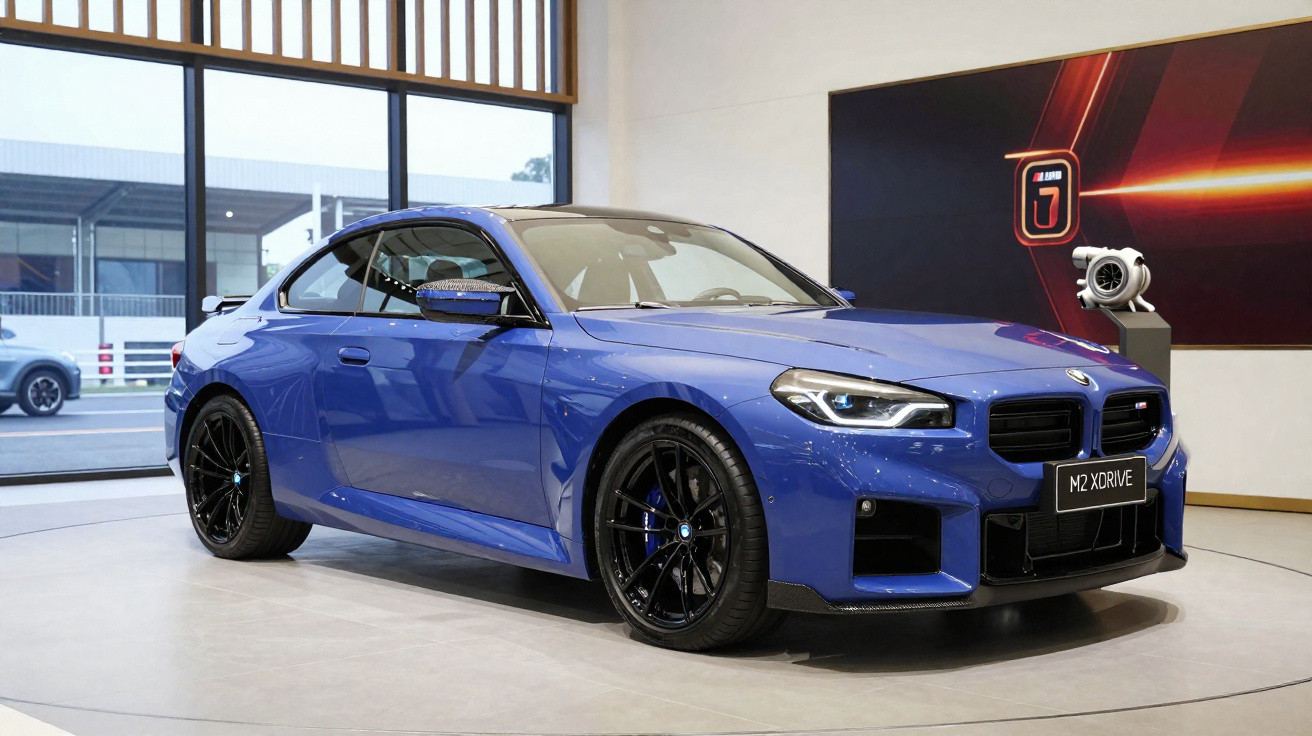
The latest generation of BMW M models has arrived with major revisions. They have gained power and technology, grown in size, put on weight and even added an extra driven axle - with the M3 and M4 as clear examples.
Against that backdrop, the BMW M2 has largely stuck to the template that helped forge the M division’s reputation: a more compact footprint, an inline six-cylinder engine, rear-wheel drive and a manual gearbox.
For many enthusiasts, the M2 looked like the last true keeper of the original BMW M formula. That is now changing.
M xDrive arrives on the BMW M2
For the first time ever, the M2 can be specified with the M xDrive all-wheel-drive system. Yet, as with the M3 and M4, one control makes all the difference, allowing this M2 to continue to operate as a genuine rear-wheel-drive car.
BMW M Ignite and the updated S58 straight-six
The changes go beyond all-wheel drive. BMW M has also used the moment to introduce the latest evolution of the S58 inline six, retaining the 3.0 litres and twin-turbo set-up. As a result, the M2 xDrive becomes the first model to debut BMW M Ignite technology on the M division’s six-cylinder engines.
Developed in-house by the German manufacturer and inspired by motorsport, this system uses a pre-chamber combustion design to ignite the air–fuel mixture more effectively. According to BMW, the approach reduces fuel consumption under high load, is already compliant with the Euro 7 standard (which comes into force in November), and does so without harming performance.
From mid-2026 onwards, this technology will be fitted to all M six-cylinder engines intended for the European market.
Has it become more powerful?
It has not gained any extra output. The BMW M2 xDrive keeps the same 480 hp and 600 Nm of torque as the rear-wheel-drive M2. However, the added traction from the front axle improves the 0–100 km/h sprint, even cancelling out the 65 kg disadvantage versus the rear-wheel-drive M2. The benchmark is now 3.7s - 0.3s quicker than the two-wheel-drive version - while 200 km/h is reached in 12.8s.
Top speed remains capped at 250 km/h, rising to 285 km/h with the optional M Driver’s Package.
How the all-wheel-drive system operates
It is important to note, however, that this all-wheel-drive system is not permanent. In practice, the rear axle continues to receive torque most of the time, with drive sent to the front axle via a clutch whenever a loss of grip is detected.
Several modes are available: 4WD, 4WD Sport (which directs more torque to the rear axle) and, naturally, 2WD (rear-wheel drive). The 2WD setting is only accessible with DSC switched off (Dynamic Stability Control).
Rear-wheel drive is here to stay
Even though the 2026 BMW M2 will be offered, for the first time, with all-wheel drive, the smallest BMW M will continue to be sold in rear-wheel-drive versions paired with both manual and automatic gearboxes.
The BMW M2 xDrive is already available to order in Portugal, with prices starting at 101,900 euros - around 3,000 euros more than the rear-wheel-drive M2 with the automatic gearbox. Interestingly, it is only 106 euros more expensive than the manual M2.
Comments
No comments yet. Be the first to comment!
Leave a Comment