
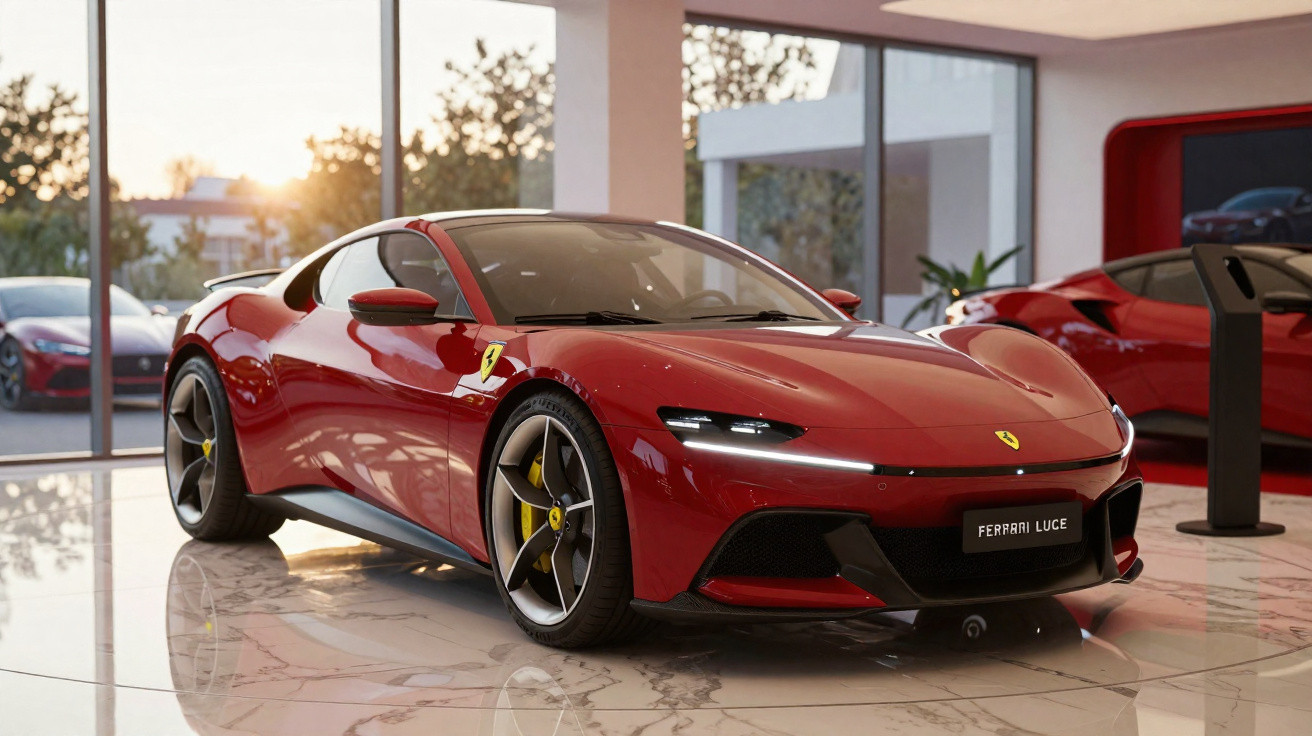
Using this opinion column to talk about the Ferrari Luce’s styling would, as Guilherme Costa likes to say, be “stating the obvious”. In the wake of the unprecedented global shock triggered by Maranello’s first electric car, there are reasons beyond the shape of the bodywork that could leave Enzo Ferrari turning in his grave.
The Luce may look odd, too big, or even like it has nothing to do with a Ferrari - but that is only one part of the headache. The argument about how it looks was unavoidable, and also the easiest one to have. Now that those who cannot tell a Ferrari from a Porsche have had their moment of FOMO (I work alongside journalists born after Expo 98 - don’t judge me), it is time to sit down and actually look at this properly.
To quote Harry Metcalfe - whom I had the pleasure of meeting a few months ago at a dinner, and who is one of the motoring journalists I most respect - “Ferrari didn’t need to have an electric car in its line-up, at this moment.” I could not agree more: the result feels like a stumble into full electrification.
From almost heaven to hell
The interior came first, unveiled in Silicon Valley, and even if it split opinion, it also attracted a long list of supporters. More physical buttons, fewer screens, more metal, analogue dials, glass… what is not to like? On top of that, it was a collaboration involving Johny Ive, and Flavio Manzoni - Ferrari’s head of design - remained at the helm of the project overall.
I understand the argument that his recent work for the brand has not always been universally loved (and it does not have to be - this is Ferrari, not Volkswagen…). Still, when you look at a modern Ferrari, there is broad agreement on something essential: it looks like a Ferrari.
Then came the exterior reveal - on that fateful night in Rome - and the division only deepened. The issue? The outside does not align with the cabin (Fernando thinks it does; I disagree, and Miguel Dias does too). There is, however, one point where a consensus seems clear: almost nobody was convinced by the Luce, and on that we can all agree.
The shape of the car drowned out everything written in the lengthy press release that accompanied the launch. “We don’t care about the specifications, or anything else - it’s awful!”, you can read in countless comments on our social channels. Fair enough… but we are an automotive publication, and we are going to look at everything.
The good students go to class
While the Luce was being developed, Porsche was effectively running lessons on “what not to do when a luxury brand, with customers used to sports cars with internal-combustion engines, develops an EV.” And it seems Ferrari did not show up. A shame, because Porsche went to the trouble of spending many billions of euros producing the literature that feeds the syllabus.
In the first module, one of the opening chapters could not be clearer: “doing 0 to 100 km/h in under three seconds isn’t enough.”
Porsche learnt that with the Taycan. And before anyone mistakes criticism for a lack of perspective: the Taycan was a hugely important car. It was the first EV from a traditional sports-car brand to prove that a battery-powered model could be more than a ridiculous straight-line acceleration trick for surprising unsuspecting passengers. From day one, the Taycan accelerated, braked and cornered like a Porsche.
It also proved that this alone was not sufficient. Once the initial shock wore off, the less romantic questions arrived. What is the range? Will it hold its value? Why does it cost so much when the range is worse than ordinary cars? And the software? These questions keep coming back - and they matter even more when someone is signing a six-figure cheque…
The problems with the Ferrari Luce
The Luce is the heaviest Ferrari ever, it carries a huge battery, it offers the biggest boot the brand has ever fitted, it has room for five adults, it claims to be the most comfortable Ferrari ever built, and its styling is the result of a hard focus on aerodynamic efficiency.
With that brief, this is not a car presented as an occasional-use toy; it is positioned as something to drive every day. To do that, it calls into question much of what we think we know about a Ferrari, in order to meet its mission as an EV with all those added attributes. Then comes the number nobody expected: it claims 530 km of range - which in real-world use could drop to just over 400 km.
Ferrari can reply that the Luce has 1050 cv, four electric motors, torque vectoring, performance from another planet, and a sound created from the vibrations of rotating components within the electric system.
All of that is interesting, and some of it may even be brilliant. But Porsche has taught all of us that, in a performance EV, the figures that sound boring are often the ones that matter most. Porsche worked out early that, in an electric car, range is also performance.
The Taycan eventually saw its range rise to nearly 700 km - but only years after arriving with a figure below 500 km, widely seen as one of its Achilles’ heels (alongside software issues and everything that haunted the model’s first generation, which still gives the brand headaches today).
All of this happened because, in truth, the Porsche Taycan arrived earlier than it should have. It was a pioneer at a time when EVs were taking tentative steps. But it was a pioneer that, for all intents and purposes, you look at and instantly recognise as a Porsche. In 2026, the pioneer argument cannot be used.
Too many obligations for a Ferrari
The Ferrari Luce was tasked with answering too many demands: space, comfort, resisting a fully digitised cabin, silence, technology, everyday usability, new customers, sustainability, and perhaps even soothing a few more anxious shareholders.
Trying to solve everything at once made the car exposed. An irrational Ferrari can be forgiven for being irrational. A poorly styled Ferrari can still sell out, to many people’s surprise. But a Ferrari that presents itself as a functional revolution has to be overwhelming in how functional it is.
In the final lesson, Porsche does not conclude with “don’t make an electric car”. It says something far more useful: if you do make an EV, do not ask the customer to accept too many compromises at the same time. Do not ask them to swallow a shift in identity, a challenging design, an overly high price, and an electric range that cars costing 10 times less can beat.
Ferrari did not have to build an EV now, and even having pushed ahead, it did not need to deliver the world’s longest-range electric car - just as it did not need to sketch an ode to nostalgia. But after giving up so much of the brand’s own imagery in the name of an EV, it should not leave the feeling that the effort was pointless.
The first tests are still missing
Perhaps the Luce will end up being an important Ferrari, remembered as the unavoidable first step of a new lineage. Perhaps the first Ferrari I ever drive will be the Luce (yes, several have passed through here, but I have never been handed one that was not stationary).
If, in a while, this piece ages badly, I will accept the verdict with the same calm with which I accept that some people think the FIAT Multipla is a beautiful car.
Even so, it is hard not to accuse Ferrari of skipping a few lessons. It walked into the final exam with confidence, dressed in a rather inappropriate way - and could at least have read the handouts from the classes it missed… it might have earned a better mark.
Comments
No comments yet. Be the first to comment!
Leave a Comment