
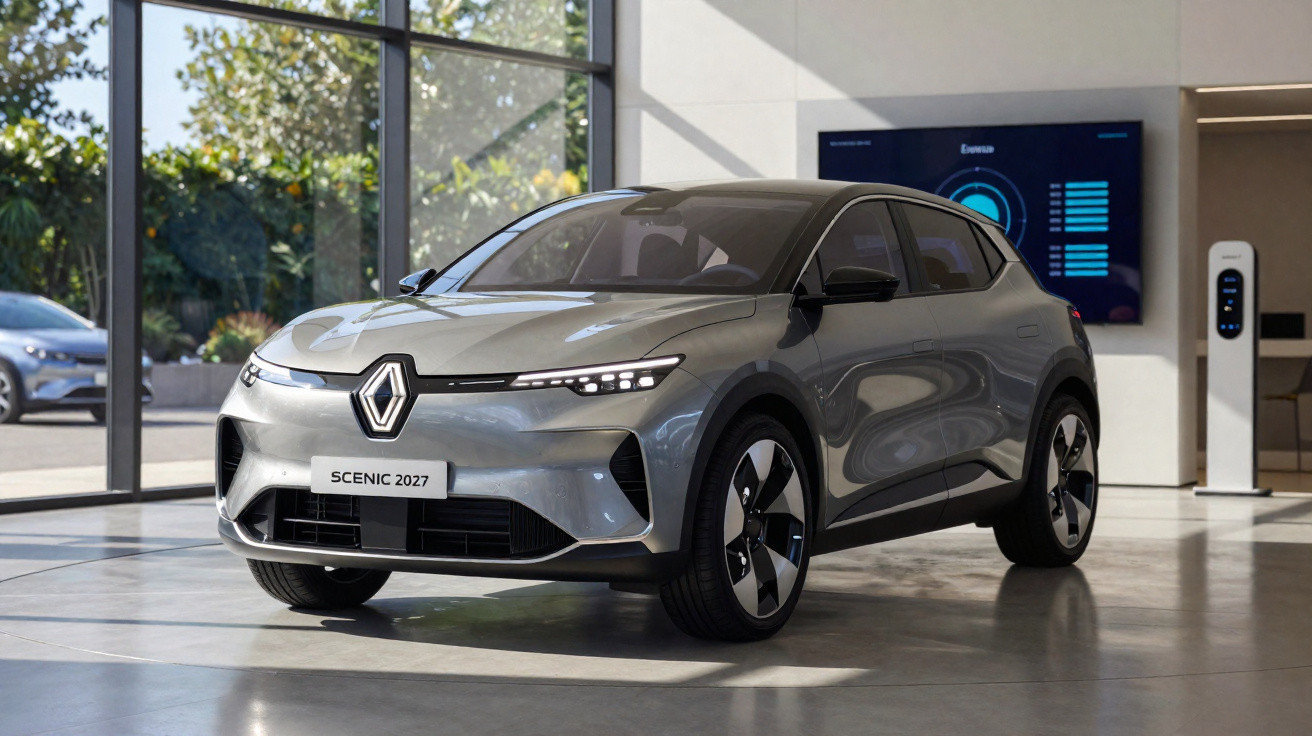
Launched in 1996, the Renault Scénic made history as Europe’s first compact MPV. Fast-forward 27 years to 2023 and it returned to Renault’s line-up, this time reinvented as a crossover powered solely by electrons.
Now, three years into its electric life, the Scénic is lining up for the usual "facelift" that most models receive during their commercial run. The proof is in the prototypes we have "caught" out testing, all wearing full-body camouflage.
Although its market arrival is pencilled in for 2027, we do not have to wait for Renault’s official unveiling to get a sense of what might change - and that is because the freshly updated Megane E-Tech is "to blame".
Thanks for the clues, Megane
The compact family car was updated just over a week ago, and we travelled to Barcelona to see it in person. Without meaning to, Renault has effectively handed us a clear guide to what could be in store for its electric SUV.
Renault Scénic exterior: revised lights and bumpers
Looking at the new Megane E-Tech, the most noticeable exterior tweaks are concentrated at the front. If the updated Scénic follows the same recipe, expect a new lighting signature made up of 16 diamond-shaped light points, along with a redesigned front bumper.
At the other end, the rear lights should also be refreshed, likely adopting a more geometric look in keeping with what we have seen on its smaller "sibling".
Renault Scénic interior: screens and Google Gemini
Inside, the changes are also expected to closely match those introduced on the new Megane E-Tech. That means the French crossover should retain the same pair of 12.3″ and 12″ displays for the instrument cluster and infotainment system respectively, with the latter set to be more connected than ever.
On the Megane E-Tech, the Google-based system has been updated, and all signs suggest the Scénic will receive the same treatment. Among the updates is the replacement of Google Assistant - the previous voice assistant - with Google Gemini, bringing artificial intelligence technology into the mix. At the same time, Google Maps is also expected to become more accurate than before.
On the Megane, the system now offers more detailed information about public charging stations. Along with other data, users can check the location, the number of available bays, estimated waiting time, and even whether the chargers are working.
More range? It’s a possibility
Beyond styling and tech, one of the biggest changes may be the adoption of a higher-capacity battery, particularly on entry-level versions that previously used the same 60 kWh battery as the earlier Megane.
It is worth recalling that, with the Megane update, the compact family model saw its battery capacity increase from 60 kWh to 67 kWh, and it now claims up to 500 km of range - a gain of 30 km compared with the previous model.
In that vein, the Scénic’s entry versions are expected to follow the same path, switching to this new battery for improved range. Meanwhile, the long-range versions should continue to use the 87 kWh pack, which promises more than 620 km between charges (WLTP).

Comments
No comments yet. Be the first to comment!
Leave a Comment