
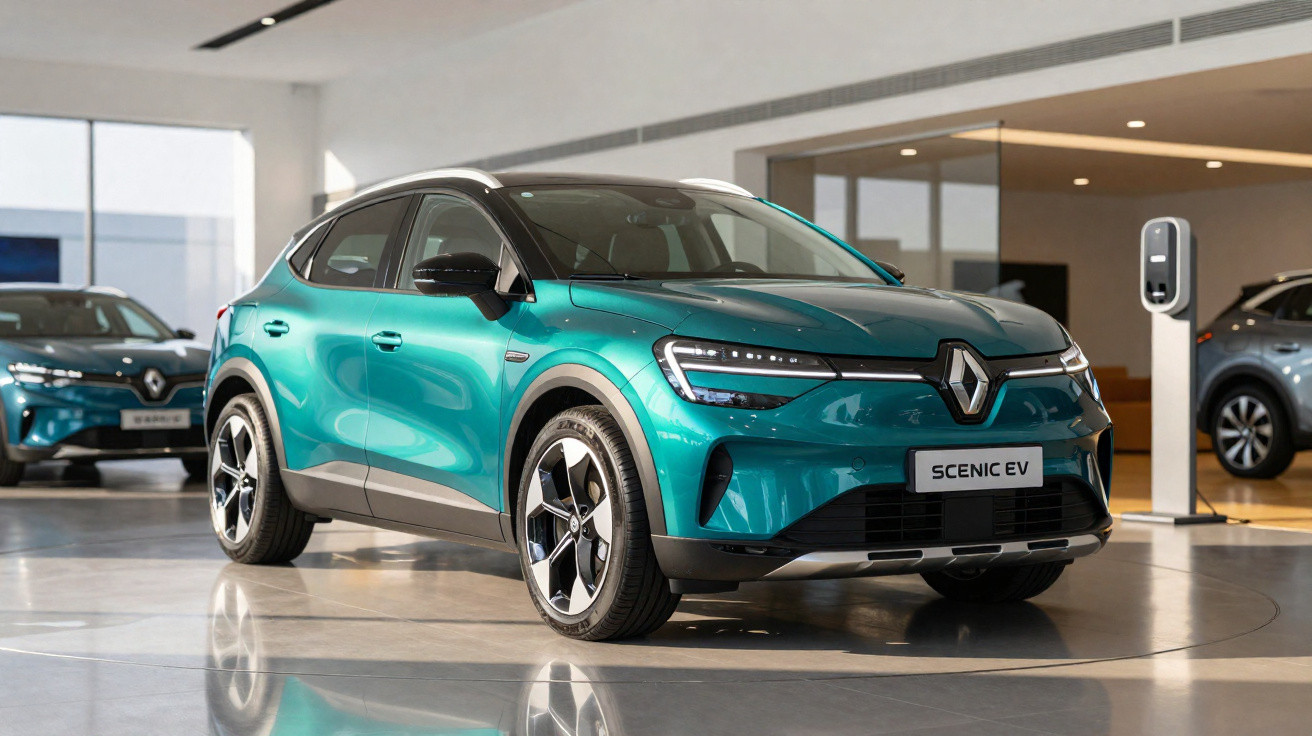
The Renault Scenic is now an all-electric crossover. Time to find out whether it is still the right car for families.
After 28 years on sale and five generations, the Renault Scenic has accepted the obvious and reshaped both its exterior and cabin concept into a crossover, leaving its MPV roots behind.
Under the skin it sits very close to the Megane E‑Tech, yet it is taller by 6 cm, wider by 10 cm and, most notably, longer by 27 cm. The wheelbase has also been stretched by 10 cm. Ground clearance would be identical, were it not for the Scenic’s larger wheel diameter, which ultimately creates a 2 cm difference between the two models.
As with the vast majority of recent electric cars, the Scenic’s 100% electric battery pack is positioned beneath the floor, between the two axles.
The car tested here - sent from Paris to Lisbon specifically for this dynamic drive as part of the European Car of the Year process, where it is one of the seven finalists - uses the 87 kWh battery. This is the largest offered in the range; the smaller option is 60 kWh.
Made by LG Chem, this battery “promises” a maximum range of 625 km, with charging at up to 22 kW on alternating current (AC) or 150 kW on direct current (DC).
An even more tech-focused Scenic
The layout, components and technology across the dashboard closely follow what we already know from the Megane E‑Tech and Espace. The intuitive Android operating system, with native Google apps (such as Maps, the Assistant and the Play Store), makes life considerably easier for anyone using mobile devices with this “genetic code”.
On top of that, this setup also streamlines voice interaction with the car (with excellent comprehension). The system is also fully compatible with Apple devices, connected either with or without a cable.
The digital instrument display and the central infotainment screen are almost the same size (12,3″ and 12,0” respectively). However, while the first is set horizontally, the second is mounted vertically and angled slightly towards the driver.
The (dated) stalk that operates the audio system - fixed to the steering column - feels like a “fish out of water” in an otherwise modern cabin. It is equally hard to justify the lack of a head-up display.
Thankfully, physical controls for the climate system and other frequently used functions remain, so you do not have to hunt through the central screen’s menus.
Most of the dashboard trim is hard plastic (though this top version includes a synthetic leather), leaving an overall impression of only average quality. Interestingly, the door bins have an internal lining (unusual in this class), yet the rear air vents only allow you to change the airflow direction.
Rearward visibility in the Renault Scenic is also hampered by the narrow rear window and the broad C-pillars, which makes the reversing camera particularly valuable.
Generous space on board
Up front, there is plenty of room and the area feels uncluttered, helped by the fact that the transmission selector and driving modes are now controlled from the steering wheel.
Thanks to the new Scenic’s very long wheelbase, the cabin offers ample legroom in the second row, even for passengers taller than 1,80 m (with legs to match).
The floor is flat in the middle, which improves freedom of movement for whoever sits there, even if that centre position still has the usual narrower cushion and a firmer backrest. Credit, too, to the rear centre armrest which, inside, includes lining, rails for mounting tablets, cupholders and USB sockets.
As an option, you can specify a panoramic roof with variable opacity (via a liquid crystal system). It can be set more opaque over the front row and clearer over the rear, or the other way around.
The boot is also worth highlighting: at 545 litres, it sits at the top of its class, even though 50 litres are located under the hatch in the floor. On the other hand, the large step between the tailgate opening and the load floor is impractical when lifting in or out bigger, heavier items.
Comfort “versus” dynamic behaviour
The suspension is independent at all four corners and the electric motor is mounted at the front, with no four-wheel-drive version planned. As with the cars tested three months ago in Paris, this Scenic that came to Lisbon wore huge 20″ alloys wrapped in 235/45 tyres.
Together with the inevitably heavy battery, this gives the car a notably abrupt ride - too firm over poor surfaces - although the flip side is more positive: impressive stability when driving quickly through a sequence of bends.
The 160 kW (218 cv) motor responds promptly and with plenty of punch, particularly in the Comfort and, above all, Sport modes. Alongside Eco and Perso, these make up the four available driving modes, selected using a button on the face of the steering wheel.
Room for improvement
The two weakest points in the new Renault Scenic’s dynamics are brake feel and steering. In the first case, there seems to be no braking response at the beginning of the pedal travel, and even once it starts working, the feel remains quite “spongy”. In other words, it is not the most confidence-inspiring sensation when you are managing more than 1,8 tonnes of car.
The steering, meanwhile, always comes across as very “synthetic” and light, creating a large disconnect between driver and road. It fluctuates between light (in Sport), very light (in Normal) and ultra-light (in Eco).
There are also three levels of deceleration/energy recuperation, chosen via paddles behind the steering wheel, but with relatively little separation between them.
On top of that, there is no “one pedal drive” function - meaning the Scenic will not come to a complete stop simply by lifting off the accelerator without using the brake.
Consumption higher than expected
Just as in Paris, consumption in Lisbon ended up above expectations, especially given the quoted figure of 16,8 kWh/100 km.
Even allowing for the fact that a test drive is typically more demanding than everyday use, the recorded 21,3 kWh will not deliver a range much beyond 400 km, even in this version with the largest-capacity battery.
The trip computer always shows two remaining-range figures: a lower one marked as fast motorway driving, and a higher one if the remaining journey is completed in urban areas. As an example, at one point in the test with the battery at 73%, we had 337 km “in our pocket”, which could fall to 251 km on the motorway or stretch to 462 km in the city.
Scenic in Portugal
For the Portuguese market, prices for the new Renault Scenic start at 40 690 euros for the Evolution version, paired with the 125 kW (170 cv) motor and the 60 kWh battery, which claims a maximum range of 430 km. Alternatively, the Techno version costs 43 490 euros, fitted with the same electric system and battery.
For the more powerful version (218 cv) with the larger battery (87 kWh) - like the unit we had the chance to drive - there are four trim levels available: Evolution, Techno, Esprit Alpine and Iconic. In this case, pricing runs from 49 300 euros for the Evolution to 52 650 euros for the Iconic, which is the one you can see in this test.
For the higher-output version, prices are in line with what will very likely be its main rival: the new Peugeot e‑3008, in 157 kW (213 cv) form with a 73 kWh battery. That pack is smaller than the Scenic’s 87 kWh, and it gives up 100 km of range to the Renault: 525 km vs 625 km.
Comments
No comments yet. Be the first to comment!
Leave a Comment