
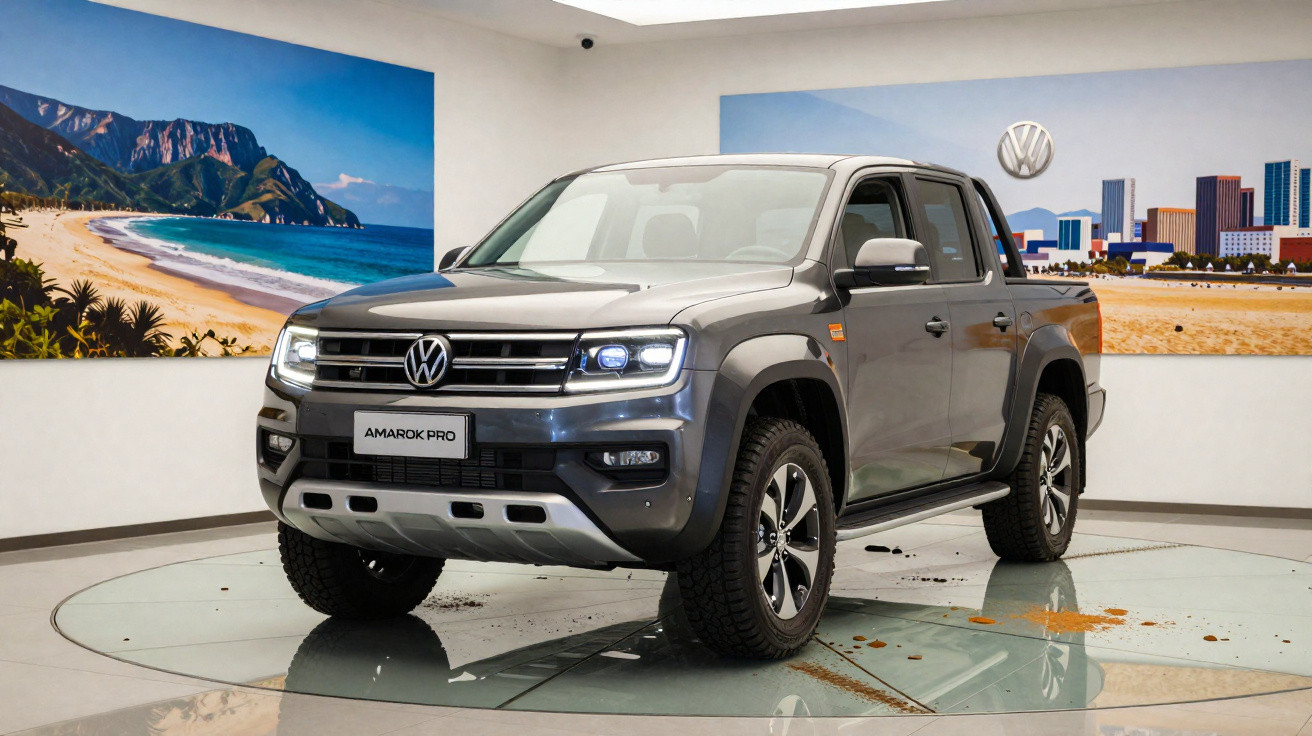
It may look like a workhorse, but the Volkswagen Amarok is far more than that.
Do you remember the Volkswagen Amarok? Volkswagen’s first pick-up arrived in 2010 and effectively forced its rivals to raise their game in a segment that had felt largely stagnant.
Almost 14 years on - and with more than 830,000 sold worldwide - I finally had the chance to get behind the wheel of the second generation. It is now built on the same production line as the Ford Ranger at the Silverton plant in South Africa, and it shares almost everything with its Blue Oval counterpart.
Even so, unless you focus on details such as the shape of the window frames, the family resemblance to its “twin sister” is not immediately obvious. Volkswagen clearly worked hard on this: from the outset, it is unmistakably a Volkswagen.
Despite being a more rugged-looking pick-up, the Volkswagen Amarok still manages to present a genuinely appealing image.
Up front, it features LED headlamps with a model-specific light signature, along with the IQ.Light system. At the rear, the lighting signature is also unique, and the tailgate - with “Amarok” embossed in raised lettering - leaves no doubt about what you are looking at.
The Volkswagen badge is similarly oversized and cleverly conceals the reversing camera for parking assistance. Along the side, the 4Motion script confirms the presence of the four-wheel-drive system.
Pick-up or car?
From the driver’s seat, the cabin is a long way from the utilitarian image many people still associate with a pick-up. Typically, these vehicles prioritise hard-wearing finishes over visual appeal; here, however, the upper dashboard and door tops are trimmed in leather, with contrasting stitching.
The driving position now feels much closer to that of a conventional family car and far less like a “work” vehicle. The steering column and wheel sit exactly where you want them, and the wheel frames a fully digital instrument cluster with bespoke animations for each driving mode. In the “Slippery” setting, you can even see raindrops animated on the display.
Space is not an issue in this Double Cab body with five seats, whether in the front or the rear. Back-seat passengers no longer sit bolt upright as they did in some older models from years past, making longer journeys noticeably more comfortable. There is also a 230 V socket, allowing you to plug in chargers or other devices as if you were at home.
Because it is a pick-up, one drawback remains: there is no conventional boot, only a large load bed. Payload is close to one tonne and, as an option, Volkswagen offers several solutions to shield this area from prying eyes.
In terms of the cabin, the Volkswagen Amarok manages to be both comfortable and genuinely practical, even with small families on board and plenty of items to carry.
Bring on the bad weather
Between the front seats you will find the selector for the 10-speed automatic gearbox - identical to the Ford Ranger’s - as well as a rotary controller for the available drive settings: rear-wheel drive, automatic four-wheel drive, permanent four-wheel drive high range, and permanent four-wheel drive low range (low gearing). When needed, a rear differential lock is also on hand.
Ten ratios may sound excessive, but here it makes sense. There always seems to be a gear that delivers exactly the right dose of torque for the moment, and the 205 hp 2.0 TDI makes the most of it.
Across almost the entire test - with rain for 99.9% of the time - I chose permanent four-wheel drive with automatic management. At lower speeds it drives all four wheels, but as speed rises it shifts responsibility to the rear axle to help reduce fuel consumption.
Even when conditions outside are at their worst, the atmosphere inside the Volkswagen Amarok remains calm. When the route includes tracks that are difficult to walk, the four-wheel-drive system rarely demands anything beyond the automatic setting.
With low range engaged, it became clear I would need time to discover where the Volkswagen Amarok’s true limits lie.
Tarmac, mud, sand or… anything
On the road or off it, the tyres fitted to the test vehicle feel like an excellent all-round choice for most circumstances - especially given that the weather was anything but kind during this drive. It only made me like the Amarok more.
On broken surfaces, the familiar rear-suspension “hop” is still present, a reminder that the leaf-spring set-up is designed to handle heavy loads - and that I was driving with an empty load bed. Even so, it is a world away from what I expected, showing just how much the Volkswagen Amarok has progressed in this area.
In town, or in tighter multi-storey car parks, guiding something that is 5.36 m long, almost 1.92 m wide, and with a roof antenna more than two metres from the ground will never be effortless.
However, the Volkswagen Amarok provides help where it matters, making manoeuvres far easier thanks to front and rear parking sensors and a reversing camera.
Considering the Volkswagen Amarok’s size and weight - above 2.3 tonnes - the 2.0 TDI came across as noisier and thirstier than ideal. At motorway speeds it has to contend with aerodynamic noise from this large package, and in mixed driving it ends up needing almost 10 litres of fuel for every 100 kilometres travelled.
Much more than an SUV
The Volkswagen Amarok tested here was in Style specification, positioned neatly between Life and Aventura, both of which are available in the national market.
With the 205 hp 2.0 TDI engine and Double Cab layout (four doors and five seats), pricing starts at €60,573. With the options fitted to this example - most of them aimed at making everyday use easier - the final figure climbs to €64,074.
It is not a small amount, but it is worth remembering that the Volkswagen Amarok is something of a Swiss Army knife in terms of capability, able to meet the vast majority of challenges you can throw at it.
Some of those challenges can be critical - including saving lives:
To make it truly complete, the remaining step is to choose one of the solutions designed to protect the load bed. After that, every trip needs planning with the fact in mind that the Volkswagen Amarok is Class 2 for tolls.
Comments
No comments yet. Be the first to comment!
Leave a Comment