
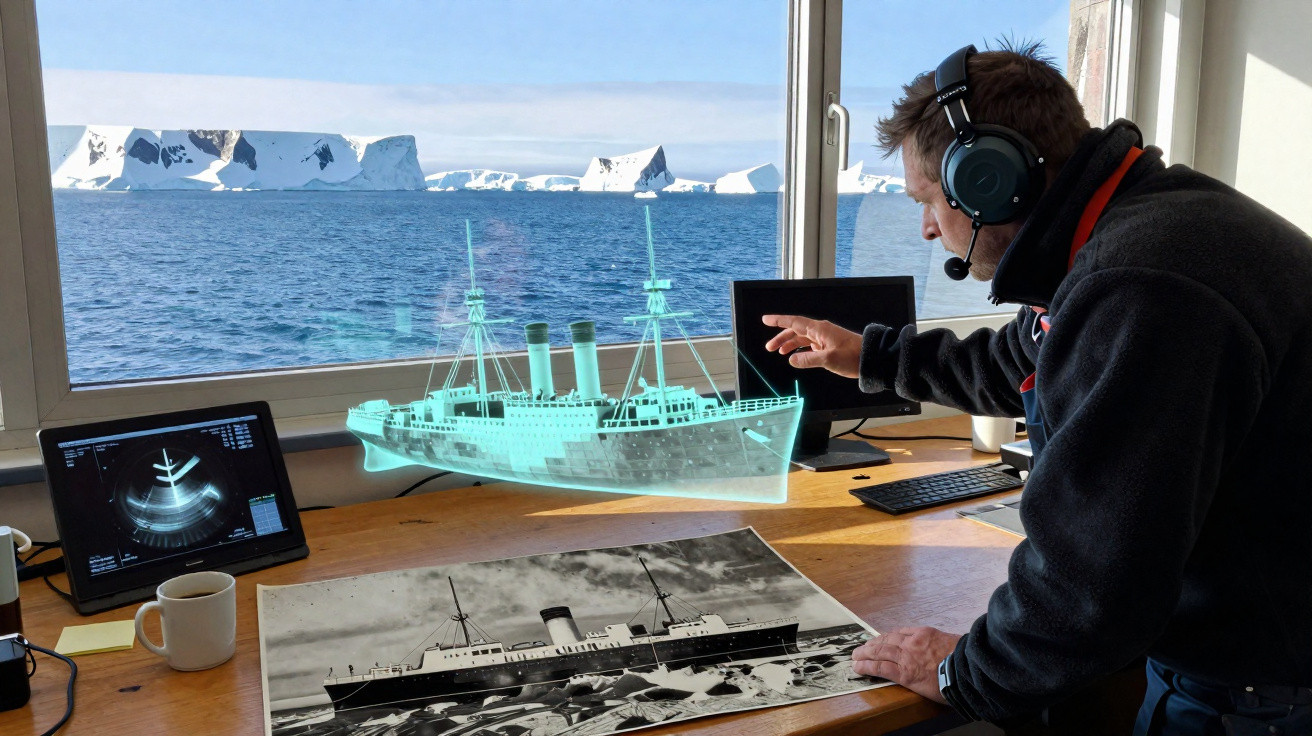
More than eight decades after it sank near Greenland, the Terra Nova has been seen again with striking clarity. A new expedition has produced the first highly detailed 3D images of the vessel linked to Robert Falcon Scott’s final voyage, while also showing that its wooden structure is vanishing quickly.
How was the Terra Nova recorded on the seabed?
The Heroic Era Expedition, led by the Royal Canadian Geographical Society in partnership with the Woods Hole Oceanographic Institution, surveyed the wreck in July 2026. The ship lies at roughly 300 metres depth, about 18 kilometres south of Greenland.
To document it, the team used the crewed submersible Alvin and the remotely operated vehicle Falcon, fitted with imaging technology from Canadian company Voyis. Thousands of high-resolution captures were then stitched together to build a three-dimensional digital model of the wreck.
What did the new images reveal?
The survey found the hull still clearly outlined and, unlike other local wrecks, not draped in fishing nets. The bow, propeller, rudder and the distinctive twin steering-wheel arrangement can still be made out, offering previously unseen detail of how the ship was built.
Even so, the damage is severe. The decks have collapsed and have almost entirely disappeared, and the reinforced wooden hull has split in two. The break exposes interior spaces, including the engine room, the boiler and sections of the former crew quarters.
Why did scientists create a digital copy?
The intention is to produce a digital twin of the Terra Nova before seawater, marine organisms and time destroy what remains. With the model, researchers can analyse the wreck without touching the fragile structure and can track how it changes in the future.
- High-resolution images documented the entire visible area.
- Sensors mapped the vessel’s three-dimensional form.
- The model will retain details even after further deterioration.
- Biologists also examined the organisms living at the site.
The expedition also surveyed the Quest, Ernest Shackleton’s last ship, which was found in 2024 in the Labrador Sea. Studying both sites together makes it possible to compare two vessels associated with the so-called Heroic Age of Antarctic Exploration and to investigate how wooden shipwrecks gradually become marine habitats.
Watch the video shared by the BBC News YouTube channel showing the Terra Nova wreck in detail.
What role did the ship play in polar history?
Built in 1884 in Scotland, the Terra Nova was designed to cope with ice and first worked in the seal-hunting trade. It later supported British expeditions and carried Robert Falcon Scott and his team as they attempted to reach the South Pole first between 1910 and 1912.
Scott arrived at the pole in January 1912, weeks after the Norwegian Roald Amundsen. Scott and four companions died on the return journey. After retrieving survivors from the expedition, the Terra Nova went back into commercial service, operating largely out of Newfoundland.
Time is running out for the Terra Nova
During the Second World War, the ship carried supplies to bases in Greenland. In September 1943, it was damaged by ice and had to be abandoned. After the crew were taken off, it was deliberately sunk to avoid becoming a hazard to navigation, and it was found again in 2012.
Now, the images turn the wreck into an accessible record before the ocean wipes away its last remaining details. Digitally preserving the Terra Nova is urgent: every lost section takes with it information about naval engineering, polar exploration and the people who endured some of the planet’s harshest environments.






Comments
No comments yet. Be the first to comment!
Leave a Comment