
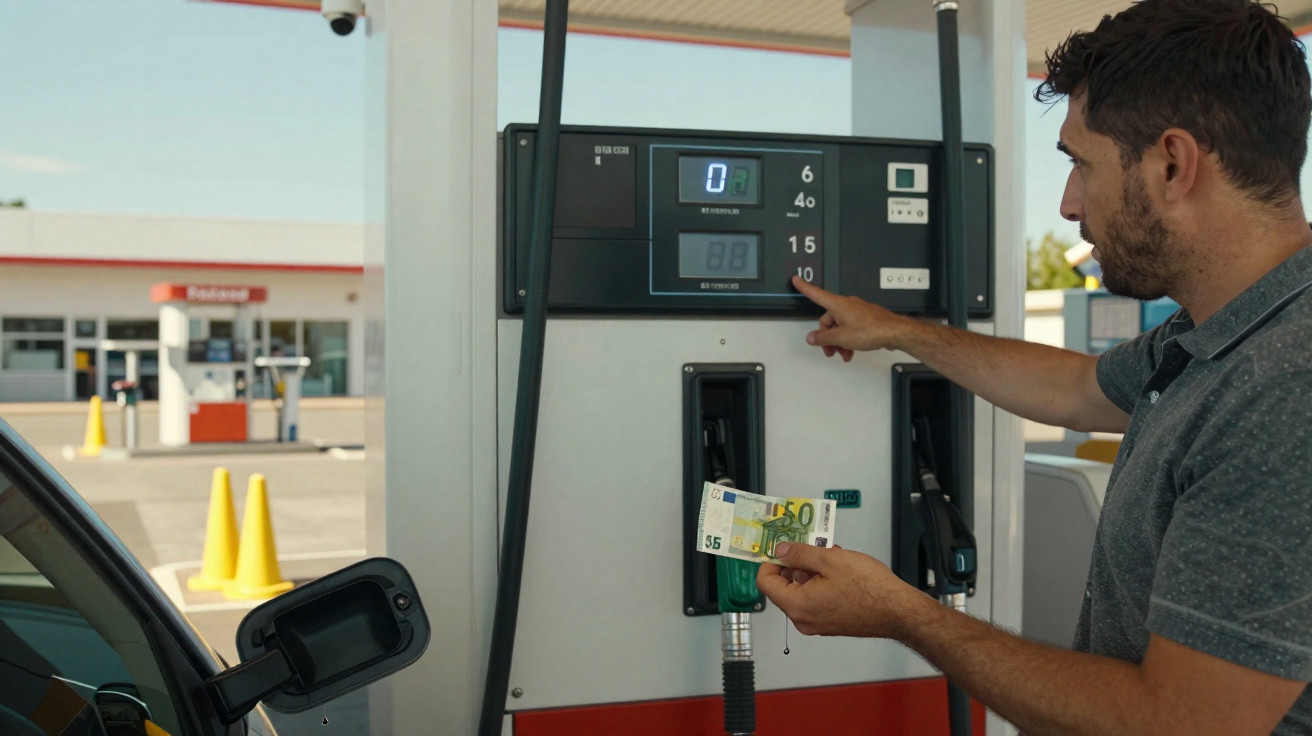
Cases are rising in France where drivers at self-service petrol stations are put under intense pressure and coerced into paying large amounts. This new trick starts with an apparently harmless request for help and often ends with a forced refuelling bill of €80 or €90. The same scam could just as easily spread to petrol stations in Germany or Austria.
How the Five-Euro Trick at the petrol station works
At first glance, the scam seems almost too simple. A stranger approaches a driver right by the pump-usually at the exact moment the driver is paying by card or has just started refuelling. The scammer describes an emergency: supposedly no bank card, no cash, perhaps a child in the car, or an urgent appointment.
Then comes the hook. They hold a five-euro note and ask you to let just a few litres of fuel run through on your card at their pump. Many people think, “What can really go wrong? Five euros-just a small favour.” That assumption is precisely where the trouble begins.
"The trick starts with a tiny amount and often ends with a full tank at the victim’s expense."
As soon as the nozzle is in their vehicle and the payment is running via the helpful driver’s card, the scammer escalates. More people often appear out of nowhere, position themselves close by, apply pressure and create an intimidating atmosphere. Standing at the payment terminal, the victim can quickly feel boxed in.
Instead of the promised small amount, the counter keeps climbing-until the tank is filled completely. Early reports mention totals of up to €90, even though the victim originally expected nothing more than a token contribution.
Why drivers fall for the scam
The perpetrators pull several psychological levers at once. They catch people off guard at a time when they are already distracted: reaching for a card, selecting the correct fuel, possibly keeping an eye on children in the car. Your attention is split.
- Caught off guard: The approach happens directly at the pump, without warning.
- Perceived duty to help: Nobody wants to appear heartless by refusing someone who claims to be in need.
- Pressure from a group: If multiple people suddenly turn up, fear of escalation increases.
- Illusion of control: Many assume they can stop at any time-only to realise too late that they no longer have the situation under control.
There is also another factor: at modern unmanned petrol stations, there is often no visible oversight at all. No staff at a till, hardly any other customers, and lighting can be poor. In that setting, offenders feel protected-while victims feel especially exposed.
Typical locations and times used by the scammers
Reports from France show a clear pattern. The offenders tend to target:
- self-service petrol stations without a kiosk or cashier building,
- sites where payment is card-only,
- off-peak times: late evening, overnight or very early morning,
- remote or quiet locations on out-of-town roads.
In some cities, incidents are concentrated in specific areas where several anonymous pay-at-pump stations are located close together. With little footfall, scammers have the time and calm to pick victims and approach them.
How to protect yourself from the petrol scam
Many of these situations can be avoided if drivers keep a few firm rules in mind. You are not obliged to help strangers at the pump. If you internalise that, you are far less likely to be drawn in.
Behaviour rules right at the pump
- Do not start refuelling for strangers: Refuse any request to pay for someone else’s fuel with your card-even for a small amount.
- Keep your distance: Do not let anyone get close to your pump or your card reader.
- Practise a clear “no”: A short, decisive response is enough: “No, I don’t do that.” Don’t debate it.
- Stay in your car if something feels off: Lock the doors from inside, watch what’s happening and decide calmly.
If you feel pressured, stop the refuelling, get back into your vehicle and drive away-even if your own tank is not full. Your personal safety matters more than saving a few pennies.
What to do if pressure is applied
If the situation has already become threatening, stick to clear steps. The key is not to react aggressively and not to try to be a hero.
- Assess the risk: If the group seems willing to use violence, end any conversation immediately.
- Create physical distance: If you can, get into your car and lock the doors.
- Call emergency services: From inside the car, call the police and briefly explain what is happening (for example, 110 or 112, depending on the country).
- Never enter a PIN under pressure: Do not hand over your card and do not type in a PIN if someone is crowding you.
"If you feel unsure, end the refuelling, drive away and call the police-everything else can be sorted out later."
Variations of the trick you should watch for
Victims in France are already reporting several twists on the Five-Euro scam. The underlying idea stays the same: a supposedly urgent problem, a small amount to build trust-and then a much bigger loss.
Fake breakdown with no fuel
One common version looks like this: a car is “broken down” at the roadside or right by the entrance to the petrol station. The driver claims there is not a drop of fuel left. They ask someone to use their card to pump a few litres into a jerry can.
Anyone who helps risks being pushed into a similar pressure situation. Once the nozzle is in the can or tank, it becomes hard to control the amount if several people are standing around you and pushing in.
Dubious mini petrol stations and cheap fuel
In some areas, makeshift “petrol stations” appear in back yards or in isolated spots. Shady sellers advertise supposedly very cheap fuel, often cash-only and without any receipt.
The risk is huge:
- Fuel may be contaminated and can damage the engine.
- Legally, there is no proof of purchase.
- Offenders can exploit the situation to demand more money or steal valuables.
Even a damaged particulate filter or a failed injection system can cost far more than any euros you thought you saved.
Why the scam also matters in German-speaking countries
Many pay-at-pump stations in Germany, Austria and Switzerland operate in a similar way to those in France: 24/7 self-service, card payment at the terminal, and little or no staff on site. When a method works in one country, offenders typically copy it quickly elsewhere.
On top of that, the economic situation is strained and fuel prices fluctuate sharply. People are more sympathetic to claims of financial hardship. Someone saying they cannot get home without fuel can easily trigger compassion.
| Factor | Benefit for offenders |
|---|---|
| Unmanned stations | No staff as witnesses, little oversight |
| High fuel prices | High profit per forced refuelling |
| Willingness to help | Victims initiate the payment voluntarily |
| Dark off-peak hours | Few other customers, low risk of being spotted |
How to spot warning signs early
If you know the typical patterns, you can judge risky situations faster. It is worth making deliberate choices even when selecting a petrol station:
- Choose well-lit stations with a shop or staff.
- Avoid isolated pay-at-pump sites at night if you are travelling alone.
- As you drive in, look out for groups on the forecourt who are not refuelling.
- If someone speaks to you the moment you get out, switch into high alert.
Healthy scepticism does not mean you must stop helping altogether. If you want to support someone, you could offer to make an emergency call or point them to the next official petrol station-without involving your own card or wallet.
The core of prevention at the pump remains straightforward: only pay for your own vehicle, never let your card out of your hand, and if you have a bad feeling, drive away one time too many rather than one time too few. That way, even sophisticated tricks involving a five-euro note have far less chance of succeeding.



Comments
No comments yet. Be the first to comment!
Leave a Comment