
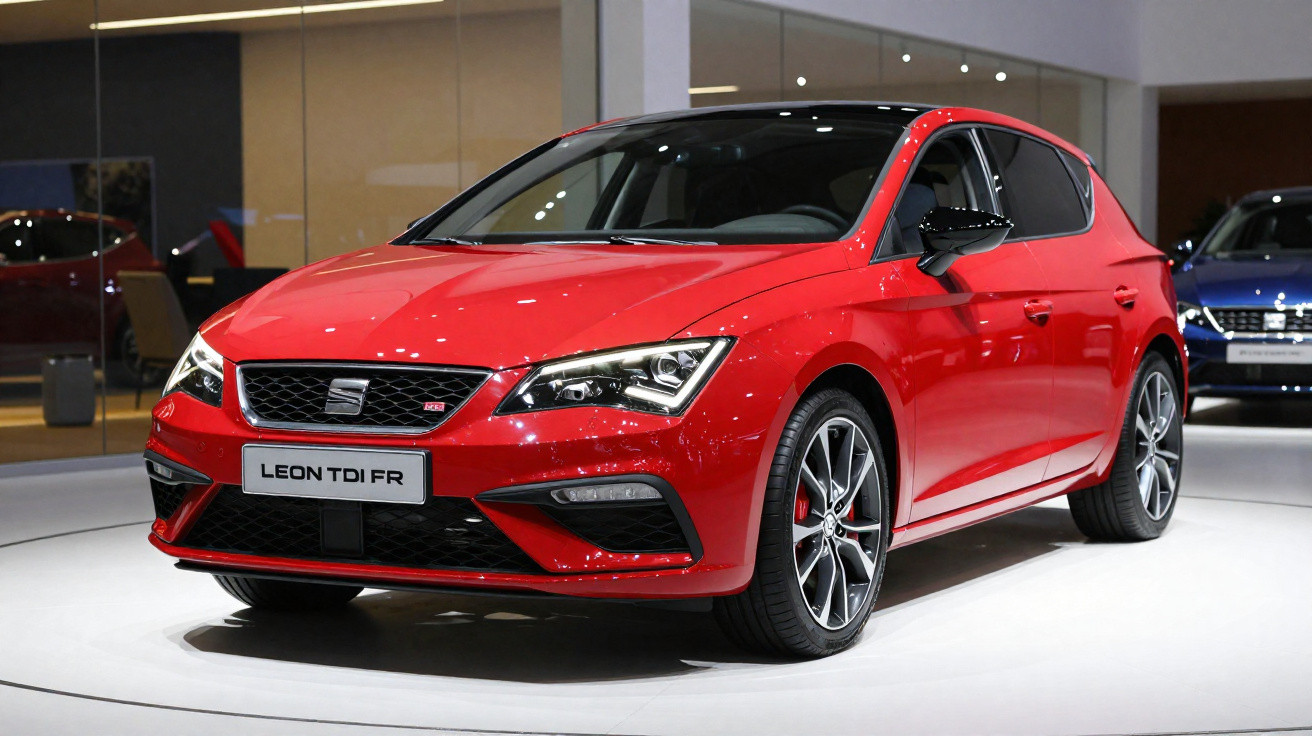
Today, more than ever, one thing the SEAT Leon is certainly not short of is a wide spread of powertrain choices (perhaps one of the factors behind its Car of the Year 2021 win in Portugal). From petrol and Diesel to CNG and plug-in hybrids, there is seemingly an engine option tailored to just about everyone.
The Leon TDI we are testing here - once the most cost-effective choice in the line-up - now faces “internal competition” from the plug-in hybrid version.
Even though it is priced (slightly) lower - 36 995 euros in this FR trim versus the 37 837 euros asked for the plug-in hybrid at the same equipment level - it is up against a key drawback: it has 54 cv less.
That’s right: even in its strongest form, the 2.0 TDI musters “only” 150 cv and 360 Nm. Meanwhile, the 1.4 e-Hybrid delivers 204 cv of maximum combined power and 350 Nm of torque. On paper, that sets the scene for the Diesel option to have a hard time justifying itself.
Diesel? What do I want it for?
With Diesel engines currently in the crosshairs of lawmakers and environmental campaigners, this 2.0 TDI with 150 cv and 360 Nm is a solid reminder of why they became so popular in the first place.
Paired with a quick, well-judged seven-speed DSG (dual-clutch) gearbox, the engine is genuinely pleasant to drive. Power arrives in a smooth, linear way and it can even feel stronger than the figures suggest.
That impression is likely helped by the fact that peak power sits “up top” between 3000 and 4200 rpm, while the full 360 Nm arrives from just 1600 rpm and holds on through to 2750 rpm.
In practice, that means you can overtake without having to “make friends” with the driver in the lane alongside (in-gear acceleration is brisk) and, above all, there doesn’t seem to be a dramatic real-world gap to the plug-in hybrid Leon I tested recently (aside from the immediate torque delivery, of course).
And while it’s true the electrified version has 54 cv more, it’s worth remembering it also carries extra mass: 1614 kg versus a more agreeable 1448 kg for the Diesel.
Consumption is another area where the 2.0 TDI 150 cv makes its case. Put it in the environment these engines suit best (national roads and motorways) and it will comfortably return 4,5 a 5 l/100 km when driven without fuss.
In fact, with little effort and sticking to the speed limits, I managed an average of 3,8 l/100 km on a route driven largely across the Ribatejo floodplains. Can the plug-in hybrid match that? It can potentially do the same - or even better, especially in town - but only if you plug it in. The Diesel can deliver these numbers without asking you to change your routine.
A final note on handling. Always accurate, predictable and capable, the Leon in FR specification feels even more committed in corners, yet it does so without giving up the comfort levels that make it a strong choice for long-distance trips.
And what else?
As I mentioned when testing the Leon plug-in hybrid, the step forward compared with its predecessor is obvious. From the outside, the styling is sporty without being over the top, and details such as the light bar running across the rear ensure the Leon stands out. In my view, it deserves a “positive mark” in this area.
Inside, the modern feel is clear (even if it comes at the expense of a few ergonomic details and ease of use). A sense of solidity is also evident, confirmed both by the lack of rattles and by materials that look and feel pleasing.
On space, the MQB platform fully delivers on its reputation, giving the Leon good room for passengers, while the 380-litre boot sits right in the middle of the class. Here, the Leon TDI has an advantage over the Leon e-Hybrid, which - due to the need to package the batteries - sees capacity drop to a more limited 270 litres.
Is it the right car for me?
The answer depends (a lot) on how you intend to use the SEAT Leon. If, like me, most of your driving is made up of long motorway and national-road journeys, then this Leon TDI is very likely the ideal choice.
It doesn’t require charging to achieve low fuel use, it offers strong-enough performance, and it runs on a fuel that is, for now, more affordable.
For anyone whose driving includes a significant amount of urban use, however, the Diesel may not be the most sensible fit. In town, despite being economical (my averages were not far off 6,5 l/100 km), this Leon TDI FR cannot do what the plug-in hybrid Leons can: drive in 100% electric mode without using a drop of fuel.
Finally, it is also worth noting that Leon TDI servicing is due every 30 thousand kilometres or 2 years (whichever comes first), while the plug-in hybrid version is serviced every 15 thousand kilometres or annually (again, whichever happens first).
Comments
No comments yet. Be the first to comment!
Leave a Comment