
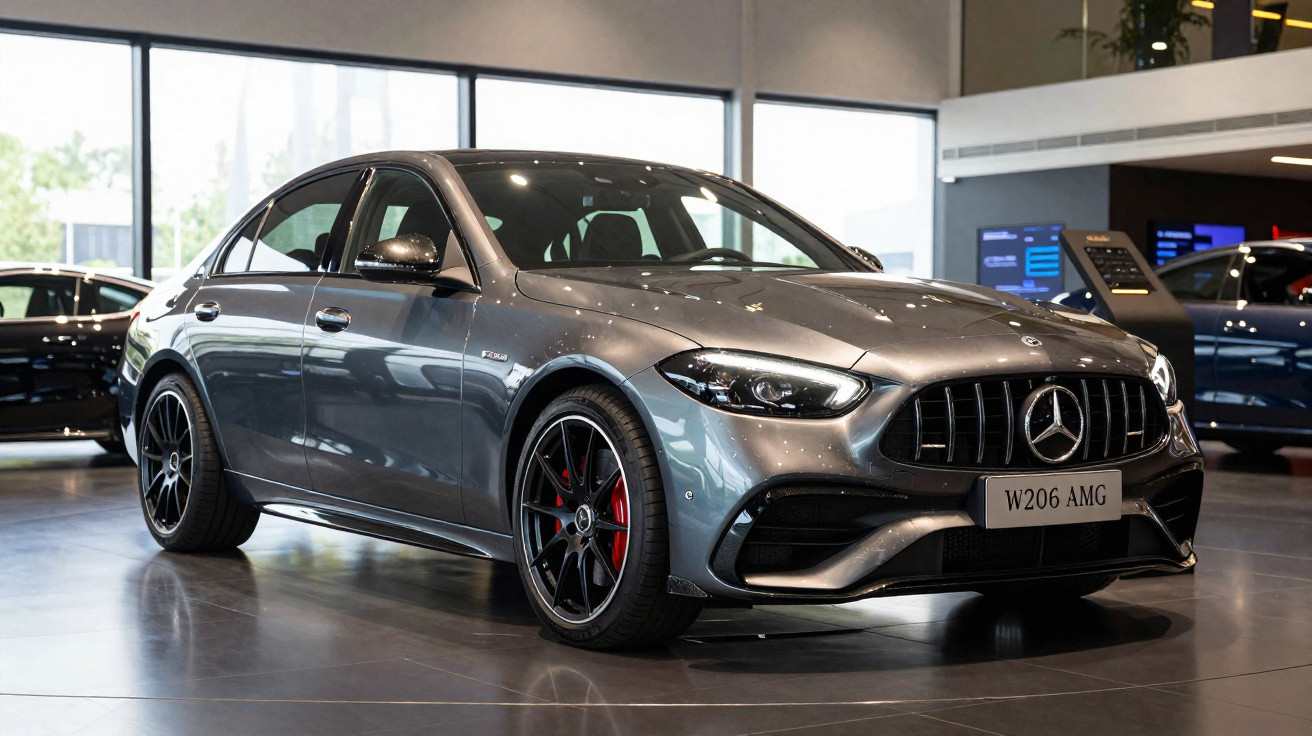
Rumours have proved accurate: the new Mercedes-Benz C-Class W206 will be offered exclusively with four-cylinder engines, regardless of trim level. That means even AMG-badged versions will drop the V6 and V8 units we’ve come to associate with them - yes, when we lift the bonnet of the next C 63, we’ll find only a four-cylinder engine.
To help make sense of such a sweeping move, Christian Früh, the C-Class chief engineer, explained the thinking behind it to Automotive News.
The obvious question is why Mercedes would choose four-cylinder power for the range-topping models when it only recently introduced, in 2017, a new inline six (M 256) that could have neatly replaced the outgoing V6 and V8.
Why the Mercedes-Benz C-Class W206 is four-cylinder only
In a way, it’s easier to defend replacing the charismatic, thunderous V8 in the C 63 with a “mere” four-cylinder - even if this is far from an ordinary four-cylinder. The engine in question is the M 139, the most powerful production four-cylinder in the world, also used in cars such as the A 45 S. Even so, it isn’t quite the same as having eight cylinders “growling” menacingly ahead of you.
For the C 63 specifically, this route is presented as the most effective way to bring down its high CO₂ emissions: not only because it effectively uses half the engine capacity compared with what it had before, but more importantly because it will rely on a plug-in hybrid system. In other words, the future C 63 is expected to match the current model for power and torque figures - or even edge them slightly, according to rumours - while delivering markedly lower fuel consumption and emissions.
Electrification and AMG performance targets
Mercedes’ rationale also rests on the idea that electrification closes the performance gap between four- and six-cylinder options. With plug-in hybrid models in the line-up, any advantage an inline six might have offered can be offset by the electrical assistance.
Früh also points out that packaging and vehicle dynamics matter as much as outright output. Making space for a larger engine installation would bring knock-on compromises that Mercedes doesn’t consider necessary, given the performance it can reach with four-cylinder power supplemented by hybrid systems.
Too long
The story is different for the C 43 - and it remains to be seen whether it keeps that badge or switches to 53, as has happened with other Mercedes-AMG models. Yes, lowering emissions is still part of the justification, but the main reason is far simpler: the new inline six simply won’t fit in the engine bay of the new Mercedes-Benz C-Class W206.
An inline six is, by design, longer than a V6 and even longer than a V8 (which isn’t much longer than an inline four). According to Christian Früh, accommodating the inline six would have required the front end of the new C-Class W206 to be extended by 50 mm.
Given that the new engine is significantly longer, why wasn’t it designed in from the start during development? The answer, as Früh frames it, is that it wasn’t needed: four-cylinder engines were sufficient to deliver the performance targets Mercedes set.
Moreover, those extra 50 mm would have meant more load over the front axle, which would also have affected the car’s dynamics.
Today’s C 43 uses a 3.0-litre twin-turbo V6 producing 390 cv, and the expectation is that the next C 43 will deliver the same 390 cv despite moving to a smaller 2.0-litre four-cylinder.
Interestingly, it won’t use the M 139, even though that engine is known to be capable of such figures - the standard A 45, for example, produces 387 cv. Instead, the upcoming C 43 will use the newer M 254, introduced on the updated E-Class. It belongs to the same modular engine family as the six-cylinder M 256 and even the four-cylinder diesel OM 654.
What they share is a 48 V mild-hybrid system, which includes a small electric motor rated at 20 cv and 180 Nm. In the E-Class, in E 300 form, the M 254 produces 272 cv; in the C 43 it is expected to reach the same 390 cv as the current model. How? Affalterbach (AMG) reportedly has further changes planned for this engine, such as adding an electric turbocharger.
Even so, it wouldn’t be surprising if the future C 43 ends up posting higher consumption and emissions figures than the… C 63 (!) simply because the two models will use different levels of electrification.
Comments
No comments yet. Be the first to comment!
Leave a Comment