
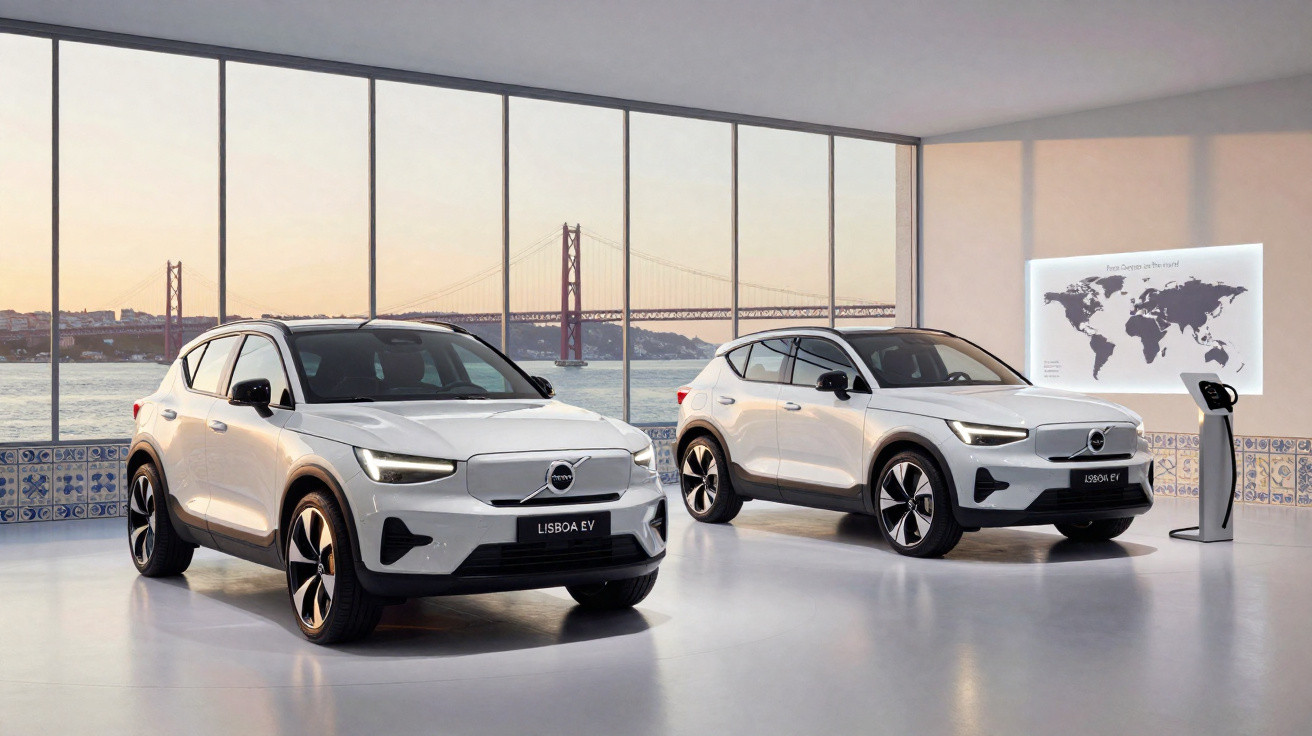
A favourite spot for many Lisbon locals (and plenty of visitors too), the riverside stretch beside the Electricity Museum becomes, from 24 May to 16 June, the home of the debut Volvo Studio - an innovative event that will later tour other European cities.
Designed to mark the arrival of Volvo’s 100% electric models in Portugal, Volvo Studio is built around a straightforward but bold idea: get prospective customers behind the wheel. To do that, Volvo is inviting anyone interested to book an extended test drive (between Belém and Carcavelos) in the new XC40 Recharge.
Unlike most events of this kind, the test drive takes place in complete privacy (with no one from the brand sitting alongside you). All that’s required is a prior booking, which you can make via the link provided. And alongside the XC40 Recharge, visitors will also be able to see the brand-new C40 Recharge on display at the venue, which is open daily from 9.30 to 19.45.
It was alongside the opening of this event that Razão Automóvel spoke with Aira de Mello, Marketing and Communication Director at Volvo Car Portugal, who shared her view of the Swedish brand’s future, the challenges ahead, and how Volvo intends to navigate this new chapter.
From Portugal to the World
Razão Automóvel (RA) - Portugal was the launchpad for an international Volvo event focused on electrification. Do you feel we’re a country that’s ready for 100% electric mobility?
Aira de Mello (AM) - That’s right, and we were extremely proud to be the first market to host the Volvo Studio concept. We’re a country with huge potential for 100% electric mobility; however, there is still a long way to go. Until there is genuine electrification of our cities that makes charging an electric vehicle simple and affordable, it will only be an option for some.
Think about people who live in areas without underground parking or private garages - for them, an electric car still isn’t a viable choice. Equipping an entire city with charging infrastructure requires a very significant investment and it’s a bit like the “chicken and egg” story: without a meaningful number of electric/hybrid vehicles, there won’t be investment, and without infrastructure, there won’t be a boom in electrified vehicles.
RA - The Volvo XC40 P8 Recharge is the big highlight at Volvo Studio Lisboa, but the Volvo C40 is also on show - the first Volvo that will be exclusively 100% electric. What has the public reaction been like during the test drives?
AM - The test drives are exclusively for the 100% electric XC40; for now, the C40 is there purely to be admired! We expect to have the first units (of the C40 Recharge) on the road in Portugal by the end of the year.
The reaction to a first encounter with the 100% electric XC40 has surpassed our most optimistic expectations: people are really enjoying the “one pedal drive” technology, the integrated Google Assistant, the car’s dynamics and balance - but above all, experiencing the performance and power of this XC40 without a combustion engine!
It has also been very important in helping to dispel the “electric car = household appliance” remark that we sometimes hear, in a derogatory tone, in corridor conversations. The feedback has been very positive. People are pleased because they genuinely feel they’re at the wheel of a powerful, quiet, clean - and of course safe - car, because it’s a Volvo.
Realistic ambition
RA - From 2030 onwards Volvo will only sell 100% electric cars. It’s a bold move and some argue it’s too soon. Is it a risky decision?
AM - At Volvo we’ve taken a number of decisions recently that aren’t risk-free. Thankfully, what we’ve seen is that, in some way, we’ve helped to “open the door” and many of our peers have followed - it happened when we took the risk of announcing the end of Diesel, when we took the risk of announcing the 180 km/h limit, and also the electrification of the entire range.
We’re glad of that - it’s exactly what we want: to spark debate and encourage change. We truly do need to do something so there’s still a planet for our grandchildren; obviously we’re not being idealistic!
Volvo alone won’t save the world, but if everyone plays their part… and, fortunately, we’ve never had such good results in terms of sales and awareness as we have since we embarked, five years ago, on this transformation of the brand. That suggests we’re on the right path, and that people are with us on this journey.
RA - Consumers are still concerned about battery degradation, replacement costs in the event of a fault, and what happens to batteries after use. How do you address that concern?
AM - Volvo batteries come with an eight-year warranty and an estimated lifespan of around 10. When they’re removed from our cars, they’re reused for a “second life”. It’s still an evolving process, but we already have good examples: we have old batteries in use at BatteryLoop and within Volvo Cars itself.
These batteries help store energy generated from solar power. Since April, some of them have been supplying charging points for cars and electric bikes at the business centre of the Swedish hygiene and health company Essity, in Gothenburg.
In a similar project, Volvo Cars, Comsys AB (a Swedish clean technology company) and Fortum (a European energy company) became involved in a pilot project intended to increase supply flexibility at a hydroelectric facility in Sweden - batteries that previously powered Volvo plug-in hybrids will serve as a stationary energy storage unit, helping to provide so-called “fast-balance” services for the energy system.
Through these projects and others, Volvo is researching how batteries age and how they can be reused - we’re gaining more knowledge about their commercial value after use in cars. That’s very important so that this becomes more competitive and it becomes easier to replace batteries in cars, if that is the customer’s objective.
RA - Volvo will become a centenarian brand within this decade. You were born in 1927 with a focus on safety, but today there are more concerns… will this be a period of total reinvention?
AM - Not at all. In terms of brand values, the focus remains the same - life, people. Everything we do at Volvo continues to contribute to YOUR safety.
But what use are intelligent, safe cars if we don’t have a planet, a future? That’s why we’re raising sustainability to the level of safety. If for 94 years we’ve been saving lives, the time has come to help save “Life” itself… for everyone.
Reinvention is less about the brand’s values and more about reinventing the business: how we perceive the car, ownership, consumption, and the service we want it to become - but that would be a topic for another interview!
RA - You say, directly, that when it comes to pollution and climate change you “are part of the problem”. It’s a “no filters” style of communication that’s growing within an industry that has always been very traditional. Do you think Dieselgate was one of the main drivers accelerating electrification and this radical shift across the industry?
AM - Any polluting industry is part of the problem. With cars, beyond the manufacturing process we also have the product itself. More or less polluting, we all have our share of responsibility, and at Volvo we want to help be part of the solution.
That’s why two of our factories are already environmentally neutral and soon all of them will be - and that’s why we want to end combustion engines.
Every episode, every news story, every documentary contributes to raising awareness - among brands, people, society. Honestly, I think the automotive industry has been an example for others, yes: industries that are far more traditional and far more polluting, and that continue to operate as they did 70 or 100 years ago without visible or announced changes.
Changing the paradigm
RA - In nine years Volvo will only sell 100% electric vehicles. But there are newer brands such as Tesla - and others that will enter the European market strongly - that have done that from day one. What will make the difference for consumers? Do you believe the history and legacy of a brand like Volvo carries enough weight in the purchase decision?
AM - Absolutely. When people choose a brand - whether it’s Volvo or any other - they’re choosing a set of values they identify with: a story, a legacy, a DNA.
We always say that being behind the wheel of a Volvo says a lot about that person - a Volvo is far more than a car; it’s a way of being in life. The car “for people who care about other people”. Whatever the car’s form of propulsion, that is unique and impossible to copy.
RA - Volvo announced that sales of its 100% electric vehicles would be done only online. But to mark the launch of your first 100% electric model, you put on a “physical event”. Isn’t that contradictory?
AM - Good point! We believe there’s a relationship between online and offline. We don’t want to abandon the “physical” part of the sales process: buying a car is highly emotional and, in our view, it’s essential that customers can feel it, touch it, and experience the product - especially when it’s a new technology that needs to be tried and proven.
That’s why we’re inviting people to come to Volvo Studio Lisboa, take our new 100% electric model for a dynamic drive, and then visit our dealers once Volvo Studio leaves (13 June).
Yes, we want to make life easier. We want the process to start online, where customers can configure the car and simulate purchase options, and then move to one of the brand’s dealers, where the sale will be completed.
RA - How will this digitisation affect dealers?
AM - It won’t affect them. We continue to invest unequivocally in our dealer network as a fundamental part of the purchase process - something also proven by Volvo’s growth in Portugal.
Nothing replaces human contact or the emotion of trying the product; we’re simply streamlining the process - for the customer and for the dealer.
People who begin a purchase online arrive at the dealership with a clear idea of what they want: they have already configured the car in detail and simulated the method of acquisition. All that’s missing is what online can’t provide: contact… with the car, with the people. In that process, the dealer’s role remains unchanged.
RA - In 2020 you limited cars to 180 km/h. From 2030 you’ll only sell 100% electric vehicles. Are more changes on the way?
AM - A few! We’ve communicated, but not yet introduced, the in-car cameras that will allow us to monitor the driver’s condition and intervene if there is danger to them or others (fatigue, intoxication, or sudden illness).
This is another innovation directly tied to safety and it will become reality soon. In 2022 we’ll have some new developments under the theme of “Mobility”, and others as well that we hope will once again help the industry evolve! Stay tuned.
Comments
No comments yet. Be the first to comment!
Leave a Comment