
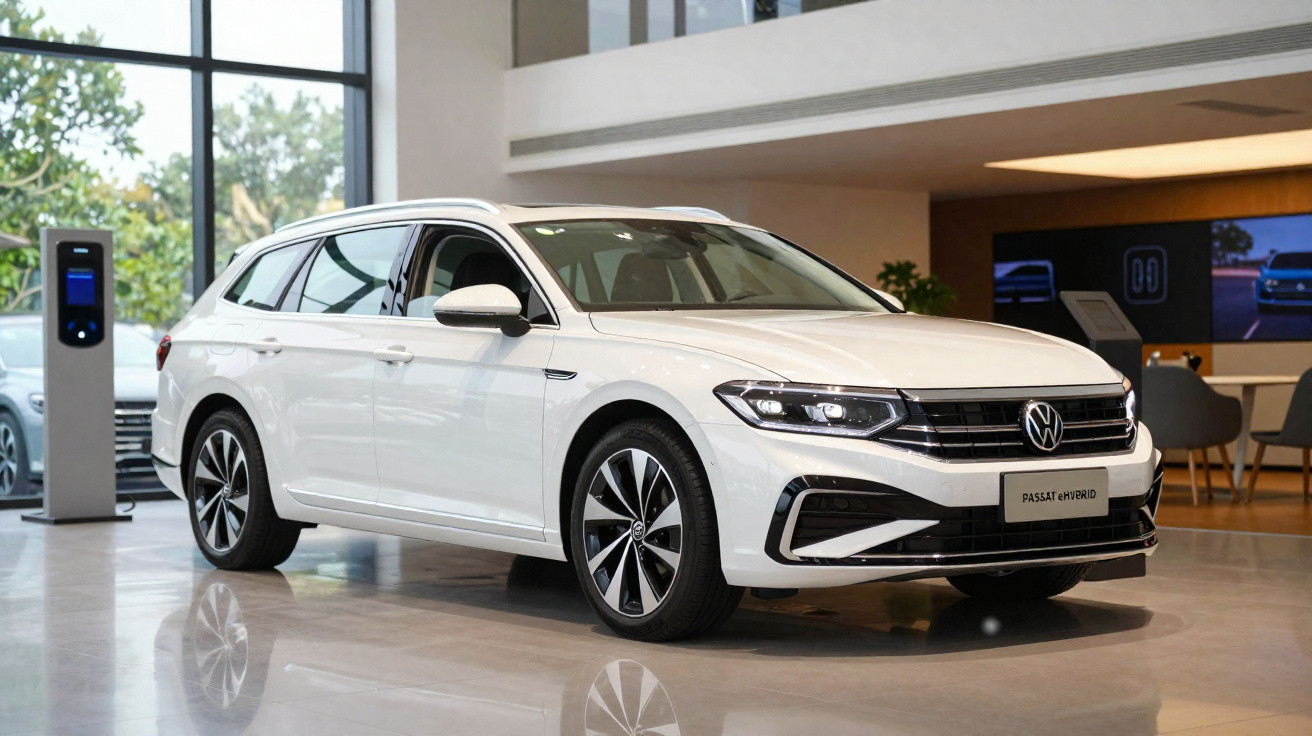
The Volkswagen Passat has never really been a car designed to stir the soul. For almost 50 years, it has instead won customers over with rational strengths - space, solid engineering and a strong price-to-quality balance.
Now it reaches its ninth generation, offered exclusively as the Passat Variant estate. That’s already been the case since 2022, when production of the saloon ended.
With conservative models such as the Passat Variant, a new generation rarely brings a revolution - and this one is no exception. The overused phrase "evolution with continuity" fits perfectly.
Even though it’s only being unveiled now, we already drove the new Passat Variant back in July, albeit in a pre-production vehicle.
The biggest Volkswagen Passat ever
With the wraps now off, we can see the new Passat Variant in full. It’s the largest Passat to date, having grown in (almost) every direction. That is hardly surprising given it was "associated" with the development of the new Skoda Superb.
The changes aren’t limited to size. One of the key body updates is a (much) more polished aerodynamic profile - Cx drops from 0.31 to 0.25.
It’s fair to say the German engineers and designers have drawn on lessons learned from developing the ID.7 - both in the sizeable aerodynamic gain and in some visual similarities.
A number of technical solutions underline that closeness to the electric ID.7: a radiator shutter that only opens when cooling is required, and air curtains that improve airflow around the wheels while also assisting brake cooling.
There are also door mirrors shaped to reduce their contact area with the air, work done to the lower rear body section up to the diffuser, and airflow guidance around the rear pillars which, together with the spoiler, cuts turbulence in that area.
More space…
This is the first application of the MQB evo platform - arriving almost alongside the new Tiguan, which shares the same "skeleton" and also the dashboard layout and powertrains - and it brings a range of updates in both hardware and software.
Visitors to the Munich Motor Show (opening on 5 September), where the new Volkswagen Passat Variant will be one of the headline acts, will be able to see how the larger exterior footprint translates into extra room inside.
That’s particularly noticeable in the rear seats, where the amphitheatre effect (the second row positioned higher than the first) is a welcome touch.
…and more technology
The drive for consistency between Volkswagens with combustion engines and the electric ID models is just as apparent on the dashboard.
That "carry-over" is equally clear in the cabin, where the infotainment display can be 12.9" as standard or, optionally, 15". The sliders (touch-sensitive sliding controls) have been improved and now feature backlighting - a missing detail that drew heavy criticism on the brand’s early ID models.
The infotainment software (MIB4 generation) mirrors what has just debuted in the ID.7. The entire control logic, personalisation options, graphics, instrument views, and so on, are the same.
Here too, the transmission selector moves from the centre console to the steering column (a stalk with the same movement logic used in the ID range), freeing up space between the front seats.
Another upgrade that should please future Passat drivers is the switch from the previous blade-style head-up display to a system that projects directly onto the windscreen, as is common in higher market segments and premium brands.
And speaking of the windscreen, the effort to make the cabin quieter has led to double glazing being fitted not only to the windscreen but also to the front and rear side windows.
It’s clear, then, that this new Passat comes with a few premium habits. From HD Matrix headlights to the strengthened acoustic insulation mentioned above, plus seats with several massage programmes and even a chassis upgrade.
Chassis evolves
The new Volkswagen Passat Variant retains its predecessor’s suspension layout: MacPherson up front and an independent multi-link rear (four links).
The big news is the optional DCC Pro system - electronically variable damping - which now uses two valves. One valve controls compression and the other controls rebound, improving control of body movements.
It’s the first mainstream brand to offer this technology, designed to better isolate the body from road surface imperfections, and we’ve already been able to confirm its effectiveness - check out our first impressions behind the wheel.
An electric boost
A look at the engine line-up shows electric propulsion taking on a bigger role. Even so, there is no 100% electric version. If you want a fully electric "Passat", the ID.7 is the answer.
The electric emphasis comes from the new plug-in hybrid versions - or eHybrid in Volkswagen terminology.
These now pair an electric motor with a new petrol engine featuring a variable-geometry turbo and 1.5 l capacity - replacing the previous 1.4 l unit - and they come in two power outputs: 204 cv (150 kW) or 272 cv (200 kW).
That gap is down to different software calibrations: the lower-output version prioritises electric range. In both cases, maximum torque is 400 Nm, limited by the six-speed dual-clutch automatic (DSG), the only gearbox offered here. All other engines use the seven-speed DSG.
Electric drive in the new Volkswagen Passat Variant eHybrid is supplied by a 19.7 kWh (usable) battery, almost double the predecessor’s (10.6 kWh). As a result, electric range almost doubles, to a figure around 100 km.
As with the previous generation, the new one does not allow the plug-in hybrid powertrain to be combined with four-wheel drive; that remains reserved for combustion versions. On the other hand, the eHybrid’s towing capacity rises from 1.6 tonnes to 2.0 tonnes.
Among the remaining engines, the 1.5 eTSI stands out in 130 cv or 150 cv form, using a small electric motor and a 48 V battery to help the petrol engine drive more and consume less. This four-cylinder can also "switch off" two cylinders when there is low or no throttle load in order to achieve that goal.
Beyond that, the new Volkswagen Passat will continue to offer Diesel engines (2.0 TDI with 122 cv, 150 cv and 193 cv) and petrol engines (2.0 TSI with 190 cv or 265 cv). The most powerful version of each is available only with four-wheel drive.
When does it arrive?
The new Volkswagen Passat Variant will be presented at the Munich Motor Show, and the first cars are expected to be on the road before the end of the year.
In Portugal, however, sales are only expected to start in the first quarter of 2024, with no pricing information available yet.
We do already know which engines will make up the Portuguese range for the new Volkswagen Passat Variant. In addition to the two eHybrid versions (204 cv and 272 cv), there will be the 1.5 eTSI with 150 cv and the 2.0 TDI in 122 cv and 150 cv forms.
Comments
No comments yet. Be the first to comment!
Leave a Comment