
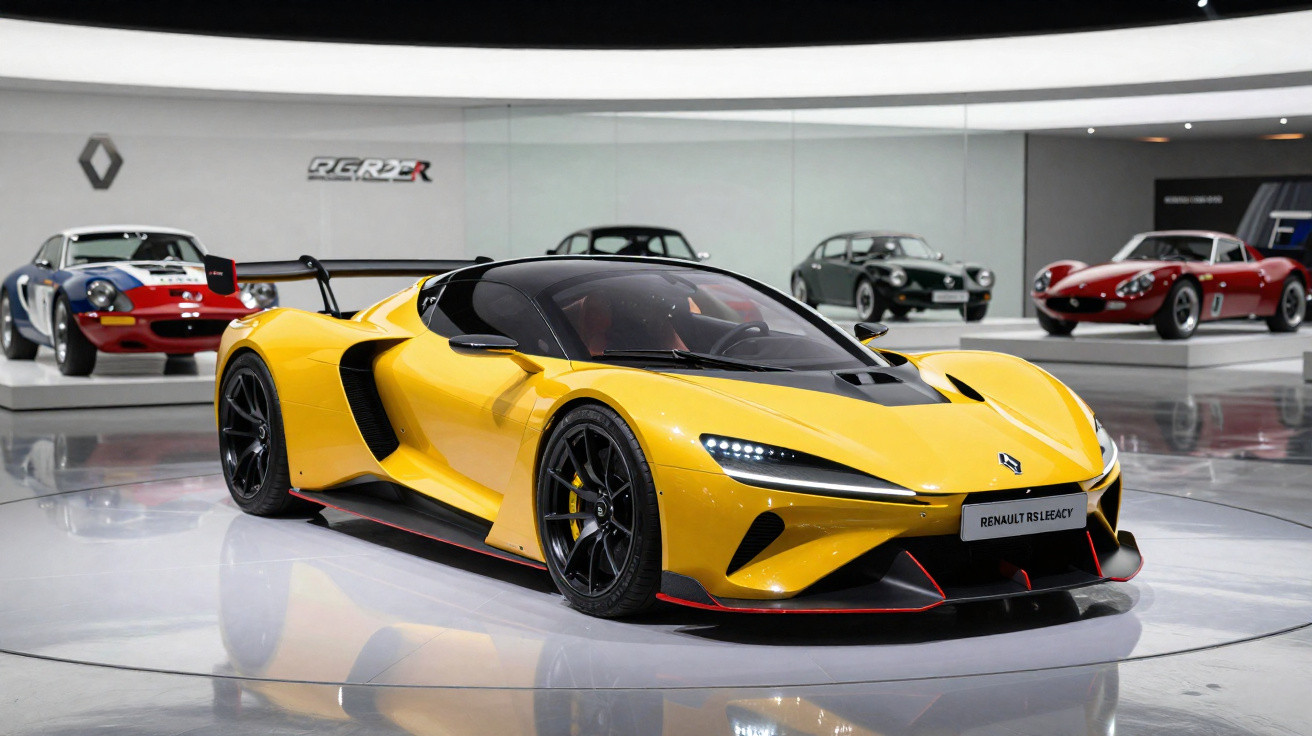
Renault Sport was created in 1976 as the brand’s new motorsport department, formed through the merger of Alpine and Gordini’s sporting operations.
It would take until 1995 for Renault Sport to set up a unit focused on engineering high-performance versions of regular production cars - a division that, in 2016, would be renamed Renault Sport Cars. That move effectively brought Alpine to an end at the time, as the marque shut its doors when A610 production finished, a rear-engined sports coupé - much like the Porsche 911.
However, in this century, with Carlos Ghosn leading Renault and with crucial input from Carlos Tavares - then the manufacturer’s number 2 and today number 1 at the newly formed giant Stellantis - Alpine was definitively “brought back to life” in 2017 with the launch of the A110. In a way, it took this story right back to its starting point.
By 2021, it was Renault Sport that “exited the stage” to make room for Alpine. The activities of Renault Sport Cars (road cars) and Renault Sport Racing (competition) were absorbed by the historic French brand, while remaining based in Dieppe.
At the time of publishing, it still was not entirely clear what this shift would mean for future “wild” Renault road cars. Even so, those 26 years left behind a substantial and valuable legacy of models wearing the R.S. badge - the vast majority being hot hatches that were, almost always, the benchmark everyone else wanted to beat.
With the end now confirmed, we have gathered a handful of R.S. models - arguably the most special of them all - to show just how fruitful this era was, and how capable the people behind these machines proved to be, with their relentless focus on dynamic excellence and the most thrilling driving experience.
Renault Spider Renault Sport
Naturally, the place to begin is the first road car launched by Renault Sport - the one that introduced it to the world in 1995: the Spider Renault Sport. Interestingly, it was originally conceived to be an Alpine, and it took the form of an extreme roadster, pared back to the essentials, with no windscreen - an item that would become available as an option a year later.
Yes, the maker of the Twingo, Espace and Clio released a roadster every bit as radical as the Lotus Elise, unveiled that very same year. If any model was going to put Renault Sport on the map, the Spider was it.
Its uncompromising concept - along with an aluminium “skeleton” - helped keep mass down to just 930 kg (965 kg with the windscreen). That meant its (modest) 150 cv - from the naturally aspirated 2.0 l unit used in the Clio Williams, but here mounted behind the two occupants - was more than enough for convincing performance. Yet it was the driving experience, with nothing assisted, that truly stood out.
The radical nature of the car - and the success of the first Elise, too - meant that across four years of production (1995-1999) only 1726 units were built. It also spawned a Trophy race version (for a one-make series) producing 180 cv.
Renault Clio V6
If the Spider was an oddball, what about the Renault Clio V6? This “monster” echoed another past “monster” from the diamond-brand’s history: the Renault 5 Turbo, a model that remains vivid in the minds of many rally fans.
Much like its spiritual predecessor, when the Clio V6 arrived in 2000 it looked like a Clio after a heavy dose of steroids - it was impossible to ignore. Considerably wider than other Clios and sporting very conspicuous side air intakes, it gave up its rear seats to “store” a huge 3.0 l naturally aspirated V6 (known as ESL) with 230 cv.
It soon earned a reputation for having… delicate handling - tricky to manage at the limit - and it was also notorious for a turning circle better suited to a lorry.
Despite the Clio V6’s exotic character, it was followed by a second iteration, launched alongside the facelift of the second-generation Clio. Renault Sport used the opportunity to smooth out its “monster’s” dynamic rough edges, while also raising output to 255 cv. The result was more cohesive and less intimidating, but no less captivating.
Production ended in 2005, with approximately 3000 units built (Phase 1 and Phase 2). Only the Phase 2 run and the Trophy competition versions left Dieppe. The Phase 1 Clio V6 models were engineered and assembled by TWR (Tom Walkinshaw Racing) in Uddevalla, Sweden.
Renault Clio R.S. 182 Trophy
Now we move into the world of “classic” hot hatches, where Renault Sport quickly became a reference point - starting with the first Renault Clio R.S., the beginning of one of the richest modern legacies in the hot hatch class, without taking anything away from its notable predecessors…
Based on the second generation of the French supermini (1998), the original Clio R.S. arrived a year later with a naturally aspirated 2.0 l (F4R) producing 172 cv. After the facelift, power rose to 182 cv - and praise for this hot hatch’s dynamic ability grew just as much, impressive though it already was.
But it was near the end of its life, in 2005, that the Clio R.S. 182 would be elevated to legend status among hot hatches, thanks to the release of the (very) limited Trophy. Just 550 units were produced, with the vast majority built in right-hand drive for the British market, and only 50 in left-hand drive for Switzerland.
As its name suggests, it retained the same 182 cv as other Clio R.S. models, with chassis work taking centre stage. The key difference between the R.S. 182 Trophy and other R.S. 182 versions lay in its Sachs motorsport dampers (with separate oil reservoirs).
High-quality and (very) expensive components, the Trophy also stood apart thanks to specific wheel hubs shared with the R.S. 182 Cup; 16″ Speedline Turini wheels that were 1.3 kg lighter than standard; a rear spoiler borrowed from the Clio V6; Recaro sports seats; the exclusive Capsicum Red paint; and, of course, a numbered plaque so you would never forget just how special this Clio really is.
The verdicts came quickly. Several outlets - naturally British ones, given they received most of the production - hailed the Renault Clio R.S. 182 Trophy as the greatest hot hatch of all time. Some still argue it deserves that title, even though 15 years have passed and many new hot hatches have appeared since.
Renault Mégane R.S. R26.R
One segment above the Clio, the first Mégane R.S. arrived in 2004, developed from the second generation of Renault’s compact family car.
It took a while to be recognised as one of the best in its class, but in 2008 it instantly earned the reputation of the ultimate hot hatch when Renault Sport unveiled the Mégane R.S. R26.R, which many dubbed the 911 GT3 of the hot hatch world.
Perhaps the most extreme hot hatch ever released (arguably only surpassed by today’s Mégane R.S. Trophy-R), the R26.R weighed 123 kg less than other Mégane R.S. models.
That reduction, combined with a revised chassis, turned it into a corner-devouring machine and a headline-grabbing conqueror of the Nürburgring, the “Green Hell”: it would be crowned the fastest front-wheel-drive car around the legendary circuit. It certainly provoked its rivals, because its 8min17s record never stopped being chased down afterwards.
To explore it in more detail, we invite you to read - or re-read - our article dedicated to this fantastic machine:
Renault Mégane R.S. Trophy-R
Finishing on a high is the least we can say about the final product developed by the now-defunct Renault Sport. And, just like the R26.R, the Mégane R.S. Trophy-R represents the most extreme and radical version of the current generation of the French hot hatch.
Once again, this is a car built to carve through corners and to set records, with the no-less-phenomenal Honda Civic Type R positioned as its nemesis.
In 2020, Guilherme had the chance to test this prodigious machine thoroughly and, without doubt, it is one that deserves a guaranteed place in the hot hatch pantheon - who would have guessed it would be the last to wear the R.S. letters?
And now?
Unintentionally, the Mégane R.S. (in its various versions) will be the final model to carry Renault Sport’s stamp. The next sporty Renault we see may not even wear the brand’s diamond, and could instead feature an Alpine “A”; it is not hard to imagine something similar to what we see between SEAT and CUPRA, or Fiat and Abarth.
Even so, the badge displayed may not be the most important point. Given the Renault Group’s plans for Alpine, Renault Sport’s end also signals the end of combustion engines in these performance models. Within a few years we will see the first results of that strategy, with the first announced model being a 100% electric hot hatch wearing the Alpine brand.
Will it persuade, excite and enchant in the same way as these five Renault Sport models we have brought you? We shall have to wait…
Comments
No comments yet. Be the first to comment!
Leave a Comment