
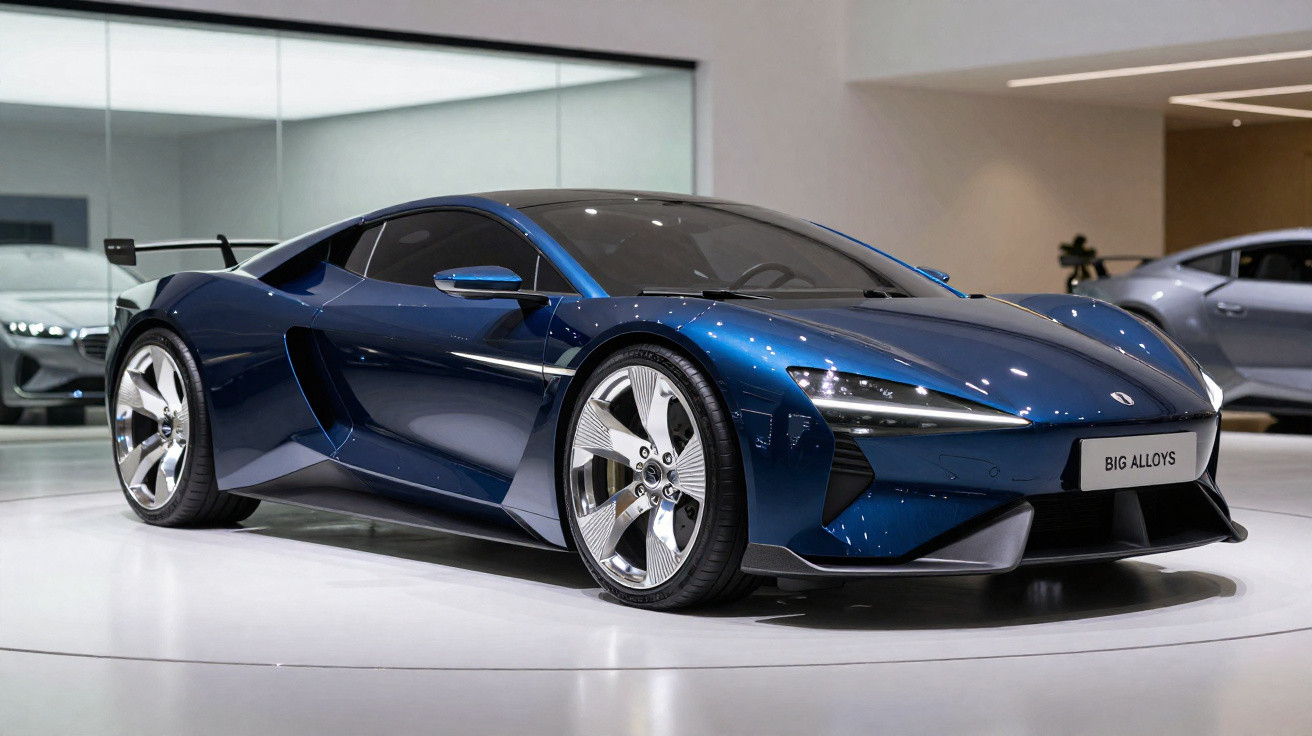
Our affection for ever-larger wheels - especially alloy wheels - really does seem to be drifting towards the gigantic. And, judging by what we see on the road, it’s not slowing down.
Bigger alloy wheels are becoming the norm
These days it’s no longer unusual to spot small hatchbacks riding on 18-inch alloy wheels. Move up to compact SUVs, and those one size above them, and 19-inch and 20-inch setups are starting to look… normal. Step into larger vehicles and things get more serious still, with certain models offering 23-inch wheels.
It sounds excessive, yet all signs suggest we still haven’t reached the ceiling. From what I’ve been reading - and from what I’ve heard directly from some automotive designers - get ready: 24-inch, 25-inch and even 26-inch alloy wheels are on the way.
A bit much? It certainly feels that way.
Why bigger rims sell
Common sense says it’s over the top, but the reality is hard to argue with: large wheels are a powerful sales tool. Plenty of buyers choose the biggest wheels a car can be fitted with - quite possibly including some of you reading this.
I understand the appeal. I also prefer seeing a wheel arch properly filled with metal rather than an expanse of rubber (with a few exceptions). Still, it’s getting absurd, because beyond “it looks really good”, there isn’t a convincing justification for the trend.
What you give up with larger wheels
There’s no inherent advantage to choosing bigger alloy wheels. When you tick the box for the largest wheel option available on a given model, the tyre sidewall has to shrink - sometimes dramatically. That almost inevitably harms comfort and ride quality.
On top of that, suspension effectiveness can suffer because of the increase in unsprung mass, and of course it becomes far easier to damage the very wheel you’re paying extra to show off.
Can a car on very large wheels still be comfortable and deliver a high-quality ride? Yes, absolutely - I’ve experienced that first-hand in several “big foot” models that have been through Razão Automóvel’s garage. If the vehicle was engineered from the outset with that requirement in mind, the engineers can find ways to work around and overcome the constraints pushed mainly by marketing and design. Even so, it doesn’t mean the car needs wheels of that size.
When I (and the RA team) get the chance to test two versions of the same model - one on larger wheels and the other on smaller ones - the differences surface quickly. The larger-wheel version tends to transmit more of the road’s imperfections, generates more road noise, and feels less well damped. I’d go as far as to say it’s almost mathematical. You can clearly tell that, during chassis development, the car was optimised around the more modest wheel option rather than the larger one.
There’s more. Choosing the biggest wheels usually (with exceptions) brings wider tyres too. It’s hard not to see the absurdity when I realise I’m driving a segment B or C car/SUV with 120–130 cv on wheels the same size - or very close to the same size - as those fitted to hot hatches pushing 300 cv. It simply doesn’t add up.
In the name of style, we end up trading away qualities that make our vehicles more effective and more pleasant as everyday, regular companions.
Is there room for a better compromise?
It feels like there should be space for a middle ground. If, in the past, it was possible to have cars on sensibly sized wheels that did their job and still looked good in photos, why does that seem so difficult today?
Comments
No comments yet. Be the first to comment!
Leave a Comment