
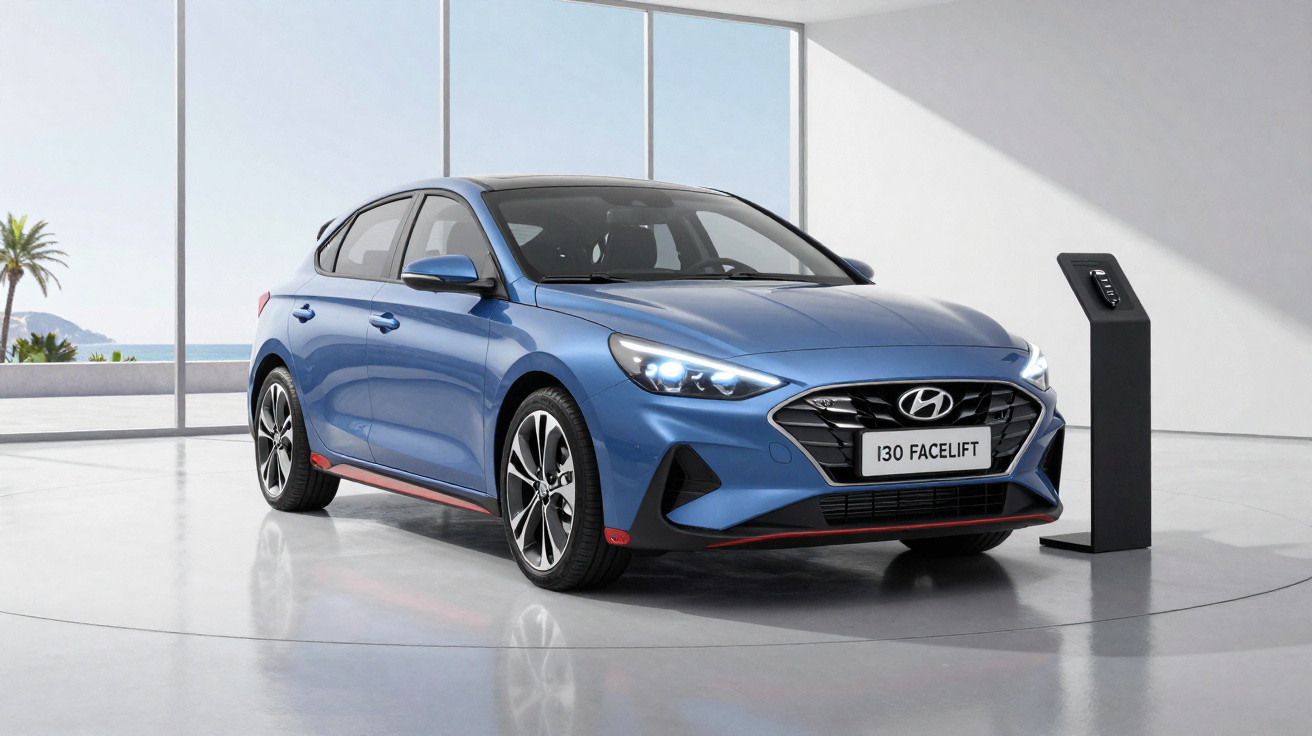
A year ago we first saw the facelifted Hyundai i30, but only now has the updated South Korean model reached us - with the delay largely down to the pandemic.
The refresh focuses mainly on the front end, where the car gains new headlamps (optionally LED), a revised grille and redesigned bumpers. At the rear, there is also a new bumper, while the tail-lights keep their shape but feature updated internal graphics (again, optionally LED). New wheel designs round off the exterior changes.
Inside, the updates are more subtle. Highlights include new 7″ and 10.25″ displays (with an 8″ screen standard), a digital instrument cluster (standard on N Line), and a refreshed infotainment system. New trim colours and redesigned air vents complete the changes compared with the model we already knew.
Hyundai i30 in Portugal
With the launch of the refreshed i30, we can now see how the range is structured in the national market. As before, three body styles are available: Hatchback, Fastback and Station Wagon.
There are two engine options: one petrol and one Diesel. The petrol is the 1.0 T-GDI with 120 PS, while the Diesel is the 1.6 CRDi with 136 PS, which now also comes as a 48 V mild-hybrid.
Missing from the line-up are the mild-hybrid versions of the 1.0 T-GDI and the new 1.5 T-GDI (also mild-hybrid), mainly due to changes in the State Budget affecting hybrid vehicles (which had included mild-hybrids). Even so, the brand still offers the mild-hybrid set-up on the 1.6 CRDi 48 V with 136 PS, absorbing the extra cost itself.
The 1.0 T-GDI is available with two gearboxes: a six-speed manual and a seven-speed DCT (dual-clutch automatic). The 1.6 CRDi offers the same choice, but with a key difference: the manual option is now Hyundai’s new iMT (intelligent manual transmission). This system can disconnect the combustion engine from the transmission when you lift off the accelerator pedal.
Style and N Line
The updated Hyundai i30 range is split into two trim levels: Style and N Line, with N Line now available across all body styles for the first time.
N Line adds a sportier look - including new bumpers with a wider integrated grille - plus LED headlamps and LED tail-lights, and wheels in either 17″ or 18″ (Style comes with 16″ wheels). Externally, it can also be specified in an exclusive colour: Shadow Grey.
Both trims include the now-essential Android Auto and Apple CarPlay, which can be used wirelessly. On the connectivity front, the i30 gains Bluelink for the first time - a free five-year subscription is included if you choose the navigation system - providing access to various connected services via a smartphone app. These include multiple real-time information features (traffic, for example), voice recognition, and vehicle control functions.
Safety kit is also well covered, grouped under the Hyundai Smart Sense package, which includes systems such as Lane Keeping Assist System (LKAS), Leading Vehicle Departure Alert (LVDA) and Forward Collision-Avoidance Assist (FCA).
How much does it cost?
As usual, the refreshed Hyundai i30 comes with a seven-year warranty with no mileage limit. In Portugal, prices start at 22 500 euros for the i30 1.0 T-GDI Style.
| Versão | Preço |
|---|---|
| i30 Hatchback (5 portas) | |
| 1.0 T-GDI Style | 22 500 € |
| 1.0 T-GDI N Line | 25 500 € |
| 1.0 T-GDI DCT N Line | 27 400 € |
| 1.6 CRDi 48 V (136 cv) Style | 30 357 € |
| 1.6 CRDi 48 V (136 cv) N Line | 33 821 € |
| 1.6 CRDi 48 V (136 cv) DCT N Line | 35 605 € |
| i30 SW (Station Wagon) | |
| 1.0 T-GDI Style | 23 500 € |
| 1.0 T-GDI N Line | 26 500 € |
| 1.0 T-GDI DCT N Line | 28 414 € |
| 1.6 CRDi 48 V (136 cv) Style | 31 295 € |
| 1.6 CRDi 48 V (136 cv) N Line | 34 792 € |
| 1.6 CRDi 48 V (136 cv) DCT N Line | 36 576 € |
| i30 Fastback | |
| 1.0 T-GDI N Line | 25 500 € |
| 1.0 T-GDI DCT N Line | 27 400 € |
Comments
No comments yet. Be the first to comment!
Leave a Comment