
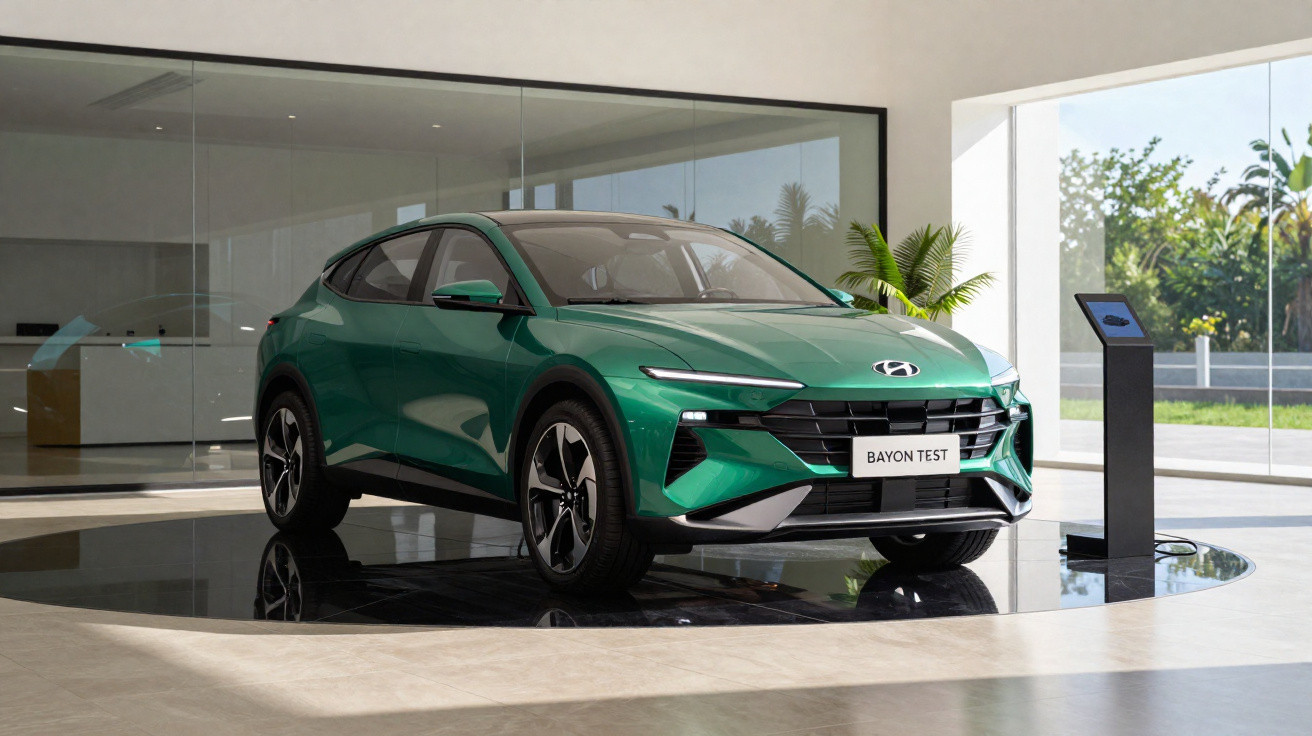
Recently unveiled, the Hyundai Bayon is positioned as the South Korean brand’s "entry point" into its SUV line-up. Even so, its exterior and interior dimensions do not place it as far from its "older brother", the Kauai, as you might expect.
Does the recently updated model have reason to "worry"? Or has Hyundai introduced a new option designed to cover a part of the market the Kauai does not reach, thereby rounding out the brand’s already broad SUV offering?
To find out what the new Bayon brings to the table-and how it stacks up not only against the Kauai but also the wider competition-we put it to the test in the only version sold in our country (Premium) and with the only engine available here: the 1.0 T-GDi with 100 hp paired with a six-speed manual gearbox (an automatic is optional).
Modern styling
With a contemporary look aligned with Hyundai’s latest models (the split front lights are a clear giveaway), I have to admit I like the small SUV’s slightly unconventional design-complete with a name inspired by Gaul.
Its measurements (4180 mm long, 1775 mm wide, 1490 mm tall and a 2580 mm wheelbase) and, above all, its proportions make it feel like a natural rival to options such as its "cousins" the Volkswagen T-Cross, SEAT Arona and Skoda Kamiq.
Against the Kauai-which is marginally larger at 4205 mm in length, 1800 mm in width, 1565 mm in height and with a 2600 mm wheelbase-the Bayon disguises the gap in status well. Parked side by side, their sizes genuinely seem much the same.
The real distinction is in character: the Kauai’s shape gives it a more dynamic edge, while the Bayon’s lines (particularly at the rear) steer you towards a more family-oriented feel. Either way, Hyundai has reason to be confident: it now offers two similarly sized models that complement each other in an important segment.
Where have I seen this interior before?
If the new Bayon looks entirely original on the outside, the cabin shares plenty with the model it rides on the same platform as: the new i20. The dashboard layout mirrors the supermini’s exactly-and that is a good thing.
After all, the i20’s dashboard (and now the Bayon’s) is defined by strong ergonomics (thank you, Hyundai, for keeping physical climate-control buttons), a modern, up-to-date style (albeit very grey) and solid overall quality. It is worth pointing out that there are no soft-touch materials here (it is a B-SUV, so that was never really on the cards), but the build feels sturdy and there are no rattles, even on the roughest surfaces.
When it comes to space, the Hyundai Bayon impresses and even puts the Kauai under pressure. Yes, its wheelbase is 2 cm shorter, but in the rear seats it never feels tighter. In luggage capacity, the Bayon actually outdoes the larger Kauai, offering a very respectable 411 litres versus 374 litres.
Set against rivals such as the Skoda Kamiq (400 litres), Volkswagen T-Cross (385 to 455 litres) or Renault Captur (422 to 536 litres), the Bayon sits squarely in the segment average. It is just a shame it does not provide modular touches such as sliding rear seats or a boot with a two-level floor.
Easy and pleasant to drive
My first kilometres behind the wheel of the Hyundai Bayon were in central Lisbon and, in the kind of urban traffic where it will probably spend most of its time, it surprised me in a good way. The controls are light without feeling vague, the clutch bite point is effortless to find, and everything feels well engineered and ready for the "urban jungle".
In those conditions, the 1.0 T-GDi proved more than capable of getting away from traffic lights with real purpose, while the precise, quick steering helps you dodge the surface imperfections that are a "calling card" of many of our roads.
However, while the Bayon started its time with me in the city, the rest of the days could not have been more different. "Confined" to long motorway runs and national roads, this is where the Hyundai Bayon fully convinced me of the quality of Hyundai’s work on this platform (not that I ever doubted it).
Stable and unfazed by (strong) crosswinds, the Bayon came across as comfortable (the seats may look simple, but they offer a very good fit). The suspension balances "forgiveness" over potholes with enough firmness to keep body movements in check through bends, and the steering I praised in town becomes a strong ally on twisty mountain routes.
Speaking of mountain roads, up there the Bayon lets its three-cylinder engine "sing" happily (it has a distinctive, rather amusing soundtrack), pulls with enthusiasm, and turns into a proposition that is even… fun. Of course, it is only 100 hp and 172 Nm, but that is more than enough for the job. The gear ratios are well chosen, the manual shift is pleasant, and the chassis response almost invites you to go looking for more corners.
Yet for the young families the Hyundai Bayon aims to attract, the standout may be its efficiency. With a calm driving style I achieved averages of 4,6 l/100 km, and when I made a point of it I saw the trip computer show figures like 4 l/100 km-typical diesel territory. In the city, consumption sat at a reasonable 5,9 to 6,5 l/100 km, and whenever I pushed the 1.0 T-GDi harder I never saw it return more than 7/7,5 l/100 km.
Is it the right car for you?
After a few days at the wheel of the Hyundai Bayon, it was easy to answer the question posed at the start: no, the Kauai has no reason to "worry" about the Bayon’s arrival-but someone does: the competition.
With the Bayon, Hyundai has rounded out its SUV range with a model that leans more on rational strengths than emotional appeal. Thanks to a larger boot and a look that, while modern, is less sporty in proportion than the Kauai’s, the Bayon is clearly aimed at young families. The Kauai, meanwhile, "winks" more at buyers who do not mind giving up space in exchange for a bit more style.
That split between "rationality" and "emotion" becomes obvious when you compare their powertrain line-ups (the Kauai’s spans everything from diesel to hybrids and electric versions) and their prices (considerably more accessible in the Bayon’s case).
Best of all, despite creating a "rational car", Hyundai has avoided making it dull, delivering a balanced, well-equipped, economical and spacious option that is also interesting to drive. All of this makes the Hyundai Bayon a choice worth taking very seriously in the "effervescent" B-SUV segment.
Note: at the time this article was published, a finance promotion was running that allows you to buy the Hyundai Bayon for 18 700 euros.
Comments
No comments yet. Be the first to comment!
Leave a Comment