
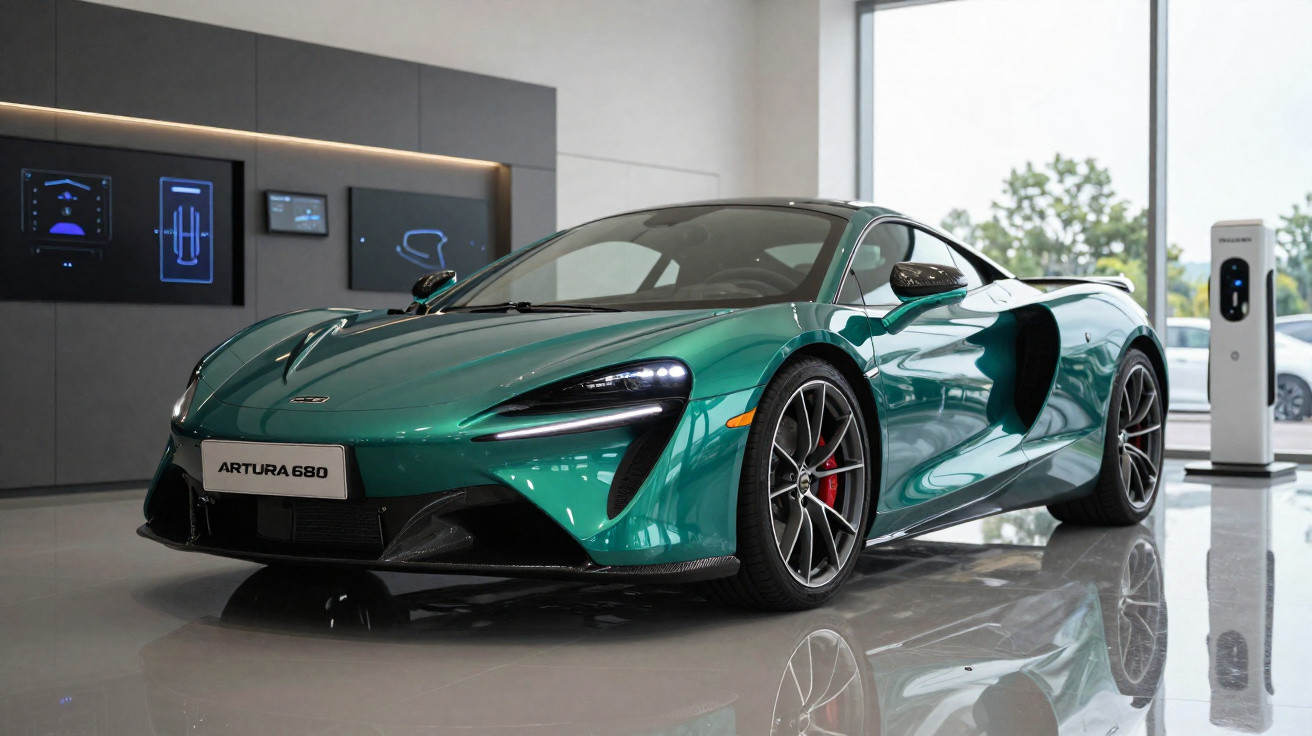
It began with the limited-run P1 (375 cars) and, much more recently, the even more restricted Speedtail (106 cars). Now, though, the new Artura will become McLaren’s first electrified road car to be produced in series, with no cap on the number of units built.
Arriving in a delicate context (see box), the Artura also carries the responsibility of signalling a new chapter for McLaren. In the line-up it sits between the entry-level GT and the Ultimate Series - Senna, Speedtail and (very recently) Elva - and it effectively operates at much the same level as the 720S within the brand’s mid-range.
To support that ambition, McLaren is introducing an all-new platform: MCLA – McLaren Carbon Lightweight Architecture. Designed from the ground up with electrification in mind, it is set to underpin a new generation of electrified McLarens, with the Artura as the first of them to reach series production.
The Artura uses an aluminium and carbon-fibre body and has a DIN kerb weight of 1498 kg, broadly comparable with other supercars that do not use hybrid propulsion. The hybrid hardware totals just 130 kg, including an 88 kg battery and a 15.4 kg electric motor. MCLA integrates a bespoke battery compartment and features an innovative Ethernet electrical architecture as well as an electric heating, ventilation and air conditioning system (eHVAC).
3.0 V6 + electric motor = 680 cv
Just as significant is the debut of a new 3.0-litre V6 - 40 kg smaller and lighter than the V8 normally found in McLarens. Its two cylinder banks sit at a 120° angle, which makes it possible to package both turbochargers within the vee (a “Hot V” configuration) while also helping to lower the centre of gravity, a clear advantage in any sports car.
This V6 layout also reduces pressure losses in the exhaust system, enabling the use of a stiffer crankshaft and allowing the rev limiter to be set at 8500 rpm - an unusually high figure for a turbocharged engine.
Although lessons were taken from the two previous hybrids, the powertrain itself is entirely new. It starts with an electric motor whose energy density is 33% higher (because it is axial-flux rather than radial-flux, as before). It produces up to 95 cv and 225 Nm, taking total system output to 680 cv and 720 Nm - with 585 cv and 585 Nm delivered by the combustion engine.
That blend of low mass and strong output underpins the quoted performance: 0–100 km/h in 3.0 s, 0–200 km/h in 8.3 s, and a top speed of 330 km/h.
The transmission is new as well, now with eight ratios instead of seven. Closer gearing helps deliver extremely rapid shifts - around 200 milliseconds - while the dual-clutch design maintains continuous torque transfer during changes.
Eighth gear functions as an overdrive to reduce consumption at cruising speeds, and it does not prevent the gearbox from being 40 mm more compact than the previous seven-speed unit - helped by the absence of a conventional reverse gear (reverse is provided by the electric motor by running in the opposite direction).
30 km on electric power
The electric motor is fed by a lithium-ion battery with 7.4 kWh of usable capacity (“liquids”), giving the McLaren Artura a 100% electric range of 30 km and the ability to reach up to 130 km/h - enough for short everyday journeys to be completed with zero tailpipe emissions.
At the same time, the electric “push” sharpens acceleration and in-gear response, as Richard Jackson, McLaren’s Director of Propulsion Systems, explains: “throttle response is much more precise and aggressive with the help of the electric motor, something we already knew when we developed the P1 and the Speedtail, but which we have now been able to improve”.
The battery and power distribution unit sit on a structural carbon-fibre floor, which is then bolted to the rear of the monocoque, improving stiffness, weight distribution and impact protection. External charging of this plug-in hybrid takes 2.5 hours (to 80%) using a conventional cable, although the driver can choose to charge the battery while driving using the petrol engine - a method that is far from the most efficient.
Given the Artura’s very high performance, the chassis engineering needed to step up as well. For the first time on a McLaren, an electronic limited-slip differential is used to manage torque independently on the rear axle. Compared with a mechanical equivalent it is lighter, easier to control and smaller (and it fits within the transmission), locking and unlocking the rear wheels individually to improve traction through corners.
In addition, as Chief Engineer Geoff Grose explains, “at the rear there is a new rear suspension with an upper wishbone and two lower links and a tie-rod in front of the wheel centre, with the aim of maximising vehicle stability and precision and reducing understeer during acceleration in a corner”.
“Tyres with a brain”
Because the tyres are the car’s contact point with the road, their role is obvious - and here too there is a major step forward developed with Pirelli. Each Cyber Tyre incorporates an electronic chip that generates real-time data and transmits it to the car’s stability control systems (as well as monitoring pressure and overall tyre performance).
Braking is handled by carbon-ceramic discs with aluminium calipers from the same family used on McLaren’s latest LT models. The electro-hydraulic steering - widely regarded as among the best in the supercar world - and the variable electronic damping system have both been revised and tuned specifically for the Artura.
New, yet familiar
We began with the Artura’s most technical aspects, drawn in by the pull of its technology, but that does not mean the exterior design and cabin deserve any less attention.
On the outside, familiar McLaren cues remain: a low “nose”, a forward-set cabin, a high rear section, and the drama emphasised by McLaren’s dihedral doors - which open closer to the body - along with the short wheelbase.
The sculpted outer skin is almost uninterrupted, highlighting elegance and the importance of slicing through the air with as little resistance as possible. At the same time, the “everything exists for a reason” philosophy is upheld: one example is the centre of the front splitter, which serves as an air intake for the eHVAC system and also houses the front radar included in the optional driver-assistance pack.
More piloting than driving
Inside, the cockpit is even more focused on the driver. The separation of drive modes between powertrain parameters (Powertrain) and vehicle behaviour (Handling) remains, but the switches have moved to the instrument binnacle. That binnacle is mounted to the steering column and adjusts with the steering wheel, helping ensure the driver rarely needs to take their right hand off the rim.
Four modes are available: Comfort (prioritising efficiency by switching off the V6 below 40 km/h), Sport and Track (increasingly aggressive in how power is delivered), and E mode for fully electric driving. Damper firmness and the level of intervention from the electronic stability control are adjusted accordingly.
The infotainment system has also moved forward notably, with new software (updated versions of familiar McLaren apps, including McLaren Track Telemetry and Variable Drift Control, plus a new navigation map in the instrument display) and new hardware for the two high-resolution screens.
The new McLaren Artura goes on sale this year, with prices expected to start at around 300,000 euros.
Technical Specifications
| McLaren Artura | |
|---|---|
| Combined Power/Torque | |
| Power | 680 cv |
| Torque | 720 Nm |
| Combustion engine (M630) | |
| Position | Longitudinal mid-rear |
| Architecture | V6 |
| Capacity | 2993 cm³ |
| Induction | Twin Turbo |
| Power | 585 cv at 7500 rpm |
| Torque | 585 Nm between 2250-7000 rpm |
| Electric motor | |
| Type | Axial flux |
| Power | 95 cv |
| Torque | 225 Nm |
| Battery | |
| Capacity | 7.4 kWh |
| Charging | Station: 80% in 2.5 h |
| Transmission | |
| Drive | Rear-wheel drive |
| Gearbox | SSG 8-speed (reverse provided by the electric motor) |
| Chassis | |
| Suspension | Front: Adaptive independent, aluminium double wishbones; Rear: Adaptive independent, aluminium upper wishbone and lower multi-link |
| Brakes | Front: Carbon-ceramic discs, 390 mm; Rear: Carbon-ceramic discs, 380 mm; Forged aluminium calipers (6 pistons front, 4 pistons rear) |
| Steering/Turns lock-to-lock | Electro-hydraulic assistance/N/A |
| Dimensions and capacities | |
| Length x Width x Height | 4539 mm x 1913 mm x 1193 mm |
| Wheelbase | 2640 mm |
| Luggage capacity | 160 l |
| Fuel tank capacity | 72 l |
| Wheels | Pirelli P Zero or Pirelli P Zero Corsa. Front: 235/35 ZR19; Rear: 295/35 ZR20 |
| Weight | 1498 kg (DIN) |
| Performance and consumption (pending certification) | |
| Top speed | 330 km/h; Electric mode: 130 km/h |
| 0-100 km/h | 3.0s |
| 0-200 km/h | 8.3s |
| 0-300 km/h | 21.5s |
| 0-400 m | 10.7s |
| 200-0 km/h | 126 m |
| 100-0 km/h | 31 m |
| Combined consumption | N/A |
| CO₂ emissions | 129 g/km |
| Electric range | 30 km |
Comments
No comments yet. Be the first to comment!
Leave a Comment