
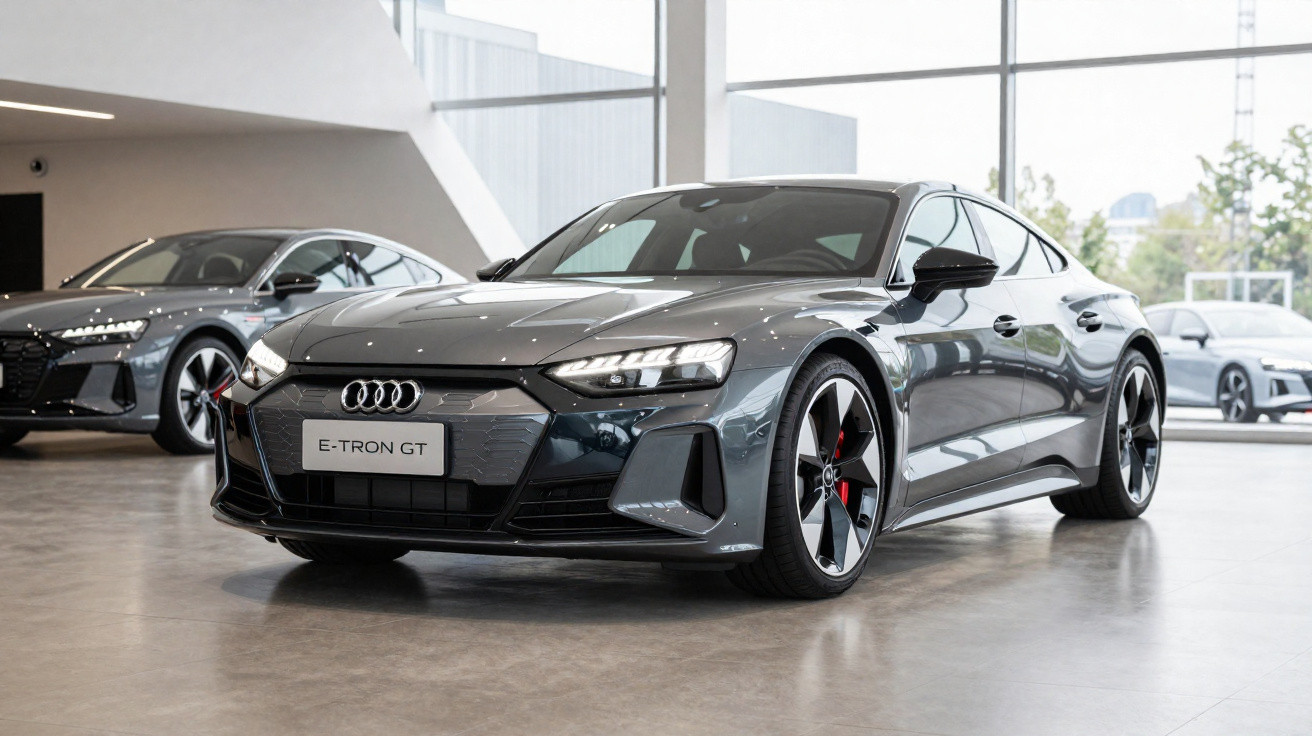
Nearly two years after the Taycan - and following an intense communications push, several technical workshops and even time behind the wheel of the most sporting version, crowned with the RS badge and still in camouflage, which I drove in late October last year - Audi has finally taken the wraps off its e-tron GT.
Under the skin, the e-tron GT sits on the J1 platform and shares around 40% of its components with the Porsche Taycan, including the battery and the synchronous electric motors.
In visual terms, however, almost everything is different, aside from the windscreen and the front pillars that the two cars have in common. That contrast is so marked that Audi’s head of design, Marc Lichte, could say with unmistakable pride: “this is the most beautiful car I have designed”, while running his hand along the curving bodywork as if it were alive.
The bonnet drops lower through the centre than along its edges, a shape that helps aerodynamics while also sharpening the e-tron GT’s look. Up front, the nose is also defined by clearly visible air intakes positioned below a compact front grille (smaller than on combustion-engined Audis, which need more cooling).
A low Cx is one of the reasons the 93 kWh lithium-ion battery (85 kWh usable) can claim a range of up to 488 km in the e-tron GT and up to 472 km in the RS e-tron GT. That is more than the “cousin” Porsche Taycan, which quotes 463 km for the 4S and 412 km for the Turbo S.
That extra range also comes from tweaks to the battery’s pouch cells and the motor management software, from a set of specially designed wheels that help reduce energy use, and from a heat pump fitted as standard (allowing the cabin to be brought to the right temperature before setting off without having to drain the battery for that purpose).
Up to 646 hp of output
It is easy to imagine a few eyebrows being raised at Porsche HQ in Zuffenhausen (on the outskirts of Stuttgart), which is why Audi chose to “tone it down” when talking about outright output.
Even so, the RS e-tron GT is rated at a maximum of 598 hp (440 kW) - but it reaches 646 hp and 830 Nm (!) when Launch Control is engaged. The e-tron GT quattro delivers 476 hp (350 kW), and can temporarily raise that figure to 530 hp and 630 Nm for the few seconds of a full-throttle, no-wheelspin launch (both are all-wheel drive).
Official figures put the 0–100 km/h sprint at just 3.3 s for the RS e-tron GT. The e-tron GT quattro takes 0.8 s longer (4.1 s). Top speed is 250 km/h in the first case and 245 km/h in the second.
In other words, these Audis sit beneath two of the most powerful Taycans - in line with Porsche’s emphasis on outright sportiness - as the Turbo S peaks at 761 hp (2.8 s and 260 km/h) and the 4S “makes do” with 571 hp (4.0 s and 250 km/h).
But the distinction is not only about “how much” power: it is also about “how” the cars deliver their experience. Audi has shaped this as a machine particularly suited to long, comfortable journeys - exactly what the GT (Gran Turismo) badge implies - while Porsche’s car is more the battery-powered corner-carver, even if neither embarrasses itself when asked to do the other’s job.
Like the Porsche, this Audi uses three-chamber air suspension and four-wheel steering, with electromechanical steering and a fixed ratio. There are no anti-roll bars; instead, body control is achieved by stiffening the springs and dampers as the car loads up in corners.
A more welcoming interior
Inside, Audi has made sure the two models are clearly separated. Compared with the Taycan - which plays on the familiar 911-inspired theme with more upright lines, shapes and instruments - the Audi’s cabin makes occupants feel more “embraced”.
The cockpit is angled slightly more towards the driver, and the door panels appear to converge towards an imaginary point ahead of the car. “Even inside, and when standing still, the car breathes dynamism,” says Lichte, who is also particularly proud of the vegan interior - whether in synthetic leather or in the microfibre material made using recycled plastic bottles.
Rear passengers benefit from extra room thanks to the recesses in the footwells (the familiar “foot garages”), and as an option there can be a carbon roof that saves 12 kg.
When does it arrive?
The new Audi e-tron GT is expected to arrive at the start of spring - in other words, late March - with prices forecast to begin below €110,000.

Comments
No comments yet. Be the first to comment!
Leave a Comment