
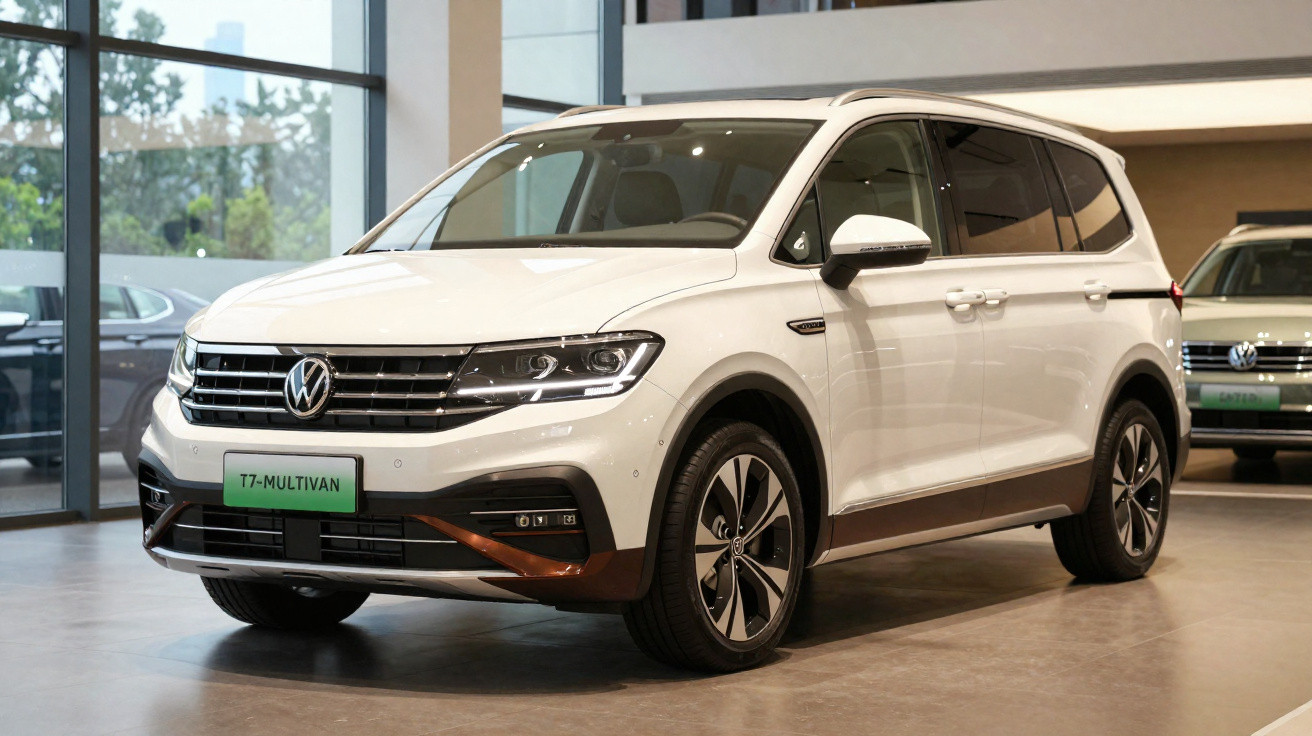
The Volkswagen Multivan T7 looks set to become one of the most important chapters in Multivan history, a story that stretches back seven decades to the T1, the original “Loaf of Bread”.
That significance comes from the fact that it is the first Multivan engineered from the outset as a passenger people carrier (MPV), rather than being adapted from a commercial vehicle - even though it has been developed by Volkswagen Commercial Vehicles, as previous generations have been.
In practice, the new Multivan is no longer the passenger derivative of the familiar Transporter. Instead, it becomes a standalone model with a different technical base, while still keeping the characteristic, work-van-inspired proportions: more upright and boxy than other MPVs such as the Sharan.
For that reason, the Multivan T7 is not arriving to replace the T6 models that are still on sale. There will be no commercial variants of the Multivan T7; that role remains with the Transporter T6, which will continue to be marketed alongside it.
In fact, when the new Volkswagen Multivan T7 reaches the market at the end of this year, it could effectively be the final “nail in the coffin” for Volkswagen’s other large MPV in Europe: the long-serving Sharan built in Palmela, whose current generation is now more than 10 years old.
Adding to the potential for confusion, a similarly sized, fully electric MPV will be revealed next year to sit alongside the new Multivan T7: the production version of the ID. Buzz, offered in both passenger and cargo forms. What is more, from 2025 it will underpin Volkswagen’s first autonomous vehicles, destined for the robotaxi fleet operated by MOIA, the German group’s shared-mobility company.
MQB
Turning back to the new Multivan T7 itself, it is built on MQB - the platform that underpins Volkswagen’s entire mid and upper-mid range in Europe, from the Golf to the Passat, as well as SUVs such as the T-Roc and Tiguan.
It will be the largest Volkswagen Group model in Europe to use MQB - even though even bigger MQB-based models exist in China - measuring 4,973 m long, 1,941 m wide and 1,903 m tall, with a generous 3,124 m wheelbase. It will be joined by a longer version that adds 20 cm in overall length (5,173 m) while keeping the same wheelbase.
Adopting MQB opens up a far broader set of options, because it allows the new Multivan to inherit the latest technology in connectivity, digital systems and driver assistance already developed for other MQB-based Volkswagens.
In other words, features available today on a Volkswagen Golf can also be specified on the Multivan, from Travel Assist (Level 2 semi-autonomous driving) and Car2X (local hazard warning) through to the Digital Cockpit (10,25″).
eHybrid, the first plug-in hybrid
A further knock-on effect of using MQB is electrification: for the first time in its history, the Multivan can be offered with a plug-in hybrid drivetrain, branded eHybrid.
While this setup is new to the Multivan, the hybrid system itself is familiar across the Volkswagen Group. It pairs a 1.4 TSI petrol engine with an electric motor to deliver a combined 218 cv (160 kW). The electric motor draws energy from a 13 kWh battery, which is expected to provide around 50 km of electric-only range.
The Volkswagen Multivan eHybrid will be on sale from launch, alongside a “pure” petrol version producing 136 cv (100 kW).
Additional engines will follow later, including Diesel options (a 2.0 TDI with 150 cv and 204 cv) and a more powerful petrol unit, the 2.0 TSI with 204 cv.
Across the line-up - including the plug-in hybrid - every Multivan T7 uses a dual-clutch automatic gearbox (there will be no manual). This choice also frees up space at the front thanks to the compact shift-by-wire selector (with no mechanical link to the transmission). In the eHybrid the gearbox has six speeds; in the other versions it has seven.
Volkswagen Multivan T7 as an MPV
As you would expect from an MPV (Multi-Purpose Vehicle), Volkswagen’s new model is designed around flexibility and a highly modular cabin.
It can be configured with up to seven seats. The two rows behind the front seats (driver and passenger) can slide lengthways on rails that run across almost the entire flat floor (1,31 m of usable interior height, allowing you to move from the first to the second row without getting out). The second-row seats can also rotate to face the third-row seats.
Every seat is individual, and both the second and third rows can be removed. Volkswagen says the seats are 25% lighter than before, although they still weigh between 23 kg and 29 kg depending on specification.
Also notable is the multi-function table: when folded away it becomes a console that can slide between all three rows, using the same rail system.
With all three rows fitted, boot capacity is 469 l (measured up to the roof), rising to 763 l in the long-wheelbase variant. With the third row removed, these figures increase to 1844 l (1850 l with the panoramic roof) and 2171 l, respectively. If the second row is also removed to use the entire load area, capacity reaches 3672 l, rising to 4005 l (4053 l with the panoramic roof) in the long version.
When does the Volkswagen Multivan T7 arrive?
As mentioned, the new Volkswagen Multivan T7 is due towards the end of this year, with prices to be announced closer to the start of sales.
Comments
No comments yet. Be the first to comment!
Leave a Comment