
Have you ever heard of the butterfly effect? The butterfly effect is part of chaos theory, a theory developed in 1963 by Edward Lorenz, and one that is now used across every scientific discipline.
In simple terms, this “effect” argues that the faint flap of a butterfly’s wings in one place can set off a chain of events that, in the end, may culminate in a storm on the other side of the world. Impressive, isn’t it?
The automotive industry’s “butterfly effect”
In the car industry, the “butterfly effect” has taken the form of small-displacement turbo engines. Smaller, more compact powerplants that are winning over more and more drivers.
Just like that barely perceptible butterfly, these little turbo engines ended up triggering a wave of change that has reshaped the automotive world.
So when did it all begin?
Back in 1988, the European Union introduced vehicle-emissions rules for the first time, calling the standard EURO 0. Since then, every vehicle sold in Europe has had to meet these regulations, which have continued to evolve over time.
From 1988 onwards we moved through EURO 1, 2, 3, 4, 5 and today’s rules, EURO 6. As the Euro standards became more and more demanding, naturally aspirated engines came under increasing pressure. It quickly became clear that larger-capacity naturally aspirated engines could not keep pace with the tightening requirements.
Last year, Honeywell Transportation Systems, the world’s largest turbo manufacturer, described the current period as the “golden age of turbo engines”. So much so that the rise of turbo engines compared with naturally aspirated units has almost pushed the latter to extinction in Europe. Today, turbo engines are the industry standard.
An old technology that is more relevant than ever
Turbo technology is not new at all. In fact, it has existed since the 1930s in military aviation.
Turbochargers were first used in bomber aircraft to increase power and reduce fuel consumption, thereby extending the range of military operations.
We had to wait until 1963 to see the first car launched with turbo technology, introduced by General Motors on an Oldsmobile model. Since then, a great deal has changed.
Video of the development of Hyundai’s Kappa 2.0 Turbo:
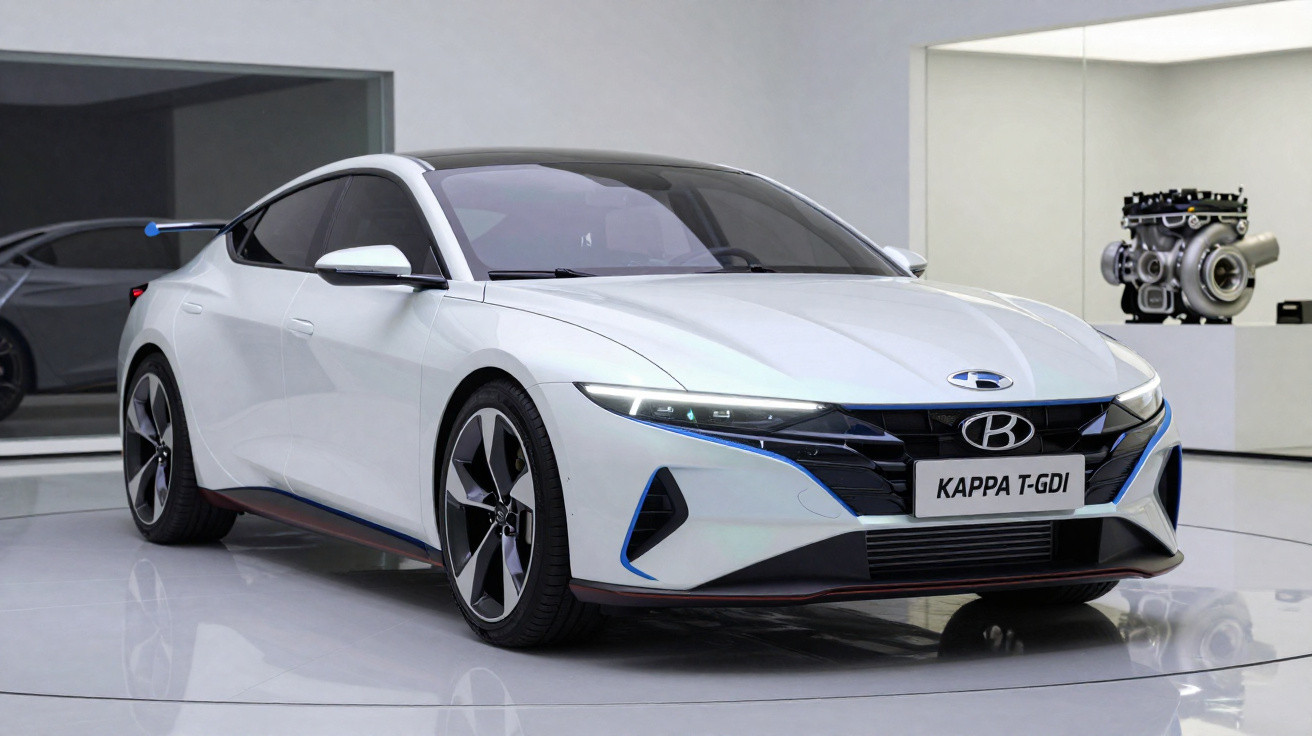
Once high-capacity, petrol-hungry machines, today’s turbo petrol engines are completely different from their predecessors. Hyundai’s Kappa 1.0 T-GDI engine is a good example.
The secrets behind Hyundai’s Kappa T-GDI engines
The Kappa name refers to Hyundai’s latest family of petrol engines. Within this broad range, the standout is the 1.0 T-GDI unit, offered in 100 and 120 hp versions.
In this three-cylinder engine, with just 1 litre of capacity, Hyundai used several solutions to improve driving refinement while lowering fuel consumption and emissions.
One of the most significant focuses is the turbo system itself, which features an electronically controlled “waste gate” valve to boost combustion efficiency, sharpen response at low revs, and protect the engine from pressure spikes.
To extract the maximum performance from every litre of petrol, Hyundai equipped this Kappa engine with six-hole GDI injectors (made using laser technology) capable of reaching 200 bar of pressure, helping to ensure clean, efficient and consistent combustion.
Another key feature of the Kappa 1.0 T-GDi is its cooling layout. The engine block and cylinder head use separate cooling circuits, allowing the brand’s engineers to manage engine temperatures independently.
The aim? To improve component durability and maximise engine efficiency.
Finally, the exhaust manifolds are integrated into the cylinder head as well. With this approach, Hyundai enables the 1.0 T-GDi to reach its ideal operating temperature sooner, which results in lower fuel consumption and reduced emissions in real-world driving.
That’s everything on the technological strengths of small turbo engines, using Hyundai engines as an example. If you want to keep being surprised by the technology of the “Korean giant”, follow this link. You have no idea…





Comments
No comments yet. Be the first to comment!
Leave a Comment