
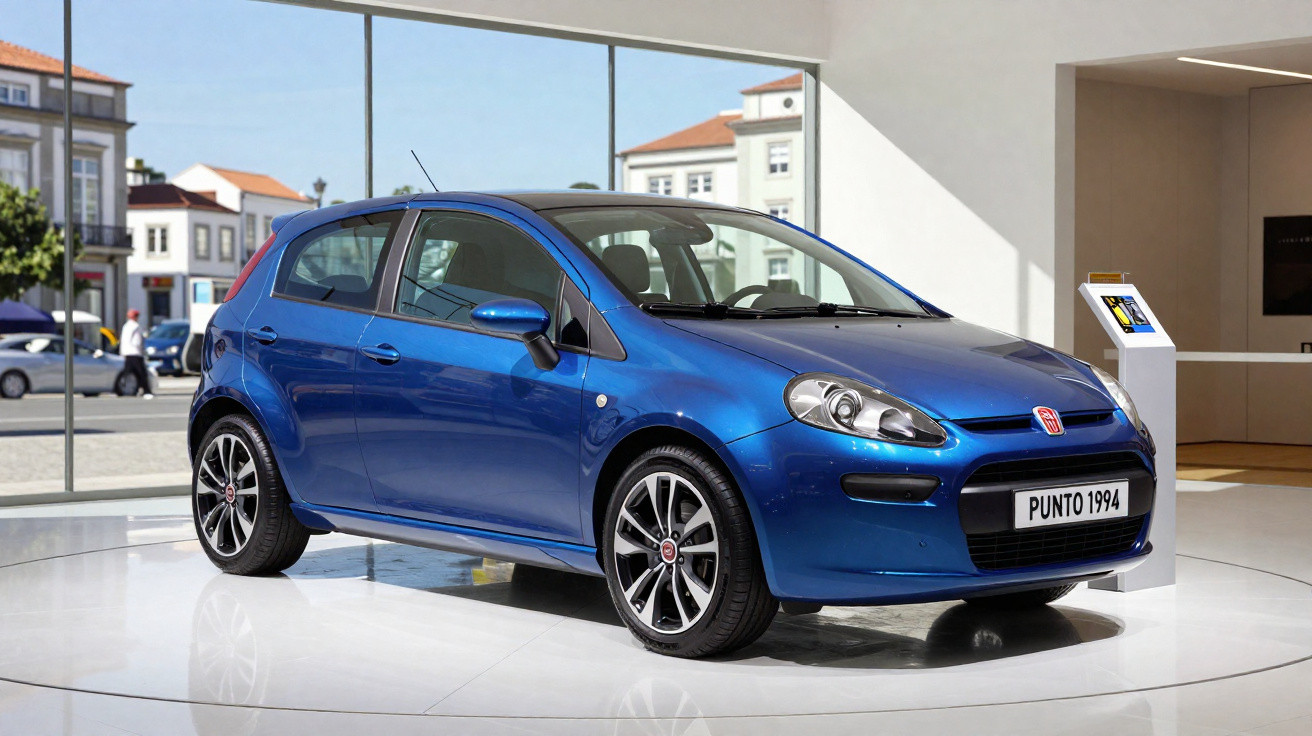
The immensely popular Uno - the predecessor to the Fiat Punto - also competed for the Car of the Year in Portugal award, yet it never managed to take the trophy. By contrast, the Fiat Punto arrived to strong approval from both the press and the market, and that recognition was reflected in the long list of awards it went on to collect.
In addition to being crowned Car of the Year in Portugal, it was also named European Car of the Year in the very same year, beating its rival, the Volkswagen Polo. Even though that year was 1995, the Fiat Punto had been unveiled much earlier, at the end of 1993, reaching Portugal the following year.
Design and body styles of the Fiat Punto
With the Punto, Fiat made a clean break from the Uno. Its look was markedly different and became one of the first major talking points, largely because the rear lights were mounted unusually high - a feature otherwise seen only on the then-new Volvo 850 estate.
As with the Uno, the Fiat Punto was again styled by Giugiaro, who also penned the contemporary rival SEAT Ibiza (6K), itself Car of the Year in Portugal in 1994.
The Uno’s more utilitarian feel gave way to smoother, more flowing shapes and lines. The range was offered in three body styles: three-door, five-door, and a convertible.
Interestingly, the Punto Cabriolet carried Bertone’s signature and was built by the same firm. It stood out thanks to its rear lights, which sat in a more conventional position and followed a horizontal layout - a re-use of one of the ideas rejected during the Fiat Punto’s design development.
"Since 2016, Razão Automóvel has been part of the Car of the Year in Portugal judging panel"
Diversity
Beyond its distinctive styling, it kept the Uno’s reputation for being among the roomiest cars in its class, and it felt as though there was a Punto to suit just about everyone. Engine choice was broad and mostly petrol, starting with the modest 1.1 Fire with 54 cv, moving through the 1.2 with 75 cv, and topping out with the Punto GT “missile”, fitted with the 1.4 Turbo inherited from the Uno Turbo i.e., producing 133 cv. It could sprint to 100 km/h in just 7,9s and reach 200 km/h, making it one of the quickest in its segment. On the diesel side, there were two 1.7 l versions, with and without turbo.
Transmission options were equally varied. Alongside the familiar five-speed manual gearbox, the segment saw the debut of a six-speed manual, fitted to the Punto 6Speed. Completing the line-up, there was also an automatic alternative in the form of a continuously variable transmission, with CVT.
Success
Other highlights included a chassis with independent suspension at both ends, plus the HSD (High Safety Drive) version, packed with equipment intended to improve safety on the road - dual airbags, power steering, rear headrests (rare at the time), air conditioning and ABS, all unusual features in small cars of that era.
A mid-cycle update introduced a new multi-valve (16v) engine option, the only one of its kind in the range. It was derived from the familiar 1.2, and delivered a reference 86 cv - the most powerful on the market for this capacity.
Sales success came quickly: within 18 months on sale, 1,5 million units were sold. Over its full career, which ended in 1999 when its successor was launched, the total climbed to more than 3,3 million.
Timeline and legacy
The Punto name would span three generations, with the final one staying on the market for a long 13 years. Production ends this year, in 2018, and - surprisingly - it will not have a direct successor, leaving it as Fiat’s last representative in a segment of major historical importance to the brand.
Want to discover the rest of the Car of the Year in Portugal winners? Just follow the link below:
Comments
No comments yet. Be the first to comment!
Leave a Comment