
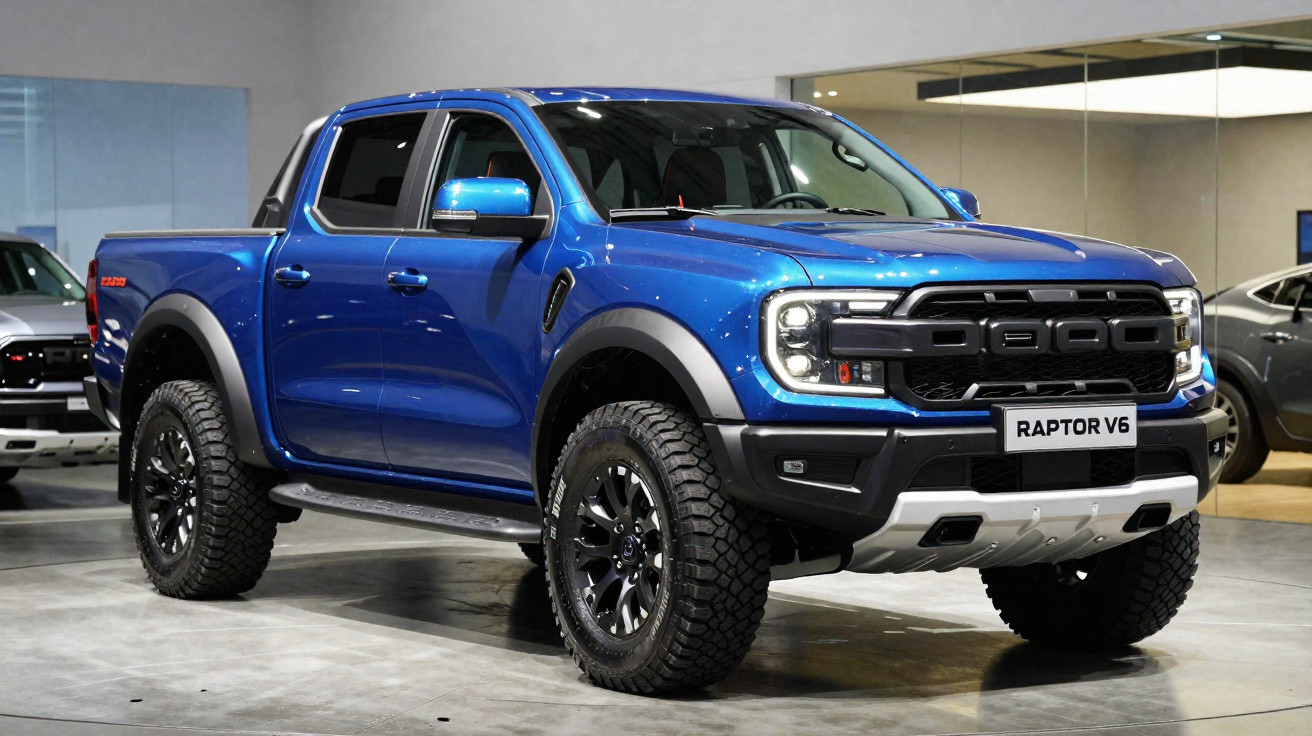
This is the most Raptor Ford Ranger ever.
Ford Performance shocked people with the first generation, so it wasn’t about to hold back this time. The new Ranger Raptor has now landed in Europe with a 3.0-litre twin-turbo petrol V6 producing 292 cv.
The core recipe hasn’t changed much from before. What has changed is the execution: everything has been refined so the end result is even more dramatic. And there’s no point pretending otherwise (sorry for the early spoiler in such a fresh test): this is the most impressive Ford Ranger ever.
Nobody will be surprised to hear the Ford Ranger Raptor is a genuine off-road “monster”. The real question is what it’s like to live with day to day. Is it merely awkward, or basically impossible? The answer is below.
Ford Ranger Raptor: Big? No, huge!
Numbers don’t lie, and the Ford Ranger Raptor’s dimensions make it clear this is no ordinary pick-up: 5.36 m long, 2.03 m wide and 1.93 m tall.
So, before you ask: no, it won’t fit in every garage, and parking bays are rarely wide enough to stop all four tyres sitting on the white lines.
And don’t even think about turning into a narrow road you don’t know well. I don’t want to imagine what it would be like to have to (or rather, attempt to) do a three-point turn halfway along.
Even so, I won’t pretend otherwise: at first, driving the Raptor can feel intimidating. But that feeling lasts about 10 minutes-maybe less. Because when you consider the sheer size and athletic stance, this pick-up is actually very easy to drive.
And even in manoeuvres that look tricky on paper, you’re backed up by parking sensors and cameras both front and rear.
Looks to match
If you hear the twin-turbo V6 growl, there’s no debate: you’ll instantly know it’s a Ranger Raptor. But even with the six-cylinder “asleep”, plenty of details give the game away-starting with the bespoke bumpers, the imposing grille with the “FORD” lettering, and the model-specific graphics.
Add to that the black protective cladding around the wheel arches, which emphasises the width and presence, the black sports bar mounted directly behind the double cab, and of course the two generously sized exhaust tips.
A cabin built to withstand almost anything-just as it should
Inside, the Ford Ranger Raptor stands out with several orange accents, dedicated sports seats, and a steering wheel featuring orange stitching plus the “RAPTOR” script at the bottom of the rim.
In terms of perceived quality, the materials won’t blow you away, but there has been a huge (truly huge) step forward compared with the previous generation. They’re more than good enough to make you feel comfortable on board, and they suit a tough, adventure-focused pick-up like this perfectly.
On a few occasions, I found the cabin’s physical controls didn’t feel especially precise. But assembly quality is strong, and even when I left the tarmac to explore this pick-up’s off-road ability, I never noticed any unwanted rattles.
In the back, on the second row, space isn’t as generous as you might expect and, once seated, you quickly notice the backrests are too reclined (more reclined than in an SUV).
That said, the rear seats aren’t uncomfortable and they’re perfectly usable even for longer journeys. Access is also always easy thanks to the very wide door openings. However, legroom is limited-shorter than in many mid-size SUVs.
Room for everything?
As you’d expect, the rear load area is large and very flexible. It offers 1.22 m of maximum width, 53 cm in height and-more impressive still-1.56 m in length when measured with the small tailgate section open.
With the optional Raptor Exterior Pack, the load bed gains a textured black lining that’s very easy to clean, plus an electric cover that can be operated from the key fob.
Over the days I spent with the Raptor, I ended up loading my dog’s travel crate and even two bicycles into the back of this pick-up. That kind of versatility is one of the reasons this body style can make real sense.
But if you’re using it for more everyday “missions”-like carrying grocery bags or a small piece of flat-pack furniture bought from a certain Swedish shop-then it’s best to use one of the many tie-down points in the bed to secure those items.
Otherwise, you’ll almost inevitably have to climb up onto the Ford Ranger’s deck just to reach everything. From ground level, even fully stretched out at 1.83 m tall, it’s impossible to reach much beyond halfway in.
A different kind of sports machine
Let’s start with the most important part of this puzzle: the engine. After all, it’s one of the headline changes of this second-generation pick-up. Where the first Ranger Raptor only offered a Diesel unit, it now also comes with a serious petrol engine.
Under the bonnet sits a 3.0 V6 EcoBoost with two turbochargers, delivering 292 cv and 491 Nm of maximum torque. Power goes to all four wheels via a 10-speed automatic gearbox.
In summer, deliveries begin for the four-cylinder 2.0-litre turbo Diesel EcoBlue with 205 cv and 500 Nm, which can already be ordered.
Back to the 3.0 V6 EcoBoost: this is the same engine you’ll find in the Ford Bronco Raptor, where it produces more than 400 cv.
In the “European” Ranger Raptor it’s somewhat “detuned” due to emissions rules, but make no mistake-this pick-up is not short on power. Proof comes in the 0–100 km/h time of 7.9s, regardless of surface (top speed is limited to 180 km/h).
On paper that may not sound outrageous, but in the real world it’s a different story: you’re dealing with a “monster” weighing more than 2.5 tonnes (2529 kg). And, as mentioned above, that performance is repeatable on any surface-on gravel, for instance, it’s remarkable how the Raptor claws forward and manages to put all that torque down.
Before we move on, I’d encourage you to watch (or rewatch) the four-wheel jump Diogo Teixeira pulled off during his first drive in this Ranger Raptor. Trust me: it’s impressive.
Capable on tarmac. But…
Away from dirt and onto the road, the Ford Ranger Raptor isn’t in its natural habitat. Yes, the suspension is more comfortable than I expected, the agility is surprisingly good, and the 10-speed automatic can be genuinely smooth. But the aggressive all-terrain tyres make their presence felt as soon as you start pushing.
More importantly, on tarmac I constantly had the sense I was only using 20% of what this model can do. Only when I headed off-road did we-me and the Ranger Raptor-start speaking the same language.
A sports machine for rough tracks
I was able to try the Ranger Raptor on two very different kinds of terrain: one fast, one slow and highly technical. And honestly, it impressed me in both.
The first challenge was a wide dirt road-with some gravel-featuring several medium-speed bends and excellent visibility. It was perfect for provoking the rear of this pick-up, with the drivetrain in 2H (rear-wheel drive only) and the ESC switched off.
After that came half a dozen kilometres of completely open track that begged you to raise the pace. Here, there was only one move: engage Baja mode. And what a difference it makes.
Throttle response becomes far sharper, the exhaust note turns up both volume and drama, and the Fox Live Valve dampers (with electronic control) show exactly why they matter.
The stability and comfort over rough patches are outstanding, and you’re left with the impression that everything works even better-and feels more finely tuned-the faster you go and the more assertive you are with every input.
Then came a slower, much more technical section where I could attempt a few axle-twisting moments, test the locking function for the three differentials, and even try Trail Control. This lets you set a constant speed (between 2 km/h and 18 km/h) so you can crawl forward cautiously over obstacles.
Do the fuel figures make you wait for the Diesel?
The Ranger Raptor’s capability is unquestionable, especially off-road. But does that translate to fuel consumption? Well-yes and no.
As you’d expect, fuel use climbs when you decide to exploit everything this pick-up can do. When I did, consumption was always above 16 l/100 km. In town, using “Normal” mode and with occasional bursts of acceleration, I rarely managed to stay below 19 l/100 km.
On the motorway-where I also covered around two hundred kilometres-it depends on how disciplined you want to be. At an average speed of 120 km/h, you can expect roughly 13,5 l/100 km. At 90 km/h, that figure “drops” to 10 l/100 km.
They’re not low numbers, but after seeing what this pick-up can do, it’s hard to be too critical. The good news is you get an 80-litre fuel tank, so a decent driving range is achievable.
How much does it cost?
I’ve heard plenty of people accuse the Ford Ranger Raptor of being irrational. My question is: has any sports car ever been rational? No.
Buying a sports machine is-and always will be-an emotional decision. And in my view, that’s precisely what makes them special. This pick-up is no exception.
It’s dramatic, spectacular and very radical. And I wouldn’t change a thing. The list of strengths is long-I’ve already covered them throughout the piece-and the downsides are close to irrelevant, aside from the price: in our country it starts at 83 391 euros, thanks to our taxation.
As we’ve seen, fuel consumption is another drawback. But for someone with more than 80 thousand euros to spend on a sports machine as dramatic as this, I can accept that it may not even register as a real issue.
And I’ll finish this test with the same question I opened with: what is it like living with the new Ford Ranger Raptor V6 with 292 cv? Is it possible? Of course it is.
I spent almost a week with this pick-up and carried on with normal life: I went shopping, commuted into central Lisbon (and parked on the street), and did a longer motorway journey. I didn’t struggle with any of it.
But does it make sense? That depends. There are more rational ways to deal with everyday life-but none are as entertaining.
That said, the new Ranger Raptor is the best generation yet of the most radical pick-up Ford sells in Europe, and it offers a sense of freedom that’s becoming increasingly rare.
Comments
No comments yet. Be the first to comment!
Leave a Comment