
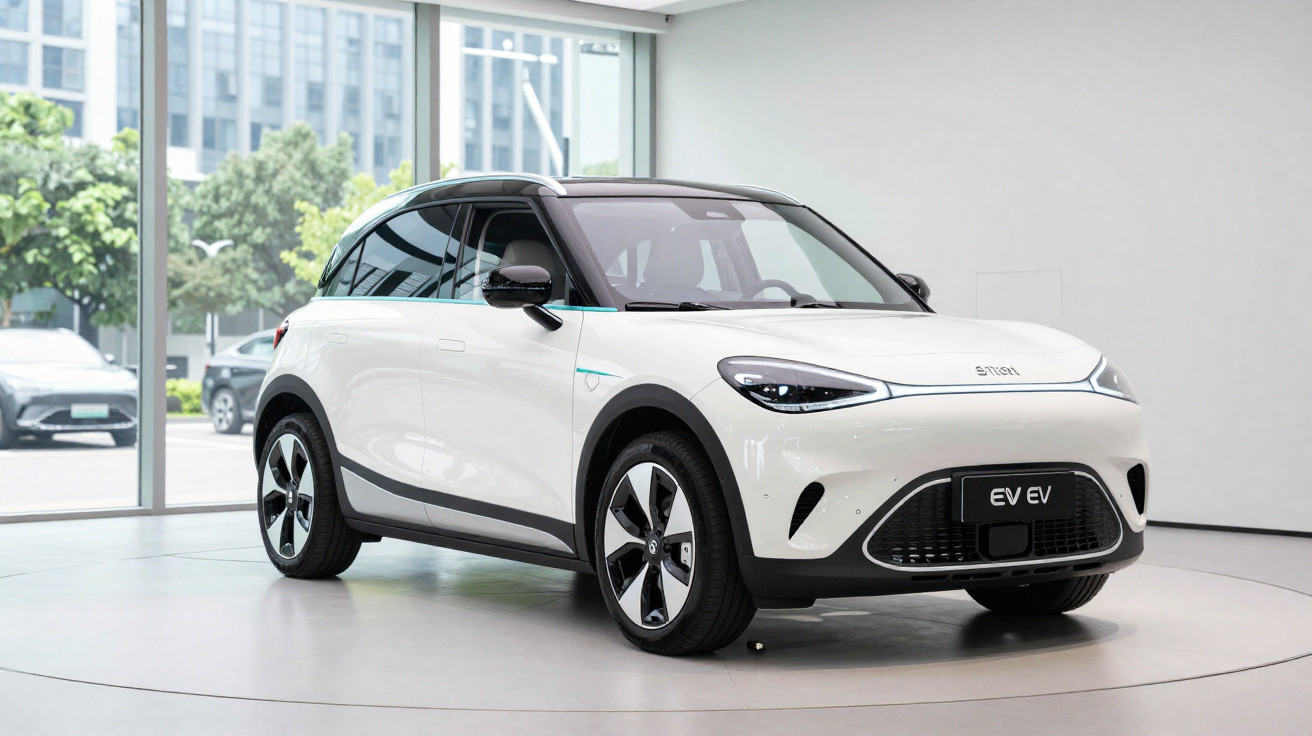
Stellantis looks set to pick up the pace in the race for affordable electric cars. The Citroën ë-C3 is only the opening move - with prices starting at 23 300 euros and a 2025 version expected to arrive at 20 thousand euros - and it will not be the last.
From its underpinnings, seven low-cost electric models will be developed, supplying more Stellantis brands beyond Citroën.
By moving early, the global giant is getting ahead not only of Renault and Volkswagen - both preparing a new generation of electric cars priced around 25 thousand euros, due to start arriving in 2024 - but also placing itself in a stronger position to face the anticipated "Chinese invasion" of budget EVs.
A "new" platform
Compared with Stellantis’ other small electric cars, the ë-C3 comes in markedly cheaper - by roughly seven thousand euros. That gap can be explained by the choices made, starting with the car’s own platform: the Smart Car Platform.
This is presented as a "new" platform, and it sits outside the four-platform strategy Stellantis unveiled in 2021 for its future range: STLA Small, STLA Medium, STLA Large and STLA Frame.
In practice, the Smart Car Platform becomes the fifth option. And behind the new name is an "old acquaintance": the Compact Modular Platform (CMP), the multi-energy architecture created during the PSA era (Peugeot 208, Opel Mokka, etc.).
More recently, CMP has split into two paths: CMP2 (Jeep Avenger and Fiat 600) and the Smart Car Platform. The latter is essentially a more affordable take on CMP, optimised (with support from Tata Consulting Services) for the Indian and South American markets. The new Citroën C3 and C3 Aircross for those regions already use the Smart Car Platform.
That platform will now come to Europe via the new ë-C3 and the forthcoming C3 Aircross. Unlike the Indian and South American models with the same names, the European versions will be built on the continent, in Trnava, Slovakia. As the Smart Car Platform spreads across more models over the next few years, production could expand to other European plants and also to Morocco (Africa).
Mission: cutting costs
To deliver the targeted cost reduction, 90% of the suppliers for this platform are based in countries with lower costs.
The upcoming models will also see fewer specification and equipment permutations and, naturally, the LFP battery it uses - supplied by China’s SVolt - is central to the cost-cutting objective.
LFP (lithium iron phosphate) batteries have helped give Chinese electric cars one of their competitive advantages, because they are between 20% and 30% cheaper than the NMC (nickel, manganese, cobalt) batteries used by Stellantis and by European EVs more broadly. NMC batteries offer higher energy density (Wh/kg), but their constituent raw materials are more expensive.
Electric Fiat Panda on the way
The seven models that will spin off from the Smart Car Platform are expected to focus heavily on electric power, although they may also be offered with combustion engines. In their respective classes, a competitive price point will likely be one of their strongest selling points.
First in line is the indirect successor to the Fiat Panda, which is expected to retain the name. It is indirect because, while today’s Panda is a city car (A-segment), the new Panda is set to be similar in size to the ë-C3 - around 4,0 m long and 1,8 m wide - effectively moving it into supermini territory (B-segment).
Styling is widely expected to take most of its cues from the 2019 Centoventi concept, blended with the practical, minimalist spirit of the very first Panda, launched in 1980.
It is not a big leap to assume the technical specification will mirror the ë-C3: 83 kW (113 cv) and a 44 kWh LFP battery. In the French model, that combination delivers a 320 km range.
Can the new Fiat Panda live up to the original’s accessibility and undercut the ë-C3 on price? We should find out on 11 July 2024, when the model is revealed - a date that will also coincide with Fiat’s 125.º anniversary.
Which other cheap Stellantis electric cars can we expect?
Beyond the Citroëns and the Fiat Panda, the only certainty for now is that Opel will also make use of the Smart Car Platform. As is the case today, the Crossland’s successor will be "paired" with the future C3 Aircross. The Crossland name, however, may not survive. Will it be called Frontera?
Given how closely it will relate to the upcoming C3 Aircross, the next Crossland is expected to grow in both size and passenger capacity. As already announced, the future C3 Aircross (2024) will offer a maximum of seven seats.
There are also rumours that Opel is preparing a 25 thousand euro electric car to sit below the Corsa - we have already driven the updated and upgraded electric version - but there is currently no certainty about which platform it will use.
It could be the Smart Car Platform or, alternatively, the future STLA Small (which replaces today’s CMP and CMP2), due to arrive in 2026.
As for the remaining missing models derived from the Smart Car Platform, it is not yet known what they will be.
It is also worth remembering that, beyond these seven announced models, Stellantis’ recent moves in China - including a partial acquisition of Leapmotor - will lead to the import of more low-cost electric cars from the Chinese manufacturer:
Comments
No comments yet. Be the first to comment!
Leave a Comment