
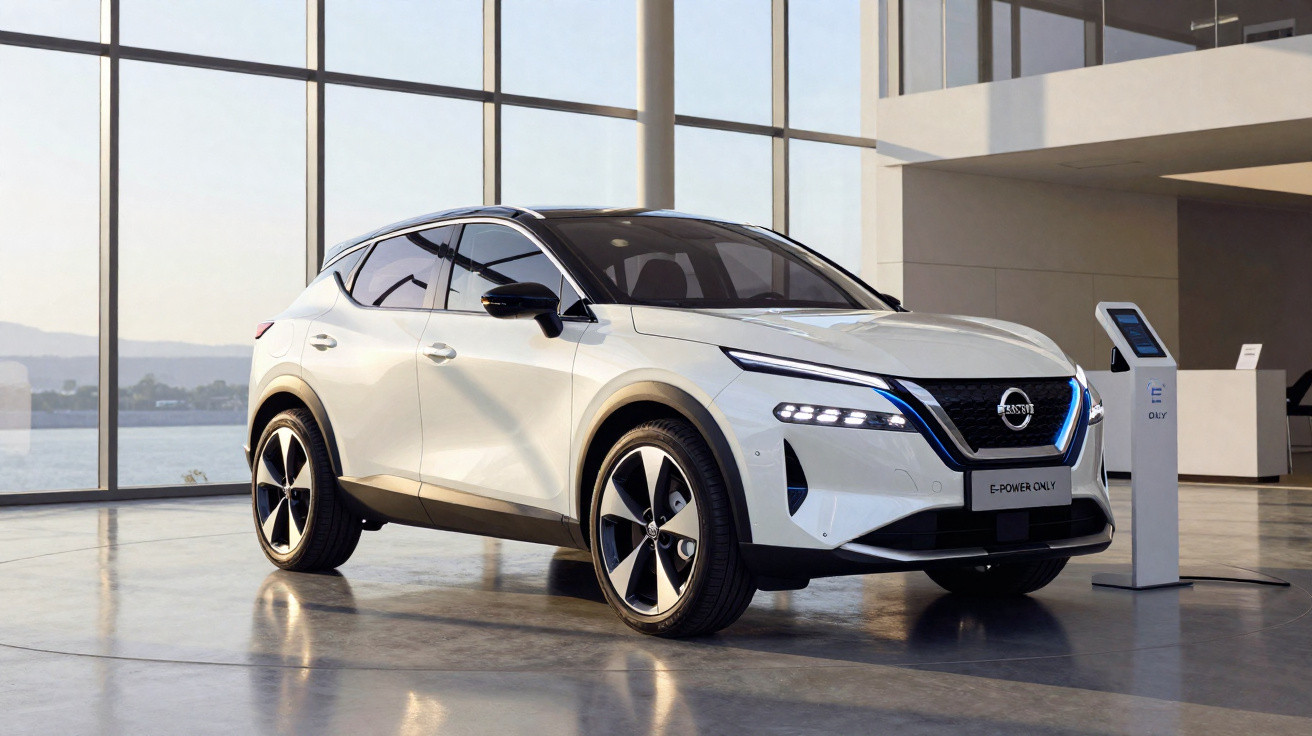
Electrified petrol only for the third-generation Nissan Qashqai
Unveiled recently, the third-generation Nissan Qashqai will be offered exclusively with electrified petrol powertrains. There will be no Diesel options. Buyers will be able to choose between a mild-hybrid set-up and the more unusual e-Power system, which is a true hybrid.
Even so, it is a conventional hybrid rather than a plug-in hybrid (with external charging).
Europe’s plug-in hybrid surge - and Nissan’s stance
Despite the “explosive” growth in plug-in hybrid sales across Europe in 2020, Arnaud Charpentier, Nissan Europe’s vice-president of product marketing, says there are no plans to introduce that kind of Qashqai.
In a market that fell overall (-23.7%), plug-in hybrid volumes rocketed by 210% to almost 620 thousand units. The segment where the new Nissan Qashqai competes is also the one contributing most to that expansion on the Old Continent.
Why not launch a plug-in hybrid Nissan Qashqai?
Speaking during the reveal of the new generation of the popular crossover, Arnaud Charpentier explained Nissan’s decision: “We made such big improvements with this powertrain that we decided a PHEV would not bring a real benefit to the customer”. He added that a PHEV would be “much more expensive”.
It is worth remembering that plug-in hybrids offer several advantages, even though they cost more than conventional hybrids. That applies both to current regulations (they are treated favourably in emissions calculations like EVs, provided they are below 50 g/km) and to taxation (many countries offer them fiscal incentives).
Is Nissan missing an opportunity? The targets for the new-generation Qashqai are ambitious. Nissan wants to regain the segment lead it lost to the Volkswagen Tiguan. That rival arrives with a broader engine mix: alongside petrol and Diesel engines, it has also gained a plug-in hybrid version.
A growing list of Qashqai competitors either already offer a PHEV or are about to. That includes the PHEV sales leader, the Mitsubishi Outlander, as well as the Peugeot 3008, Citroën C5 Aircross, Opel Grandland X, Hyundai Tucson and Ford Kuga.
e-Power is enough
Nissan has nonetheless chosen to concentrate solely on the e-Power hybrid. This is a series hybrid, an approach that remains relatively uncommon both in this segment and across the wider industry. In practice, only the electric motor is connected to the driven axle, while the combustion engine - in this case a new 1.5 turbo with 154 hp - works purely as a generator.
Only Honda offers something similar in the CR-V, although in a specific situation (at high speed) the combustion engine can be connected to the driven axle.
Other potential hybrid rivals, such as the Toyota RAV4, Ford Kuga or the new Hyundai Tucson Hybrid, use parallel or series-parallel hybrid systems instead. In those layouts, both the internal combustion engine and the electric motor are linked to the driven axle, allowing the two power sources to operate in… parallel.
Whether the lack of a plug-in hybrid powertrain (or even a Diesel option) will affect the new Nissan Qashqai’s commercial fortunes will only become clear once sales begin, which is scheduled for the summer.
However, Nissan’s electrified crossover and SUV line-up will not be limited to the new Qashqai. The brand will also launch the Ariya this year, its all-new 100% electric SUV, with equally bold ambitions: the Japanese manufacturer expects it to become its best-selling EV, even overtaking the Leaf.
Comments
No comments yet. Be the first to comment!
Leave a Comment